Support

Marcos A. Gelabert International Airport

Airports in the city

About the Airport

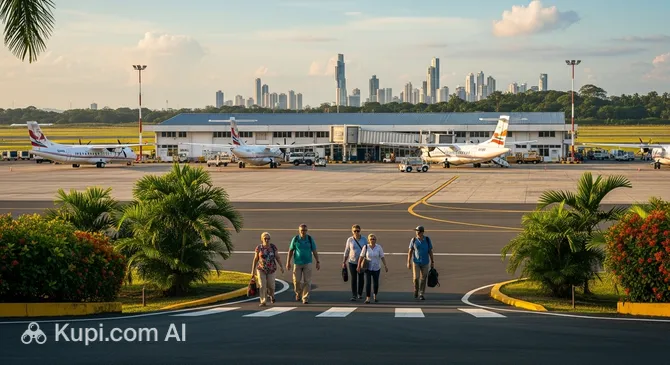
Marcos A. Gelabert International Airport. Source: Kupi.com Binoculars

Marcos A. Gelabert International Airport, comfortably nestled in the Albrook district, is not just a transport hub but a truly "homey" gateway to the world of Panamanian adventures. Unlike its bustling older brother Tocumen, this airport welcomes travelers with a relaxed atmosphere and the feeling that your journey to the wild jungles of Darién or the paradisiacal beaches of Bocas del Toro begins right at the check-in counter. Located on the site of a former US Air Force base, it has preserved a spirit of history while offering a unique opportunity to take off over the very center of Panama City, enjoying breathtaking views of skyscrapers and the canal right from your window.

IATA Code PAC
ICAO Code MPMG
City Panama City
Distance to Center ~4–6 km (within city limits)
Status International (Regional)
Annual Passengers Around 300,000 — 350,000
Schedule Check the official website

Airport Features and Advantages:

  • Exceptional Location: The airport is located practically in the center of the capital, next to the giant Albrook Mall and the country's main bus terminal. A taxi ride to the tourist district of Casco Viejo or the business center takes only 15–20 minutes, allowing you to save a significant amount of time and money on transfers.
  • Speed and Comfort: Thanks to the compact terminal, all procedures here are lightning-fast. The absence of long queues for security and check-in allows you to arrive at the airport just an hour or an hour and a half before departure, saving you from unnecessary stress.
  • Exclusive Destinations: This is the main base for domestic flights across the country. Only from here can you quickly and comfortably reach remote corners of Panama, such as the San Blas Archipelago (Guna Yala) or Contadora Island, where large airliners do not fly.
  • Scenic Takeoffs: A flight from Albrook is an excursion in itself. Upon takeoff, small planes pass low over the Panama Canal, the Bridge of the Americas, and the green hills of Ancón, giving passengers some of the best panoramic views in all of Central America.

Contact Information

For current information on flights, services, and airport regulations, we recommend contacting official channels. Below are the main contact details for Marcos A. Gelabert International Airport (PAC).

  • Official Website: The airport is managed by the Civil Aviation Authority of Panama. Current information can be found on their official website: www.aeronautica.gob.pa.
  • Help Desk Phone: +507 501-9257 / +507 501-9875
  • Address: Avenida Canfield, Albrook, Panama City, Panama
  • Email: For general inquiries, you can use the contact email of the Civil Aviation Authority: info@aeronautica.gob.pa.
  • Social Media: Official news and updates are published on the pages of the Civil Aviation Authority of Panama (Aeronáutica Civil de Panamá), for example, on X (Twitter) under the handle @AeronauticaPma.
  • Lost Luggage Information: In case of lost luggage during a flight, you should first contact your airline's representative. For items left in the terminal building, contact the airport administration via the general phone number.
  • Passenger Support Contacts: For reference information regarding airport operations and flight schedules, please use the main help desk phone number.

How to Get to the Airport

Marcos A. Gelabert International Airport (PAC), also known as Albrook Airport, is distinguished by its convenient location right within the city limits of Panama City. It is situated next to the country's largest transport hub — the Great National Transport Terminal (Gran Terminal Nacional de Transporte), making it easily accessible from any point in the capital.

Public Transport is the most economical way to get to the airport. Thanks to its integration with the city's main transport hub, you have several convenient options:

  • Metro: The nearest station is "Albrook", the terminus on Line 1. From the metro exit, you can walk to the airport terminal in 5-10 minutes by following the signs. The cost of a metro trip is very low.
  • Buses (Metrobús): Many city and suburban bus routes end at the Albrook terminal. To pay for the fare, you will need a Metro Bus card. This is an excellent option for budget travelers.

A ride by taxi or booking a transfer is a more comfortable option, especially if you have a lot of luggage. From central districts, such as Casco Viejo or the financial district, the journey will take about 15-30 minutes depending on traffic. To get a predictable price, it is recommended to use official services or ride-hailing apps popular in Panama, such as Uber or Cabify.

If you are traveling by rental car, you will easily reach the airport via city streets. Most major rental companies have offices here, allowing you to return the car without problems before departure. Parking is also available on the airport territory, suitable for both short stops and long-term vehicle storage.

The main advantage of Marcos A. Gelabert Airport is its exceptional transport accessibility compared to the country's main international hub, Tocumen International Airport (PTY), which is located significantly further from the city. Choosing public transport is the fastest and cheapest way to avoid traffic jams, while a taxi offers maximum comfort.

Terminals and Layout

Marcos A. Gelabert International Airport (PAC), also known as Albrook Airport, is a compact and convenient aviation hub serving primarily domestic flights within Panama. Its structure is simple and intuitive, making it particularly convenient for tourists traveling around the country for the first time.

The airport consists of one small passenger terminal that handles all departures and arrivals. Thanks to this, you won't have to worry about transferring between different buildings. The terminal layout is extremely simple: after entering, you immediately find yourself in the public area where airline check-in counters are located. After checking in and dropping off luggage, passengers proceed to pre-flight security screening, followed by a small waiting hall with boarding gates.

Departure and arrival zones are located in the same building but are functionally separated. The arrival zone is situated to the side of the main hall and includes a baggage claim belt and an exit to the city, where passengers are met by taxi drivers and transfer company representatives. The entire process from exiting the plane to retrieving luggage usually takes minimal time.

One of the main advantages of PAC Airport is the speed of completing all formalities. Check-in and security screening procedures typically take no more than 20-30 minutes. Nevertheless, it is recommended to arrive at the airport approximately 1.5 hours before departure to go through all stages without rushing and have a coffee before boarding.

To navigate the terminal, simply follow the few signs available. It is practically impossible to get lost here. Inside, you will find basic amenities: several small cafes, airline offices (primarily Air Panama), car rental counters, and ATMs. Marcos A. Gelabert Airport is a fine example of how a small aviation hub can be maximally efficient and convenient for travelers.

Airport History

The history of Marcos A. Gelabert International Airport (PAC) is a vivid example of how Panama itself changed at the end of the 20th century. The airport is named after Marcos Alonso Gelabert, one of the pioneers and founding fathers of Panamanian aviation. However, its modern location has a rich backstory unrelated to civil aviation. The current terminal and runway are located on the territory of the former Albrook Air Force Station, which was one of the key American military facilities in the Panama Canal Zone.

The key event that predetermined the birth of the airport was the signing of the Torrijos-Carter Treaties, under which the Canal Zone gradually passed under Panama's jurisdiction. After the Albrook base was handed over to the Panamanian government in 1997, a strategic decision was made to move the main domestic air transport hub here. Until that moment, domestic flights from Panama City were served by Paitilla Airport, which by then was hemmed in by dense urban development and had no prospects for expansion.

The official opening of the new Marcos A. Gelabert Airport took place in January 1999. This event marked not only the relocation of aviation infrastructure but also the beginning of a new era in the development of the country's domestic air travel. Over the years of its existence, the airport has undergone several stages of modernization to cope with the growing passenger flow, which mainly consists of tourists heading to the Bocas del Toro and San Blas archipelagos, as well as other remote corners of the country. Today it is the main hub for regional aviation.

Perhaps the most interesting fact in the airport's history is its successful transformation from a foreign military facility into a thriving civil transport hub. This transition became a symbol of sovereignty and a new era for the entire country. Thus, every takeoff and landing at Marcos A. Gelabert Airport is not just part of a journey, but a touch of Panama's living history.

Services and Amenities

Marcos A. Gelabert International Airport, despite its more modest size compared to Tocumen, provides passengers with all necessary services for a comfortable wait before departure. This airport serves primarily domestic and some regional flights, creating a calmer and more intimate atmosphere.

Dining and Shopping: In the terminal, you will find several cafes and snack bars where you can have a bite before your flight, drink coffee, or purchase refreshments. Small shops offering souvenirs, travel goods, and press are also open. The assortment is not as wide as in major hubs, but all the essentials are here.

Comfort and Connectivity: Passengers have access to free Wi-Fi, allowing them to stay connected. Charging stations for mobile devices are provided in the waiting areas. There may not be specialized VIP lounges in the airport, but the general waiting areas are quite comfortable.

Financial and Other Services: ATMs and currency exchange points are located on the airport territory, which is convenient for tourists. A medical point is available for emergency assistance. Passengers with children are offered mother and child rooms, and a barrier-free environment including ramps and specially equipped toilets has been created for travelers with reduced mobility; assistance services can also be requested.

Accommodation and Business Services: There are no hotels directly inside the airport building, but many hotels of various levels are within walking distance in the Albrook area and in Panama City itself, which is easy to reach by taxi. Specialized conference halls or business centers are absent in the airport, as it is primarily oriented towards serving short-distance passenger transport.

Where to Eat

When planning a departure from Marcos A. Gelabert International Airport, also known as Albrook Airport, it is worth considering that this is a small airport focused mainly on domestic flights. Accordingly, the choice of dining establishments here is quite limited compared to major international hubs.

The main opportunities for a snack are concentrated in the main terminal building, usually in the public zone (landside), before passing security control. Here you will find several small cafes and snack bars. These are ideal places to drink a cup of famous Panamanian coffee, eat a sandwich, pastries, or other light snacks before your flight. There are no full-service restaurants with extensive menus and waiter service at the airport, so it is more suitable for a quick bite than for a substantial lunch or dinner.

Among local dishes, you can sometimes find empanadas (turnovers with various fillings) or other Panamanian snacks. Regarding special dietary requirements, finding vegan, gluten-free, or Halal dishes here will be difficult. Passengers with strict dietary restrictions are recommended to bring food with them or eat beforehand before arriving at the airport.

Prices in cafes are moderate, but, as in any airport, slightly higher than in the city. Opening hours of establishments usually correspond to the flight schedule, starting work in the morning and closing after the departure of the last planes in the evening. Since the selection after passing security control (airside) is practically non-existent, it is best to have a snack before that.

Travel Tips

Traveling through Marcos A. Gelabert International Airport, also known as Albrook Airport, has its own specifics, as it serves mainly domestic and some regional flights. Here are a few tips to make your trip from Panama City more comfortable.

Arrival Time at the Airport: Despite being a small airport, it is recommended to arrive 1.5-2 hours before departure. This time will be sufficient to check in, drop off luggage, and pass security control without rushing. For international regional flights, it is better to allow a full 2 hours.

Check-in and Security: Procedures here generally go faster than in major hubs. However, always keep your passport, visa (if required), and boarding pass ready. To speed up the process, check in for your flight online if your airline provides such an option.

Seat Selection on the Plane: Many flights from this airport are operated on small planes flying at low altitudes. To enjoy stunning views of the Panama Canal, the coast, or islands, choose a window seat. If comfort and the ability to leave the cabin quickly are more important to you, your choice is an aisle seat.

Hand Luggage Rules: Standards here are generally accepted. Liquids can be carried in containers up to 100 ml, packed in a transparent bag. Sharp objects, weapons, and flammable substances are prohibited. Be sure to check the exact rules of your airline, as domestic flights may have their own restrictions on the weight and size of hand luggage.

For Passengers with Transfers: If you have a connecting flight, check in advance whether you need to collect and re-check your luggage yourself. The airport is compact, so moving between gates will not take much time, but it is always better to have a buffer time between flights of at least one hour.

Customs Control: When arriving from another country, you will have to pass customs control. Declare all goods subject to duty. Keep your passport and completed migration card at hand to speed up the process. Customs officers may ask standard questions about the purpose of your visit to Panama and the duration of your stay.

Saving Time and Money: Pre-book a transfer or taxi to avoid inflated prices upon arrival. You can also use public transport, as the large Albrook bus terminal is located near the airport. Bring a light snack and an empty water bottle (it can be filled after security check) — this will help save on purchases at the airport.

In Case of Flight Delay: In the event of a delay or cancellation of a flight, first contact your airline representative for information on the flight status and possible options (rebooking, compensation). The airport has cafes and free Wi-Fi to help pass the waiting time.

Reached the end of the page?

That means the route is fully explored