Support

Goroka Airport

About the Airport

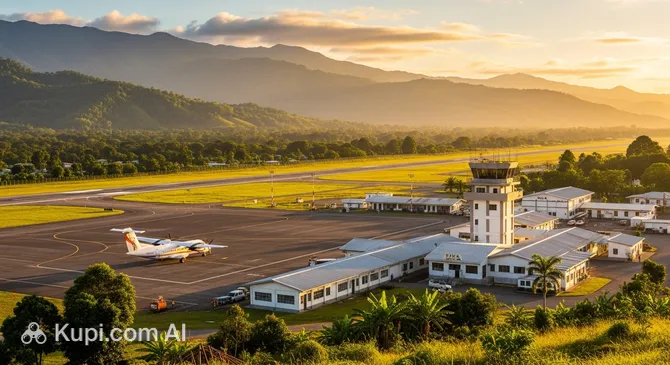
Goroka Airport. Source: Kupi.com Binoculars

Goroka Airport is not merely a transport hub, but a true gateway to the heart of the Papua New Guinea highlands. Located in a picturesque valley at an altitude of 1,600 metres above sea level, it welcomes travellers with cool mountain air and breathtaking views of misty ridges immediately upon landing. For many tourists, this is where their introduction to unique tribal cultures, the famous Asaro "Mudmen", and the endless coffee plantations for which this region is renowned, begins.

Thanks to its location practically in the centre of urban life, the airport creates a sense of home-like comfort and instant immersion in the local atmosphere. It is a key point for those arriving for the world-famous Goroka Show, which gathers thousands of guests annually. Despite its modest size, the air harbour plays a vital role, connecting isolated mountain areas with the rest of the world.

IATA Code GKA
ICAO Code AYGA
City Goroka
Distance to city centre ~3 km (5-10 minutes)
Status Domestic
Annual Passengers No official data publicly available
Schedule We recommend checking airlines' websites for current flight times

Features and advantages of Goroka Airport:

Proximity to the city. One of the main "highlights" of the airport is its incredible closeness to infrastructure. The terminal is literally a few minutes' drive from the main hotels and markets of Goroka, allowing travellers to save time and money on transfers. Some tourists joke that one can walk from the aircraft steps to a cup of the best local coffee.

Scenic approach for landing. The flight to Goroka is an adventure in itself. The descent takes place over green valleys and mountain peaks, offering passengers the opportunity to take stunning photos even before touching the runway. This is one of the most beautiful aerial routes in the country, demonstrating the grandeur of the nature of the Eastern Highlands.

Compactness and simplicity. There are no complex labyrinths or long walks here. The airport consists of a small terminal where all procedures are completed quickly and without unnecessary fuss. The staff are accustomed to foreign guests, especially during the festival season, and strive to make the stay as comfortable as possible, despite the basic level of amenities.

Strategic importance. Goroka serves as an important hub not only for passenger transport but also for small aviation serving remote villages. Here, one can often see small aircraft of missionary and humanitarian organisations departing for the most remote corners of the jungle, which are impossible to reach by land.

Contact Information

Finding direct and up-to-date contacts for a small regional airport, such as Goroka Airport, can be challenging. The airport is managed by the National Airports Corporation (NAC) of Papua New Guinea, so for many queries, you should contact them or your airline directly.

  • Official Website: Goroka Airport is managed by the National Airports Corporation (NAC) of Papua New Guinea. It is recommended to look for information on their official website: www.nac.com.pg. A separate website for Goroka Airport generally does not exist.
  • Information Desk Phone: A direct public phone number for the airport is difficult to find. For information regarding flight status, booking, or check-in, it is strongly recommended to contact your airline directly.
  • Airport Address: Goroka Airport (GKA), Goroka, Eastern Highlands Province, Papua New Guinea.
  • Email: For general (non-urgent) enquiries, you can try using the contact email of the National Airports Corporation: info@nac.com.pg.
  • Social Media: Goroka Airport does not have its own official pages on social media.
  • Lost Luggage Information: Issues regarding lost or damaged luggage are handled exclusively by the airline on which you flew. Please contact the Lost & Found service of your air carrier.
  • Passenger Support Contacts: For assistance with issues related to your flight (ticket changes, special services), contact your airline directly. If questions arise on-site, please approach the airline representatives at the airport.

How to get to the airport

Goroka Airport (GKA) is located very close to the city centre, so getting to the terminal is quick and easy. The journey from most hotels in Goroka to the airport usually takes no more than 5-10 minutes, making it one of the most accessible in Papua New Guinea.

Taxi and Hotel Transfer — this is the most popular and recommended method for tourists. Most hotels in Goroka can organise a transfer for you, which is the safest and most convenient option. You can also use local taxi services. It is recommended to ask hotel staff to call a trusted car for you or agree on the fare in advance. This is a reliable way to avoid misunderstandings and arrive for your flight on time.

For those seeking a more authentic and budget-friendly experience, there are PMVs (Public Motor Vehicles) — local route buses and trucks. This is the main form of public transport in the region. The fare is inexpensive, but be prepared for a lack of a strict schedule, crowding, and minimal comfort. This option is more suitable for experienced travellers without bulky luggage.

Car Rental in Goroka is possible, but for a simple trip to the airport, it is not the most practical choice. Road conditions can be challenging, especially outside the city. If you do decide to rent a car, there is basic parking at the airport. However, for most visitors, taxi or transfer services will be more than sufficient.

Terminals and Map

Goroka Airport (GKA) is a small regional airport, so its structure is extremely simple and intuitive for passengers. You will not have to worry about complex navigation or long walks, which makes travelling through it quite comfortable.

The airport operates one passenger terminal, which serves all flights — both arrivals and departures. The terminal building is compact, and all key zones are within walking distance of each other. The airport layout is very simple: upon entering the main building, you will immediately see the check-in counters, and nearby — the security screening area and the boarding gate. There is no need to move between terminals, as there is only one.

Departure and arrival zones are clearly separated but located close by. The departure zone includes several check-in counters and a small waiting hall after passing security control. The arrival zone consists of a baggage claim hall, which is located immediately at the exit from the airfield. Due to the airport's small size and moderate passenger flow, all pre-flight procedures, including flight check-in and screening, usually proceed very quickly. Nevertheless, it is recommended to arrive at the airport approximately 1-1.5 hours before the departure of a domestic flight to complete all formalities without rushing.

The main advice for navigation at Goroka Airport is to follow the signs, although it is practically impossible to get lost here. All main services — from check-in to baggage claim — are located within one small space. Airport staff are generally friendly and ready to help if questions arise. Simplicity and compactness are the key features of this airport, making it convenient for travellers arriving in this region of Papua New Guinea.

Airport History

The history of Goroka Airport (GKA) is inextricably linked with the exploration of the highland regions of Papua New Guinea and is full of interesting events. Its inception dates back to the 1930s, when Australian gold prospectors, the famous Leahy brothers, built the first airstrip here. In conditions of impassable jungles and mountains, aviation was practically the only way to deliver supplies and transport the precious metal out, which laid the foundation for the city's aviation future.

With the outbreak of the Second World War, the simple airstrip acquired strategic importance. The airfield, known then as Goroka Airfield, was actively used and expanded by Allied forces during the New Guinea campaign. It served as an important base for military aircraft, contributing to the course of events in the Pacific theatre of operations. This period left a noticeable mark on the airport's history.

After the war, a new era began for Goroka Airport — an era of peaceful development and economic growth. It became the main transport hub for the booming coffee industry, which made the region famous throughout the world. It was through this airport that tonnes of the famous local coffee were exported, and goods were delivered to the city while specialists arrived. This contributed to transforming Goroka into the administrative and commercial centre of the Eastern Highlands Province.

Throughout its history, the airport has been modernised repeatedly to meet growing demands. One of the key stages was the paving of the runway, which allowed it to accommodate larger and more modern aircraft. Quite recently, as part of a civil aviation development programme, a large-scale reconstruction was carried out: a new terminal was built, infrastructure was updated, and security systems were significantly improved, bringing passenger service to a modern level.

Thus, Goroka Airport has travelled an amazing path from a simple dirt strip laid by brave adventurers to a modern regional aviation hub. Today, it remains the key gateway to the highland regions of Papua New Guinea, playing a vital role in the economy, tourism, and daily life of people, connecting this unique corner of the planet with the rest of the world.

Services and Facilities

Goroka Airport (GKA) is an important regional aviation hub in Papua New Guinea, providing passengers with a basic set of services necessary for a comfortable wait for their flight. The airport infrastructure is compact and easy to navigate, making a stay here convenient, albeit without luxuries.

Inside the terminal, you will find small kiosks or cafés where you can have a snack, drink coffee, and purchase beverages. The selection of catering establishments and shops is limited; however, one can buy essential goods and local souvenirs here. Specialised business lounges or VIP lounges are absent at the airport.

Free Wi-Fi is generally not provided at the airport, so it is better to use mobile data for internet access. The number of power outlets for charging gadgets may be small. There are no bank branches or currency exchange points in the terminal, so it is recommended to settle all financial matters in advance in the city.

Passengers with children should note that separate mother and child rooms are not provided. Travellers with reduced mobility are recommended to notify their airline in advance regarding the need for accompaniment and assistance so that staff can organise support upon arrival and during boarding. Medical services are limited to the provision of basic first aid.

There are no hotels or business centres within the airport building. The nearest options for accommodation and holding business meetings are located in the city of Goroka, which is situated a few minutes' drive from the terminal.

Where to Eat

When planning a flight through Goroka Airport (GKA), it is important to understand that this is a small regional air terminal with a basic set of services. Dining options here are limited and designed primarily for passengers to have a quick snack before departure, rather than for a full gastronomic experience.

All catering establishments are typically concentrated in the single terminal, in the general area before security control (landside). Usually, this consists of one or two small cafés or kiosks. Here you can purchase:

  • Beverages: bottled water, carbonated drinks, carton juices, as well as instant coffee and tea.
  • Snacks: crisps, biscuits, chocolate, and other packaged products.
  • Fast food: simple sandwiches, pastries, or sometimes basic hot dishes, such as instant noodles.

Regarding local cuisine, it is unlikely to be found at the airport. The assortment mainly consists of standard and universal products. Passengers with strict dietary requirements (vegetarians, vegans, or those observing a Halal or gluten-free diet) are advised to bring food with them, as specialised options will likely not be available here. The opening hours of establishments are strictly tied to the flight schedule — they open shortly before departures and close after the last aircraft has departed.

Our advice: if you wish to have a full meal, it is better to do so at one of the establishments in Goroka city before travelling to the airport. The facilities of the terminal itself are ideally suited for buying a drink or a light snack while waiting for boarding. Prices here may be somewhat higher than in the city, which is typical for airports worldwide.

Tips for Travellers

Travelling through Goroka Airport, the gateway to the mountain regions of Papua New Guinea, can be a fascinating experience. To ensure your trip goes smoothly, use these helpful tips developed specifically for this unique airport.

Arrival Time: Goroka Airport is small, but local flights can be unpredictable. It is recommended to arrive at least 2 hours before the departure of a domestic flight. This will give you sufficient time in case of unforeseen circumstances, such as schedule changes or queues at the check-in counter.

Check-in and Security: Be prepared for the fact that most processes here are carried out manually. Online check-in may be unavailable for local airlines, so allow time for check-in at the counter. Screening procedures are generally standard but may be less formalised than in major international airports. Nevertheless, always observe basic security rules.

Choosing a Seat on the Plane: Flights in this region reveal breathtaking views of mountain landscapes and valleys. At check-in, ask for a window seat — this is your chance to take incredible photos even before arriving at your destination. The views are particularly beautiful during take-off and landing.

Hand Luggage: Standard restrictions on carrying liquids and sharp objects apply here as well. Additionally, be careful when taking out local souvenirs. The transport of certain plants, seeds, or products of animal origin may be prohibited under biosecurity rules between provinces. It is better to clarify this issue with an airline representative in advance.

Connecting Passengers: If you have a connecting flight, especially with a transfer to another airline, allow the maximum possible buffer time. Automatic baggage transfer is not always guaranteed. You will likely have to collect your belongings and check them in again for the next flight.

Customs Control: There is no international customs control on domestic flights. However, checks may be conducted regarding compliance with quarantine and bio-sanitary standards, especially if you are flying from one province to another. Simply be ready to show the contents of your luggage upon request by staff.

Saving Time and Money: To save money, book tickets in advance, as prices for domestic flights can vary greatly. Keep all documents (passport, ticket) to hand to speed up the completion of formalities. Given the limited selection of food and drinks at the airport, it is better to eat beforehand or bring light snacks with you.

Flight Delays: Delays and cancellations of flights in the mountainous part of Papua New Guinea are not uncommon due to rapidly changing weather conditions. Remain calm and seek information from representatives of your airline. It is useful to have a book, a charged power bank, and a bottle of water with you, as waiting conditions at the airport may be basic.

Reached the end of the page?

That means the route is fully explored