Support

Nadzab Airport

About the Airport

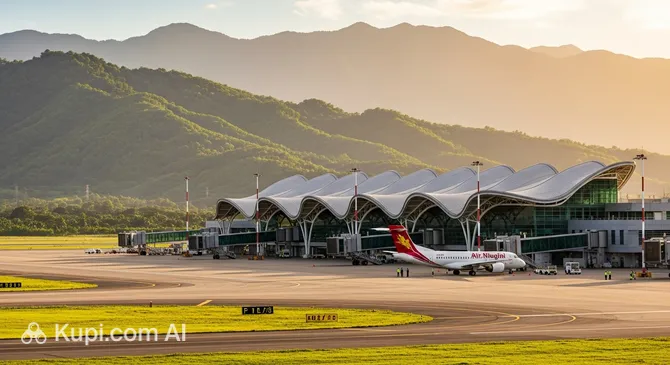
Nadzab Airport. Source: Kupi.com Binoculars

Nadzab Airport (Nadzab Tomodachi International Airport) is not merely a transit point but a true gateway to the Morobe Province and the industrial heart of Papua New Guinea. Situated in the picturesque Markham Valley, this aviation hub welcomes travellers with views of lush green hills and a historical heritage dating back to World War II. A recent large-scale reconstruction, carried out with the support of Japan, has transformed it into a modern and comfortable terminal, which now bears the symbolic name "Tomodachi", meaning "Friend" in Japanese.

IATA Code LAE
ICAO Code AYNZ
City Lae
Distance to centre ~42 km
Status International
Annual Passengers Over 250,000
Schedule Check official airline websites

Airport Features and Advantages:

Nadzab Airport has undergone complete modernisation and now offers passengers an entirely new level of service. The new terminal is designed with environmental standards in mind and is equipped with modern air conditioning systems, which is a huge plus in the hot tropical climate. Spacious waiting halls, convenient check-in zones, and an improved security system make waiting for your flight comfortable and peaceful. Despite the distance from the city centre of Lae, the journey to the airport can itself be a small adventure with beautiful views of the valley.

Contact Information

To obtain current information regarding the operation of Nadzab Airport (LAE), it is recommended to use the following contact details. Please note that the airport is managed by the National Airports Corporation (NAC) of Papua New Guinea, so many contacts lead to this organisation's resources.

  • Official Website: Nadzab Airport does not have its own separate website. All official information is available on the portal of the management company, National Airports Corporation (NAC): www.nac.com.pg.
  • Help Desk Phone: For general questions regarding airport operations, you can call +675 472 5297. For information on flights, tickets, and check-in, please contact your airline directly.
  • Airport Address: Nadzab Airport, Lae, Morobe Province, Papua New Guinea.
  • Email: For official enquiries, you can use the general e-mail of the National Airports Corporation: info@nac.com.pg.
  • Social Media: Operational news and updates on the work of the country's airports, including Nadzab, can be found on the official NAC social media pages.
  • Lost Baggage Information: In case of loss or damage to luggage, you must immediately contact the Lost and Found service of your airline. It is the carrier that bears responsibility for passengers' checked belongings.
  • Passenger Support Contacts: Assistance for passengers with reduced mobility, questions regarding the transport of children or animals should be addressed to the support service of your airline whose services you are using.

How to Get to the Airport

Nadzab Airport (LAE) is located approximately 42 kilometres from the city of Lae, the main industrial centre of Papua New Guinea. The journey from the city centre to the airport usually takes from 1 to 1.5 hours, but this time can increase significantly due to road conditions and traffic. Travellers have several transport options available, each with its own specific features.

Public Transport in its conventional sense is represented here mainly by minibuses known as PMV (Public Motor Vehicles). This is the most budget-friendly way to get to the airport, but also the least comfortable. PMVs are often overcrowded, lack a fixed schedule, and may make numerous stops along the way. This option is suitable for experienced travellers travelling light, but is not recommended for tourists with large luggage or those who value predictability and safety.

Taxis and Transfers are the most preferred option for the majority of tourists. It is recommended to book a transfer in advance through your hotel or use the services of a verified local transport company. A taxi ride will be significantly more expensive than a PMV, but it guarantees your safety, comfort, and timely arrival at the airport. Be sure to agree on the fare before the trip begins if using private taxi services.

Car Rental is a good choice for those planning to explore the region independently and feel confident driving in challenging road conditions. The road from Lae to Nadzab is part of the Okuk Highway, the condition of which can be variable. It is often recommended to rent a four-wheel-drive vehicle (4x4). Nadzab Airport has parking where you can leave a car for both short and long terms. This method offers maximum flexibility but requires thorough preparation and navigation skills.

Terminals and Map

Nadzab Airport (LAE) is a modern transport hub with a simple and clear structure, making it convenient for passengers. Recently, a new terminal was opened here, replacing old structures and significantly increasing the level of comfort.

The airport operates one main passenger terminal, which serves all flights — both domestic and international. Thanks to this, you will not have to worry about transferring between different buildings. The terminal layout is extremely logical: all key zones are located within a single building, minimising the likelihood of getting lost.

Departure and arrival zones are clearly separated. Upon arrival, you enter the baggage claim hall, and then proceed to the exits to the city. The departure zone includes check-in counters, a security screening point, and a waiting hall. Navigation is intuitively understandable thanks to signage. Since there is one terminal, all infrastructure — check-in counters, boarding gates, baggage claim — is within walking distance of each other.

Completing all formalities typically does not take much time. Registration and screening procedures at Nadzab Airport usually proceed faster than in major international hubs. Nevertheless, it is recommended to arrive at the airport at least 1.5–2 hours before a domestic flight and 2–3 hours before an international one, to pass through all stages without haste.

Airport History

The history of Nadzab Airport (LAE) is inextricably linked with the events of World War II. It was built in 1943 as a strategic military facility by Australian engineers with the support of American troops. Its main task was to provide a staging ground for the Allied offensive on the city of Lae, which at that time was an important Japanese stronghold in the territory of Papua New Guinea.

A key moment in the airport's history was the airborne operation on September 5, 1943. On this day, American paratroopers and Australian artillerymen landed here, marking the first major airborne landing of the Allies in the South West Pacific. The successful capture of the Nadzab airfield allowed for the rapid deployment of troops and equipment, which played a decisive role in the subsequent liberation of Lae.

After the war ended, Nadzab was transformed into the region's main civilian airport, replacing the old airfield located closer to the city. The former airfield was prone to flooding and unsuitable for accommodating large aircraft. Interestingly, it was that old airfield that is known as the place from where the famous aviator Amelia Earhart departed on her final flight in 1937. Moving the main air traffic to Nadzab became an important stage in the development of the entire country's transport infrastructure.

In the 21st century, the airport entered a new era of its development. A large-scale reconstruction and modernisation began, including the construction of a modern passenger terminal, improvement of the runway, and navigation equipment. This project aims to turn Nadzab into a modern international airport capable of accepting a greater number of flights and passengers, strengthening its status as the key air gateway of the northern region of Papua New Guinea.

Services and Facilities

Nadzab Airport (LAE), serving the city of Lae and the Morobe Province in Papua New Guinea, provides passengers with a basic set of services necessary for a comfortable journey. Although the airport is not large in size, everything essential for waiting for a flight is present here.

In the terminal, you will find several small cafes and eateries where you can have a snack or drink coffee. Kiosks offering local souvenirs, newspapers, magazines, and essential goods are also in operation. The selection here is modest but sufficient to satisfy basic needs before departure.

General halls with seating are provided for waiting for flights. The availability and conditions of access to VIP lounges are best checked in advance with your airline, as their facilities may be limited. There are points for charging electronic devices in the airport building, however, Wi-Fi access may be paid or not available throughout the entire terminal territory.

Financial services include ATMs and currency exchange points, where travellers can obtain local currency (Kina). In case of feeling unwell or minor injuries, a medical point is operating at the airport, ready to provide first aid.

For passengers travelling with small children, mother and child rooms are equipped. Passengers with reduced mobility are provided with necessary assistance when moving around the airport, boarding, and disembarking. It is strongly recommended to inform the airline in advance about the need for such a service.

There are no hotels within the airport territory itself. The nearest hotels and guest houses are located in the city of Lae, which can be reached by taxi or by booking a transfer. Specialised business centres or conference halls are absent at Nadzab Airport, as it is focused mainly on passenger transport.

Dining

Nadzab Airport (LAE), serving the city of Lae, offers passengers basic but sufficient opportunities to have a snack before departure. It is important to remember that this is a regional airport, not a major international hub, so the choice of establishments here is limited and concentrated in the main terminal building.

Inside the terminal, usually in the public zone before security control (landside), a cafe or kiosk operates. Here, travellers can purchase coffee, tea, soft drinks, water, as well as simple snacks. The assortment usually includes sandwiches, pastries, chocolates, and crisps. This is a good option for a quick snack, but for a full hot lunch or dinner, it is better to eat in the city before arriving at the airport. Sometimes you can find packaged local snacks here, for example, sweet potato chips (kaukau) — a nice opportunity to get acquainted with the cuisine of Papua New Guinea.

Opening hours of food outlets depend directly on the flight schedule — they open before the first departures and close after the last aircraft depart. Finding specialised dietary dishes, such as vegetarian, vegan, or gluten-free, will be practically impossible here. Passengers with strict dietary restrictions (including Halal requirements) are strongly advised to bring food with them. Prices at the airport are traditionally higher than in city establishments.

Travel Tips

Travelling through Nadzab Airport (LAE), serving the city of Lae, will be more comfortable if you familiarise yourself with its features in advance. Here are some practical tips that will help you orient yourself and avoid unnecessary hassle during your trip around Papua New Guinea.

Arrival and Check-in: It is recommended to arrive at the airport at least 2 hours before a domestic flight departure. Although the airport is not as large as international hubs, procedures can take time. Ensure you have all necessary documents at hand: passport, ticket, and visa (if required). Online check-in, if available with your airline, can significantly save time.

Security Control and Hand Luggage: Rules for carrying hand luggage are standard: liquids in containers up to 100 ml, packed in a transparent bag, and no sharp objects. Pay special attention to the country's strict bio-safety rules. Do not attempt to transport fresh fruits, vegetables, seeds, or animal products without appropriate permission to avoid fines during customs inspection.

In-flight and Transfers: When choosing a seat on the plane, prefer a window seat — flights over Papua New Guinea offer breathtaking views of mountains, jungles, and the coast. If you have a connecting flight, immediately upon arrival check the boarding gate number for the next segment and verify whether you need to collect and re-check your luggage yourself.

Savings and Unforeseen Situations: To save money, book a transfer from the airport to the city in advance, as prices on the spot may be higher. It is also useful to carry a small amount of local currency for minor expenses. Flight delays are not uncommon here, often due to weather conditions. For this case, keep a portable charger, a book, or downloaded films with you. Remain calm and stay in touch with your airline representative for current information.

Reached the end of the page?

That means the route is fully explored