Support

Capitan FAP Renan Elias Olivera Airport

About the Airport

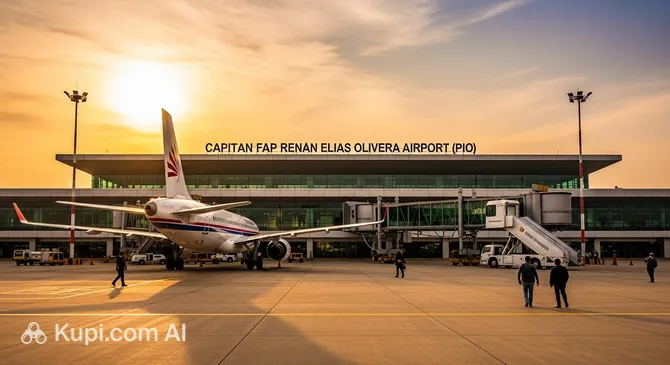
Capitan FAP Renan Elias Olivera Airport. Source: Kupi.com Binoculars

Capitan FAP Renan Elias Olivera Airport is not merely a regional transport hub, but a true aerial gateway to the mysteries of ancient civilizations and the natural wonders of the Peruvian coast. Located at the junction of the desert and the ocean, this modern air haven serves as the main starting point for breathtaking flights over the enigmatic Nazca Lines, saving tourists from exhausting overland journeys. Thanks to recently updated infrastructure, the terminal offers travellers an atmosphere of calm and comfort, contrasting sharply with the hustle and bustle of capital city airports, and becomes the first step in exploring the unique Paracas Reserve.

IATA Code PIO
ICAO Code SPSO
City Pisco
Distance to Centre About 5 km
Status International
Passengers per Year About 60,000 (mainly tourist charters)
Schedule Available on the operator's website

Airport Features and Advantages:

Pisco Airport boasts a number of unique advantages that make it a strategically important facility for tourists:

  • Gateway to the Nazca Lines: This is perhaps the airport's primary tourism function. Light Cessna Grand Caravan aircraft regularly depart from here for sightseeing flights over the famous geoglyphs. Departing from Pisco saves hours of travel time compared to taking a bus to the city of Nazca.
  • Modern Infrastructure: Following a large-scale renovation completed in 2016, the terminal received the latest equipment and a runway capable of accommodating even large liners. The building is notable for its spaciousness, cleanliness, and modern architecture.
  • No Queues: Thanks to moderate passenger traffic, all pre-flight procedures — from check-in to security screening — are completed as quickly as possible and without the stress typical of major hubs.
  • Proximity to Resorts: The airport is literally a 15-minute drive from the resort town of Paracas and the national reserve of the same name, where you can see sea lions and Humboldt penguins.
  • Strategic Alternate Aerodrome: Due to excellent weather conditions (it is almost always clear here), PIO is frequently used as a reliable alternate aerodrome for flights heading to Lima when there is heavy fog in the capital.

Contact Information

Below you will find contact information for Capitan FAP Renan Elias Olivera International Airport (PIO), which serves the city of Pisco and its surroundings. We recommend checking the validity of the data on official resources before your trip.

  • Official Website: You can find flight schedules, service information, and airport news on the official page of the operator Aeropuertos del Perú (AdP): www.adp.com.pe.
  • Helpline Phone: For immediate information, you can call: +51 (056) 53-2928.
  • Airport Address: Carretera Pisco – Paracas Km. 20, Pisco, Ica, Peru.
  • Email: For general inquiries and feedback, you can use the customer support e-mail: atencionalcliente@adp.com.pe.
  • Social Media: Follow the news of the Peruvian airport operator (AdP), which manages Pisco Airport, on their official Facebook page.
  • Lost Luggage Information: If your luggage has been lost or damaged, you should contact your airline representative immediately. For items left behind in the terminal building, please contact the airport information service.
  • Passenger Support Contacts: To resolve issues related to your stay at the airport, use the main phone number (+51 (056) 53-2928) or the support service email.

How to Get to the Airport

Capitan FAP Renan Elias Olivera Airport (IATA: PIO) is located just a few kilometres from the city centre of Pisco, making the journey there quick and simple. Travel from the central part of the city usually takes no more than 10-15 minutes. The main ways to get to the terminal are by taxi, mototaxi, or rental car, as direct public transport connections to the airport are limited.

The most convenient and popular method is a taxi or mototaxi (local three-wheeled transport). A taxi ride will cost approximately 15–25 Peruvian Soles (PEN), while a mototaxi will be cheaper — around 5–10 PEN, but it is suitable for passengers with light luggage. It is extremely important to agree on the fare with the driver in advance, as is customary in many cities in Peru, to avoid misunderstandings. For greater comfort and a fixed price, you can book a private transfer through your hotel or travel agency, which is particularly convenient for early or late flights.

Budget travellers can use local minibuses, known as "combi" or "colectivo". These vans run along the main Pan-American Highway that passes near the airport. The fare is minimal — just a few soles. However, please note that they do not drive directly up to the terminal, and you may have to walk a short distance from the highway. There is no metro or railway service in the city.

If you plan to explore the surroundings, such as the Paracas National Reserve or the Huacachina oasis, renting a car would be a good option. There are several local and international rental agencies in the city. The road to the airport is simple and intuitive. For those arriving in their own or rented vehicle, there is parking available on the airport grounds where you can leave your car for the duration of your trip.

Terminals and Map

Capitan Renan Elias Olivera Airport in Pisco is a modern and compact air hub with a structure that is simple and intuitive for any traveller. It operates one passenger terminal, which serves both domestic and international flights, as well as tourist charters heading to the Nazca Lines.

The terminal layout is extremely logical. All main zones — check-in, departure, and arrival — are located in a single building, eliminating the need for long walks or shuttles. Thanks to its compact size and well-thought-out navigation, finding your way around is very easy. Signs in Spanish and English will help you quickly locate the necessary counter, boarding gate, or baggage claim area.

The departure and arrival zones are clearly separated. Upon arrival, passengers enter a hall with baggage claim belts, and then proceed to the general meeting area where taxi and car rental counters are located. For departing passengers, there are check-in counters, followed by a security screening area and a small but comfortable waiting lounge with several boarding gates.

The main advantage of Pisco Airport is the speed of completing all formalities. Due to the low passenger traffic, flight check-in and security screening proceed very quickly, usually without queues. For domestic flights, arriving 1.5 hours before departure is sufficient, and for international flights — 2 hours. This makes travelling through PIO as comfortable as possible and eliminates the stress typical of large airports.

Airport History

The history of Capitan FAP Renan Elias Olivera Airport (PIO) is closely tied to the development of tourism and the strategic needs of the region. Originally created as a military airfield, it long served as a small air harbour for domestic flights, primarily catering to tourists heading to the famous Nazca Lines and the Paracas National Reserve. Located in the city of Pisco, it was a key but modest part of Peru's transport infrastructure.

A turning point in the airport's history was the devastating earthquake of 2007, the epicentre of which was not far from Pisco. In those days, the airport transformed into a vital logistics centre, receiving aircraft with humanitarian aid, rescuers, and medics from all over the world. This event highlighted the strategic importance of the airport and served as a catalyst for its future radical modernization.

The most significant stage in the airport's development began in 2012 with the launch of a massive reconstruction project. In 2016, a completely new international terminal was ceremoniously opened, capable of serving up to 400,000 passengers per year. The project included the construction of a new runway, a modern control tower, and all necessary infrastructure to accommodate large international liners. This turned a modest regional airfield into a modern international airport.

The main goal of this ambitious modernization was to create an alternative to the congested capital airport in Lima and to stimulate tourist flow directly to the southern regions of the country. Thanks to its location, Pisco Airport has become the ideal "gateway" for travellers wishing to visit iconic places such as the Ballestas Islands, the Ica Desert, and the mysterious Nazca Plateau, significantly reducing travel time.

Interesting fact: the airport is named after Renan Elias Olivera, one of the pioneers of Peruvian aviation. Today, despite its immense potential, the airport is still on the path to fully realizing its capabilities for handling regular international flights, but its modern infrastructure makes it an important reserve and tourism hub for the country.

Services and Amenities

Capitan FAP Renan Elias Olivera Airport (PIO) is a regional airport serving the city of Pisco and its surroundings. Despite its modest size, it offers passengers essential amenities to make waiting for a flight comfortable. In the terminal, you will find several small cafes and snack bars where you can have a bite to eat, drink coffee, or enjoy soft drinks. The selection of shops is limited, but you can purchase souvenirs, travel necessities, and basic items here.

For those who need to stay connected, wireless internet (Wi-Fi) is available at the airport. The waiting lounges also have charging stations for electronic devices. Financial services are represented by ATMs and a currency exchange point, although for larger transactions, it is recommended to use banking services in the city. A medical post operates within the terminal to provide first aid in emergency situations.

The airport is equipped to accommodate various categories of passengers. For travellers with small children, there are nursing rooms. Passengers with reduced mobility are provided with necessary assistance, including access to ramps and specially equipped restrooms. However, to receive assistance, it is recommended to notify your airline of your needs in advance.

There are no hotels within the airport building itself. The nearest accommodation options, ranging from budget guesthouses to comfortable hotels, can be found in the city of Pisco and at the popular resort of Paracas located nearby. There are no specialized business centres or conference rooms in the terminal, but such services are often provided by major hotels in the region. Thus, PIO Airport provides a basic but sufficient level of service for travellers exploring this amazing corner of Peru.

Where to Eat

Capitan FAP Renan Elias Olivera Airport (PIO) is a small regional airport serving the city of Pisco and its surroundings. Consequently, the choice of dining establishments here is quite limited and designed primarily for passengers who need a quick snack before departure. Do not expect a wide variety of restaurants, but the basic needs of travellers will be met.

The main and usually the only dining option at the airport is a small cafe or snack bar located in the public area (before security control). Here you can purchase sandwiches, pastries, chips, chocolate, and other snacks. Beverages on offer include coffee, tea, bottled water, and soft drinks. Sometimes the assortment includes the famous Peruvian soda Inca Kola — a great way to experience the local flavour.

If you follow a special diet (vegetarian, vegan, gluten-free, or Halal), finding suitable dishes at the airport may be difficult. It is recommended to bring food with you to avoid inconvenience. Prices in the airport cafe are generally higher than the city average, which is standard practice for such facilities. Opening hours are usually tied to the flight schedule, so they may be closed during quiet periods.

For a quick snack, the local cafe offers are quite suitable. However, if you are counting on a full lunch or dinner, the best solution would be to eat at one of the numerous restaurants in the city of Pisco or the neighbouring tourist centre of Paracas before arriving at the airport. This will allow you to enjoy authentic Peruvian cuisine without rushing and with a greater selection of dishes.

Travel Tips

Travelling through Capitan FAP Renan Elias Olivera Airport in the city of Pisco can be an easy and pleasant start or end to your adventure in Peru. To ensure everything goes smoothly, use these tips to help you save time, money, and stress.

Arrival Time and Check-in: Although the airport in Pisco is not as large and busy as the capital's, it is recommended to arrive in advance. For domestic flights, allow at least 1.5 hours before departure, and for international flights (if applicable to your schedule) — 2 hours. This will give you enough time to calmly go through check-in and security control. If possible, check in for your flight online — this will save you time at the airport.

Security Control and Seat Selection: Screening procedures here are standard. To speed up the process, have your passport and boarding pass ready in advance, and remove all electronic devices and liquid containers from your carry-on luggage. When choosing a seat on the plane, if you are flying for an excursion to the Nazca Lines, definitely choose a window seat. For regular flights, an aisle seat will allow you to stand up freely without disturbing your neighbours.

Luggage Rules: Liquids in containers larger than 100 ml, sharp objects, weapons, and flammable substances are prohibited in carry-on luggage. It is best to always keep all valuables, documents, medication, and portable electronics with you in your carry-on. Be sure to check the weight and size limits for carry-on luggage on your airline's website, as they may vary.

Customs Control and Transfers: When departing the country, be prepared for standard customs questions about the purpose of your trip and any goods to declare. Do not export archaeological treasures or items representing the country's cultural heritage without special permission. If you have a connecting flight, clarify in advance whether you will need to collect and re-check your luggage at the transit airport. Typically, in small airports like this one, there are no transit zones for long layovers, and any transfer will require going through all standard procedures.

Savings and Unforeseen Situations: To save money, book a taxi or transfer in advance through trusted services rather than catching a car at the terminal exit. In case of a flight delay or cancellation, immediately contact your airline's counter for information on further actions, possible compensation, or the provision of food and accommodation. Carry a portable phone charger to stay connected at all times.

Reached the end of the page?

That means the route is fully explored