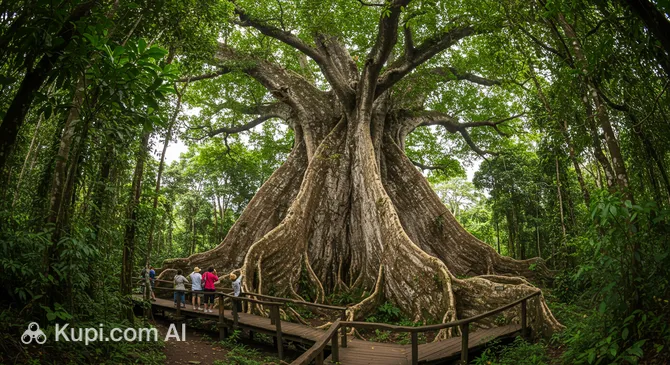
Imagine a living monument whose age is measured in centuries—the majestic Lupuna Tree (Arbol de la Lupuna) is exactly that. Located within the city limits of Pucallpa, this natural wonder (species Ceiba pentandra) captures the imagination with its scale: its height reaches nearly 50 meters, and the diameter of its powerful trunk exceeds 3 meters. For Peru, it is not just a plant, but a symbol of the richness and vitality of the Amazon jungle.
Lupuna Tree. Illustration.
Source: Kupi.com AI
Traveler photos:
This giant Ceiba, also known as the silk-cotton tree, is considered one of the oldest and largest in the Ucayali region. Despite the surrounding urban development, the Lupuna maintains the aura of a primordial forest and serves as an important link in the local ecosystem. Its broad canopy provides shelter to numerous birds, butterflies, and even small animals, creating a green oasis in the middle of a modern city.
For tourists, visiting this spot is a unique opportunity to touch an Amazonian legend without venturing deep into impenetrable thickets. The tree has a high rating among travelers and is considered a must-see stop for those who want to witness the region's natural heritage in all its glory.
Contacts
For more information about visiting the site and potential organized tours, you can use the following contact details:
The main reason people come to the Lupuna Tree is to feel the sheer scale of nature. At the base of this giant, you can take impressive photos: against its massive buttress roots, a person looks tiny. Information signs are installed here, explaining the significance of this species for the Amazonian ecology and the mythology of local tribes.
Nature lovers can enjoy some birdwatching: bright parrots and other exotic birds often hide in the dense foliage. If you look closely at the trunk, you might spot iguanas or unusual butterflies. Many visitors prefer to simply sit on the benches in the shade of the canopy, enjoying the coolness and tranquility after hot walks through city streets or boat trips on the Ucayali River.
During the summer months, the tree may delight visitors with its bloom, as the branches become covered with small buds that attract many insects and birds. In the evening, the area around the Lupuna is illuminated, creating a special, somewhat mysterious atmosphere. Locals often gather here to exchange news or retell ancient legends associated with the "sacred tree of life."
Getting There
The city of Pucallpa is located in the eastern part of the country, and the fastest way to get here is by taking a domestic flight from Lima. The flight to Coronel FAP Francisco Secada Vignetta airport takes about an hour, with flights operating daily. From the airport terminal, you can reach the attraction by taxi or a traditional local mototaxi (motorized rickshaw) in just 10–15 minutes.
If you are already in the city center—for example, near the river port on the Ucayali—a walk to the tree along Ciro Alegria street will take about 20–30 minutes. You can also use local minibuses ("combis") that run along the main city routes. For the most comfortable travel around the city, using mobile taxi apps is recommended.
Nearest city: Pucallpa
History & Facts
The Lupuna Tree is a silent witness to history, with its age estimated to be between 300 and 500 years. It towered over the jungle long before Pucallpa transformed into a major river port. For the region's indigenous peoples, such as the Shipibo-Conibo, this tree is sacred: according to legends, spirits of the forest dwell in its powerful roots and canopy, and the tree itself serves as a link between worlds.
The street where this giant stands is named after the famous Peruvian writer Ciro Alegría. In his works, he celebrated the beauty and harshness of the Amazonian nature, so it is symbolic that one of the city's main natural monuments is located here. In the mid-20th century, during a period of active industrial development in the region, the tree nearly fell victim to urbanization but instead became a symbol of nature's resilience in the face of the encroaching city.
Today, the Lupuna is recognized as a living heritage of the Peruvian Amazon. Even as modern neighborhoods have grown around it, the tree remains an "eternal guardian," reminding residents and tourists of the ancient roots of this land and the importance of preserving the jungle ecosystem.
Time Needed
For a standard viewing of the Lupuna Tree, including time for a short photo session and reading the information plaques, 30–60 minutes is usually sufficient. This is enough time to appreciate the scale of the trunk and examine the details of its unusual bark.
If you decide to relax in the shade of the giant canopy, have a small picnic, or watch the birds that often nest in the branches, you should plan for about 1.5–2 hours. Visiting this site is easy to combine with a city sightseeing tour or a walk to the Ucayali riverfront.
Working Hours
The attraction is open for visits most of the week around the clock. According to current data, on Monday the site is open from 07:00 to 21:00, and from Tuesday to Sunday, access to the tree is open 24 hours a day.
Since the tree is located in a public space, entry is free. Nevertheless, before planning your trip, it is recommended to check the current access status on the official tourism portals of Pucallpa or at local information services.
Day
Working hours
Monday
07:00–21:00
Tuesday
Open 24 hours
Wednesday
Open 24 hours
Thursday
Open 24 hours
Friday
Open 24 hours
Saturday
Open 24 hours
Sunday
Open 24 hours
Nearby
A walk to the famous tree can be the start of a fascinating city route. Exploring the surroundings will allow you to better feel the atmosphere of modern Pucallpa, where natural monuments coexist with recreation areas and local flavor.
Within a few kilometers of the site, you'll find popular parks, entertainment centers, and cozy spots to relax after your excursion.