Support

General Santos International Airport

About the Airport

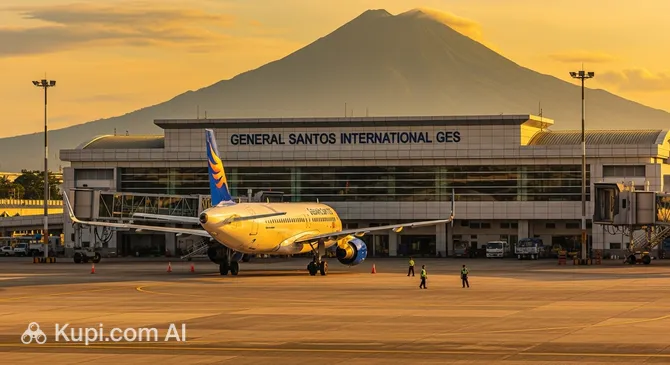
General Santos International Airport. Source: Kupi.com Binoculars

General Santos International Airport, also known as Tambler Airport, serves as the main aerial gateway to the SOCCSKSARGEN region and the famous "Tuna Capital" of the Philippines. Despite its high status, the air terminal maintains an atmosphere of comfort and tranquillity, welcoming travellers with scenic views of the majestic Mount Matutum right from the aircraft steps. It is a unique transport hub that combines powerful infrastructure, capable of accommodating the world's largest liners, with the convenience of a regional hub situated amidst lush green plantations.

IATA Code GES
ICAO Code RPMR
City General Santos
Distance to Centre 14 km
Status International
Passengers per Year Approx. 1.2 million

Airport Features and Highlights

Impressive Runway

One of the airport's main sources of pride is its concrete runway, measuring 3,227 metres in length. It is one of the longest runways in the Philippines, second only to the airports in Manila and Cebu. Thanks to these specifications, General Santos can accommodate wide-body aircraft such as the Boeing 747 and Airbus A380, opening up significant prospects for logistics and tourism.

Modern Terminal

Recent large-scale renovations have significantly transformed the airport complex. The passenger terminal has been expanded and modernised: aerobridges (jet bridges) have been installed, making boarding and disembarking much more comfortable in any weather. Inside, travellers will find updated waiting areas, modern check-in systems, and improved signage.

Key Role in Exports

As General Santos is known as the fishing capital of the country, the airport plays a critically important role in the economy. It is from here that tonnes of fresh tuna (sashimi-grade) are shipped daily via cargo and passenger flights to markets in Manila and other countries. High-tech cargo processing equipment ensures the freshness of this famous local delicacy.

Transport Accessibility

The airport is located just a 15–20 minute drive from the city centre. It is accessed via a high-quality concrete road (Philippine-American Friendship Road), ensuring a smooth and quick transfer. For passenger convenience, taxis, multi-cabs (local shared vans), and hotel transfers are available and easily found at the exit of the arrivals hall.

Contact Information

Below you will find contact information for General Santos International Airport (GES). It is recommended to verify the data before your trip, as details may change.

  • Official Website: The airport is managed by the Civil Aviation Authority of the Philippines (CAAP). Information can be found on their official website: caap.gov.ph. There is no separate dedicated website for General Santos Airport.
  • Inquiry Service Phone: For information, you may contact the airport administration by phone. The main number may vary, but is frequently listed as: +63 (83) 876-0003.
  • Airport Address: Philippine-American Ave, General Santos City, 9500 South Cotabato, Philippines.
  • Email: A dedicated email address for general passenger inquiries is not published. It is recommended to use the telephone or contact forms on the management company's website for communication.
  • Social Media: Official social media pages for the airport are not maintained. Please be cautious of unofficial accounts claiming to represent the airport.
  • Lost Luggage Information: For issues regarding lost or damaged luggage, please contact your airline's representative at the airport directly. Airport staff do not handle luggage tracing.
  • Passenger Support Contacts: For on-site assistance, please visit the information desk within the airport terminal or use the phone number listed above for general queries.

How to Get to the Airport

Getting to General Santos International Airport (GES) from the centre of General Santos city can be done in several ways, each offering its own advantages depending on your budget, time, and preferences. The airport is located approximately 15-20 kilometres from the city centre, and the journey usually takes between 30 to 45 minutes.

Public Transport

The most budget-friendly, though least predictable method, is public transport. In the Philippines, shared taxis (vans known as UV Express) and jeepneys are widely used. There may not be a direct jeepney route to the terminal itself, but vans heading towards the airport are a good option. You will likely need to get to their terminal in the city. This method is ideally suited for travellers without large luggage who wish to save money. The cost will be minimal, but be prepared for potential transfers and waiting times.

Taxi and Transfer

The most convenient and popular option among tourists is a taxi or pre-booked transfer. Taxis can be found anywhere in the city or booked via ride-hailing apps if available in the region. This guarantees a door-to-door journey without unnecessary stops. The cost of the trip will be significantly higher than public transport, but it ensures comfort and speed. for complete peace of mind, you can book a transfer through your hotel or a travel agency, which allows you to fix the price in advance.

Car Rental

If you plan to actively explore the region, renting a car can be an excellent solution. There are several car rental agencies in General Santos City. This option provides you with maximum freedom of movement, allowing you not only to reach the airport at a convenient time but also to visit surrounding attractions. Ensure you have all necessary documents, including an International Driving Permit.

Airport Parking

For those arriving in their own or rented vehicle, parking is provided at General Santos Airport. There are zones for both short-term and long-term parking. It is best to check rates and conditions in advance via the official airport website or by phone, as they may change.

When planning a route through the southern part of the Philippines, it is also worth considering other airports. The nearest major hub is Francisco Bangoy International Airport in Davao City, located approximately 122 km away. Also within reach is Awang Airport in Cotabato City (about 163 km), which may be convenient for compiling complex itineraries across the island of Mindanao.

Terminals and Layout

General Santos International Airport (GES), serving the city of General Santos and the surrounding region in the Philippines, is distinguished by a structure that is simple and easy for passengers to understand. This significantly simplifies navigation and makes the airport experience comfortable even for first-time visitors.

Structure and Terminals

The airport consists of one passenger terminal, which handles both domestic and international flights. Thanks to this, you do not need to worry about transferring between different buildings—all procedures from check-in to boarding take place in one location. The terminal building is designed logically and intuitively.

Layout and Navigation

The terminal layout is quite straightforward. Typically, the departure area with airline ticket offices and check-in counters is located in one part of the hall, while the arrival area with baggage claim belts is in another. Signs in English and Filipino help you orient yourself easily. Due to the compact size of the airport, it is practically impossible to get lost here. All main zones—check-in, security screening, and boarding gates—are within walking distance of each other.

Processing Time

Completing all pre-flight formalities at General Santos Airport usually takes significantly less time than in major international hubs. Nevertheless, it is recommended to arrive at the airport at least 1.5-2 hours before a domestic flight and 2-3 hours before an international one. This time will be sufficient to check in, drop off luggage, pass through security control, and reach your boarding gate without rushing.

Recommendations for Passengers

For quick navigation, simply follow the standard signs: "Departures" and "Arrivals". After check-in and security screening, you will enter a small waiting lounge where there are a few souvenir shops and cafes. Since there is only one terminal, information about your flight will be displayed on general screens, which is very convenient for tracking flight status.

Airport History

The history of General Santos International Airport (GES) is a story of ambition and rapid regional growth. Although air connectivity in General Santos existed previously thanks to the old Buayan Airport, the modern airport we know today was built to meet growing economic needs. Its construction was a key development project for the entire Mindanao region.

The new airport was officially opened in 1996, just in time for the 40th Palarong Pambansa (National Games) hosted by the city. The project was implemented with the support of the United States Agency for International Development (USAID). From the very beginning, the airport was designed with grand ambitions: its main pride is one of the longest runways in the Philippines, measuring 3,227 metres. This allows it to accommodate even the largest wide-body aircraft, such as the Boeing 747 and Airbus A380.

The primary driving force behind the construction of such a massive facility was the economy, specifically the tuna industry. General Santos holds the unofficial title of the "Tuna Capital of the Philippines", and the new airport was essential for the rapid shipment of fresh catch to international markets. Consequently, the airport played a decisive role in the economic rise of the region known as SOCSARGEN (South Cotabato, Sarangani, and General Santos).

Since its opening, the airport has not undergone radical reconstruction, as it was originally built to modern standards with ample capacity reserves. However, it is constantly being modernised to meet international safety and passenger comfort requirements. One interesting fact that locals love to recount is that the runway is so large it was considered as a potential emergency landing site for NASA space shuttles. While this is likely a legend, it perfectly highlights the scale and significance of this important transport hub.

Services and Facilities

General Santos International Airport (GES) offers passengers a set of essential services and amenities to ensure a comfortable stay before departure. Despite its relatively small size, the airport in General Santos is ready to meet the basic needs of travellers arriving in or departing from the Philippines.

For those wishing to have a snack or buy something for the journey, the terminal features small cafes and eateries offering local and international dishes, as well as beverages. Additionally, there are several shops where you can purchase souvenirs, essentials, and local delicacies. The selection here is not as vast as in capital city airports, but it is sufficient for a comfortable wait for your flight.

Comfortable seating is installed in the general waiting halls. Passengers can utilise free Wi-Fi for internet access and find charging stations for electronic devices. Although specialised VIP lounges may be absent, some airlines may offer specific conditions for their premium passengers, so it is recommended to verify this information with your carrier.

Other important services are available within the airport grounds. There are ATMs and currency exchange counters, which is convenient for tourists needing local cash. A medical unit operates to provide emergency assistance. Families with small children can make use of the mother and child room. For passengers with reduced mobility, ramps and accessible toilets are provided, and assistance services can be requested through the airline.

There are no hotels or large business centres within the airport building itself. However, a multitude of accommodation options, from budget guest houses to comfortable hotels, can be found in the nearby city of General Santos, which is easily accessible by taxi or other transport. Conference services are also primarily provided in city hotels and business centres.

Where to Eat

At General Santos International Airport (GES), the selection of dining establishments reflects its status as a regional transport hub. You will not find global restaurant chains here, but you can comfortably grab a bite before your flight while experiencing local flavours.

Most cafes and snack bars are located in the public area before security control (landside), making them accessible to both departing passengers and those seeing them off. Here you can find small cafes offering fresh pastries, sandwiches, as well as hot and cold drinks. It is an ideal place for a quick breakfast or a light lunch.

Since General Santos is known as the "Tuna Capital of the Philippines", you may encounter tuna dishes on the menus of local cafes. Be sure to try a tuna sandwich or other local snacks—this is a great opportunity to appreciate the region's main gastronomic symbol. For a full meal, look for establishments serving traditional Filipino dishes with rice.

Options for passengers with strict dietary restrictions (vegan, gluten-free, or Halal meals) may be limited. If you adhere to a special diet, it is recommended to bring food with you. The price range at the airport is quite affordable and does not differ significantly from city prices. Establishments usually operate according to the flight schedule, opening a few hours before the first departure and closing after the last one.

Traveller Tips

To ensure your journey through General Santos International Airport goes as comfortably as possible, take advantage of a few useful tips. These recommendations will help you save time, reduce stress, and even save money, making the start or end of your trip to the Philippines pleasant and organised.

Arrival Time and Check-in. It is recommended to arrive at the airport at least 2-3 hours before the departure of domestic flights. This will give you enough time to complete flight check-in and security control without rushing. To save time in queues, take advantage of online check-in if your airline provides such a service.

Seat Selection and Hand Luggage. When choosing a seat on the plane, be guided by your preferences: a window seat offers beautiful views, while an aisle seat provides more freedom of movement. Be sure to pack all valuables in your hand luggage: documents, money, gadgets, and necessary medications. Remember the standard restriction on liquids: containers no larger than 100 ml, packed in a transparent bag. Sharp objects and flammable substances are prohibited in the cabin.

Passengers with Connections. If you have a connecting flight, check in advance whether you need to collect your luggage and check it in again. Always allow a sufficient time interval between flights to avoid problems due to potential delays and to calmly complete all formalities at the transit airport.

Customs Control. When departing from General Santos airport, customs control is standard and mainly related to security. If you are entering the country, be prepared to declare goods if their value or quantity exceeds duty-free limits. Keep receipts for major purchases.

Saving Money and Unforeseen Situations. To save money, bring an empty water bottle that can be filled after the security check, as well as a light snack, since prices at the airport are usually inflated. In case of a flight delay, do not panic. First, contact your airline representative to find out about the flight status and any compensation due (water, meals). Use the free time for rest or reading.

Reached the end of the page?

That means the route is fully explored