Support

Monument to Alexander III

About

The Monument to Alexander III in Irkutsk is a majestic memorial dedicated to the Russian Emperor Alexander III. Located in the central part of the city, it is one of the key historical and architectural landmarks of Russia, attracting the attention of both locals and visitors.
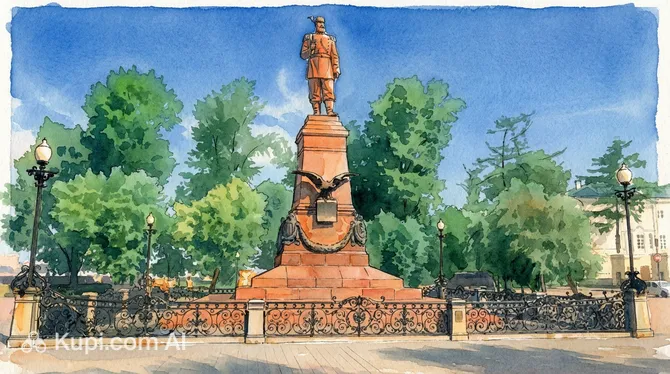
Monument to Alexander III. Illustration.
Source: Kupi.com AI

Traveller photos:

The monument consists of an impressive full-length bronze statue of the Emperor set on a tall granite pedestal. Its austere and solemn appearance reflects the significance of Alexander III to the country's history and, specifically, to the development of Siberia.

The rich artistic decoration of the pedestal deserves special attention. Its faces feature bronze bas-reliefs of prominent figures who played an important role in the exploration and development of Siberian lands: Yermak Timofeyevich, as well as the Governors-General of Eastern Siberia N.N. Muravyov-Amursky and M.M. Speransky. These images serve as a reminder of the glorious chapters of the region's history.

On the eastern side of the pedestal, you can see an image of a double-headed eagle holding the imperial decree appointing the heir to the throne, Tsesarevich Nikolai Aleksandrovich, as chairman of the committee for the construction of the Siberian Railway. The composition is completed by the coat of arms of Irkutsk, as well as the coats of arms of Siberia, the Yakutsk Region, and the Yenisei Governorate, emphasizing the historical connection of the Emperor with these territories. A visit to this monument allows for a deeper appreciation of the region's history and culture.

Contacts

The Monument to Alexander III is a public city landmark and does not have a dedicated administration or direct contact information. If you are planning a visit and would like more information, such as details on guided tours or nearby attractions in Irkutsk, we recommend contacting the city's tourist information centers. Local tour agencies, which often include this monument in their historical routes, can also provide helpful details.

How to contactContact
AddressUlitsa Karla Marksa, 2, Irkutsk, Irkutskaya oblast', Russia, 664003

What to Do

Visiting the Monument to Alexander III is a wonderful opportunity to touch an important page of the history of Russia and Siberia. You can take impressive photos at the monument and carefully study its historical details. Of particular interest are the bas-reliefs on the pedestal, which tell the story of the prominent individuals who played a key role in the development of the Siberian region and help you better understand their contribution.

The monument is located in a very picturesque spot in Irkutsk, making it a convenient starting point for further walks through the city's historic center. After viewing the monument, you can continue your exploration of Irkutsk, paying attention to the architectural features of the surrounding buildings and enjoying the unique atmosphere of this old Siberian city. It is also a popular meeting point or a place for a short break during busy sightseeing routes.

Getting There

The Monument to Alexander III is conveniently located in the central part of Irkutsk, making it easily accessible for all travelers. You can reach the monument by public transport: numerous buses and trolleybuses run through the city's main streets. The nearest stops are just a few minutes' walk away, which is very convenient for independent tourists.

If you prefer walking and want to get a better feel for the atmosphere of Irkutsk, finding the monument is easy by heading toward the city center. You can also easily reach the site from the Irkutsk railway station by public transport or taxi. Additionally, the Monument to Alexander III is often a key stop on city sightseeing tours, providing another convenient way to visit.

Nearest city: Irkutsk

History & Facts

The history of the Monument to Alexander III in Irkutsk dates back to 1908. Its initial installation was timed to coincide with a landmark event—the completion of the Great Trans-Siberian Railway. This massive project connected the central part of the country with its eastern outskirts, and the monument became an expression of gratitude to the Emperor for his significant contribution to the development of Siberia and, of course, for the realization of the Trans-Siberian Railway.

The creation of the monument was preceded by an All-Russian design competition announced in 1902. The work of sculptor R.R. Bach (also mentioned in some sources as V.V. Bach) was chosen as the winner. Interestingly, the funds for the construction—an impressive sum for that time of about 150,000 rubles—were raised through donations. The grand opening took place on August 30, 1908, accompanied by a lavish ceremony: the day began with five cannon shots, followed by a religious procession from the Cathedral of the Epiphany through the city's main streets, Amurskaya (now Lenin Street) and Bolshaya.

The monument’s fate proved to be difficult. In 1963, it was dismantled and replaced by a pyramidal concrete spire in honor of the pioneers of Siberia. However, historical justice eventually prevailed: in 2003, after an 83-year absence, the Monument to Alexander III was meticulously recreated and returned to its original historical site. The modern version accurately replicates the appearance of the 1908 original, allowing us to see it today as it was originally intended.

Time Needed

To see the Monument to Alexander III in Irkutsk, the average visitor will need relatively little time. If your goal is simply to see the monument, appreciate its scale, and take a few photos, allocating 15–30 minutes will be quite sufficient. During this time, you can carefully observe the bronze statue of the Emperor and the bas-reliefs on the pedestal, which depict key figures in the history of Siberia's exploration.

If you plan to delve deeper into the historical context of the monument or if it is part of a longer tour of Irkutsk, it is worth setting aside about one hour. This will allow you to slowly study all the details, perhaps learn more about the personality of Alexander III and his role in the region's development, and enjoy the atmosphere of the surrounding space. Thus, the duration of your visit depends on your interest and your plans for the day.

Working Hours

The Monument to Alexander III in Irkutsk is an open-air city landmark. As such, it is accessible for visiting 24 hours a day, year-round, any day of the week. There are no specific operating hours for viewing the monument, and no advance booking or ticket purchase is required.

In order to fully enjoy the view of the monument, examine the details of the bas-reliefs, and take high-quality photos, it is recommended to plan your visit during daylight hours. This will allow you to better appreciate the craftsmanship of the sculptors and the monument's architectural design.

Open 24/7

Nearby

After viewing the Monument to Alexander III, don't rush to leave this historic corner of Irkutsk. A walk through the surrounding area will allow you to dive deeper into the city's atmosphere and discover other interesting places located just nearby. Each new discovery will enrich your impressions and make your trip even more memorable.

Nearby attractions offer plenty of variety: from museums to other iconic landmarks, each holding its own piece of history and culture from this amazing Siberian city. Below is a list of some of them, along with the approximate distance from the Monument to Alexander III.

NameDistance
Irkutsk Regional Museum of Local Lore0.1 km
Yuri Gagarin Monument0.2 km
Babr Monument0.6 km
130 Kvartal (Irkutsk Sloboda)0.7 km
The Bronze Horse (O. Konnyy Monument)0.7 km
V.P. Sukachev Irkutsk Regional Art Museum0.9 km
EDISON Craft Bar1 km

Reached the bottom of the page?

Looks like you know this route inside out