Support

Ploshchad' Arata

About

In the very heart of the city of Kyzyl, located in picturesque Russia, lies Arat Square—the main public space and spiritual center of the Republic of Tuva. This is not just an administrative hub surrounded by government buildings and theaters, but a living cultural monument where modern urban traditions and ancient nomadic heritage are harmoniously intertwined.
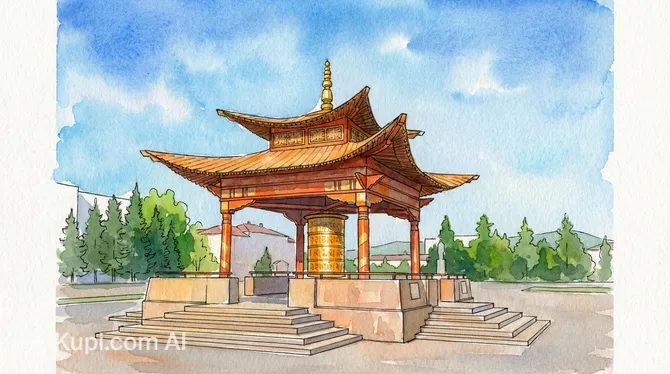
Arat Square. Illustration.
Source: Kupi.com AI

Traveler photos:

The square is famous for its magnificent fountain complex, decorated with unique carvings in agalmatolite (soapstone), and the majestic "Mani Khurtu" prayer drum. Millions of Buddhist sutras are placed inside this gilded structure, making it a point of attraction not only for tourists but also for pilgrims.

Flanked by the National Music and Drama Theatre and the Supreme Khural building, Arat Square serves as the arena for all significant events in the republic. It is a place where every visitor can experience authentic Tuvan flavor, while contemplating architectural elegance and feeling the tranquility emanating from the sacred relics.

Contacts

For information regarding public events or holiday programs on the main square, you can contact the city administration or the tourist information center.

How to contactContact
Addressул. Чульдум, 18, Кызыл, Респу́блика Тыва́, Россия, 667001

What to Do

Visiting the square is an opportunity to touch the living culture of Tuva. One of the essential rituals here is spinning the "Mani Khurtu" prayer drum. According to tradition, one rotation of the drum with pure intentions is equivalent to reading the millions of mantras placed inside it, bringing good luck and purification.

Be sure to take time to examine the fountain complex. Its uniqueness lies in the masterful carving of agalmatolite—a soft stone that Tuvan craftsmen have used since ancient times to create miniature masterpieces. National motifs can be seen in the design of the fountains, turning an ordinary hydraulic structure into a work of art.

For fans of event tourism, Arat Square will be a true discovery during holidays. Here you can hear the famous Tuvan throat singing, see performances by national dance troupes, and witness vibrant parades. It is an ideal spot for photo sessions against the backdrop of the colorful theater building and for observing the measured life of the locals surrounded by majestic Sayan landscapes that can be seen beyond the city limits.

Getting There

Getting to this landmark is easy, as it is located in the very heart of the city at 18 Chuldum St. Most city bus and fixed-route taxi (marshrutka) lines pass through the "Arat Square" (Ploshchad Arata) or "City Center" (Tsentr Goroda) stops, from where the architectural ensemble is just a couple of minutes' walk away.

If you are arriving from Kyzyl Airport, a taxi ride will take about 20–30 minutes (the distance is approximately 10 km). You can also use bus No. 1 or No. 2. From the railway station (located 3 km away), it is most convenient to take public transport or enjoy a pleasant 30-minute walk.

For those traveling by car, there are parking zones near the square; however, during major holidays, traffic in the center may be restricted, so it is advisable to plan your route in advance.

Nearest city: Kyzyl

History & Facts

The history of this site began in 1916, shortly after the founding of the city of Belotsarsk. At that time, it was a bustling Bazaar Square with a fire lookout tower standing in the center. Over time, the name changed along with the eras: the square was known as Revolutionary Square and October Square, and until 1993, it bore the name of V. I. Lenin.

The modern name "Arat Square" was approved on August 12, 1993, by a decree of the President of the Republic. This name was chosen by the residents themselves—scientists, writers, and public figures—to emphasize the connection with national roots and respect for the working person ("arat" means "peasant-herder" in Tuvan). Since that time, the square has been officially recognized as a regional cultural heritage site.

Many architectural elements appeared here long after the city's founding. For example, the famous fountain complex was added in 1984, while the sacred Buddhist prayer drum took its place of honor in 2006. Every surrounding building, whether it is the Government House (built in 1942) or the Music and Drama Theatre, preserves the memory of important milestones in the life of Tuva.

Time Needed

To leisurely explore the main features of the square—the fountains, the prayer drum, and the architecture of the surrounding buildings—1–2 hours is usually sufficient. This is enough time to take beautiful photos, perform the Buddhist ritual at the drum, and simply enjoy the atmosphere of the city center.

If your visit coincides with a holiday concert or a national festival, it is worth setting aside about 3 hours. On summer evenings, it is especially pleasant to stay longer, watching the play of water in the fountains and immersing yourself in the rhythm of the Tuvan capital.

Working Hours

As an open urban space, Arat Square is accessible for visiting 24/7 and free of charge. You can come here at any convenient time, whether it is early morning for quiet reflection or late evening when the city lights come on.

Please note that the fountains on the square operate seasonally—usually from May to September. For those planning to attend events at the National Theatre or other institutions located on the square, it is recommended to check their schedules in advance on the official websites of the organizations.

Nearby

The central location of the square makes it an ideal starting point for further exploration of the city. A walk through the surrounding area will allow you to see many interesting monuments and iconic sites that reveal the history and culture of this fascinating region.

NameDistance
Tuva National Museum0.6 km
Obelisk Center of Asia0.7 km
Tsechenling Buddhist Center0.9 km
Tyva Republic National Park1.1 km
Mio Pizza1.7 km
Aristokrat2.3 km

Reached the end of the page?

That means the route is fully explored