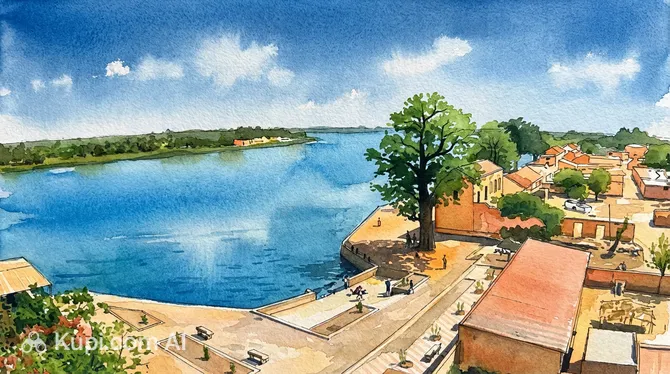
Dagana is a charming and peaceful corner of Senegal, located on the left bank of the majestic Senegal River in the Saint-Louis Region. The city is permeated with an atmosphere of authentic provincial life, where time seems to slow down, allowing travelers to immerse themselves in the genuine daily life of West Africa. As the administrative center of the eponymous department, Dagana maintains its status as an important hub in the river valley while remaining a quiet and cozy place to live.
Dagana. Illustration.
Source: Kupi.com AI
Geographically, the city sits at an altitude of about 12 meters above sea level, which defines its landscape as flat, typical of the Sahel zone. The population of Dagana is approximately between 20,000 and 31,000 people. Although the city is not a major tourist or industrial center, its rich historical heritage, dating back to the 1300s, makes it a significant point on the region's cultural map. In colonial times, the city was part of French Senegambia, and traces of this era can still be found in some administrative buildings.
For tourists, Dagana is primarily interesting for its authenticity. It is worth visiting the colorful local market and strolling along the banks of the Senegal River, observing the daily activities of the residents. This place is ideal for those seeking solitude and wanting to see Senegal unadorned, in its natural and hospitable form.
Weather Overview
Dagana is located in the Sahelian tropical climate zone, characterized by two distinct seasons. Typical weather here consists of hot summers with rare but intense rainfall and very warm, dry winters. Average annual temperatures remain high, often rising to 35–40°C in the summer months and dropping to a comfortable 25°C during the winter period.
The dry season lasts from November to May. During this time, there is virtually no precipitation, and humidity is at its minimum. However, it is worth considering the influence of the harmattan wind, which brings dust from the Sahara, temporarily reducing visibility and air quality. The wet season arrives in June and continues until October, peaking in August and September (up to 50–75 mm per month).
To plan a comfortable trip, we recommend checking the detailed climate of Dagana. The best time to visit is considered to be from December to February, when the heat is less exhausting and the dry air makes walks along the river as pleasant as possible.
Average monthly temperature
Average monthly precipitation
Interesting Facts
Dagana is considered one of the oldest settlements in the Senegal River valley: the first mentions of the city date back to the 14th century (the 1300s).
In some historical documents and on maps, the city is referred to as Tagana.
The city is located in the UTC±0:00 time zone, and its center sits at an altitude of only 12 meters above sea level.
Despite its remote location, Dagana ranks 22nd in population in Senegal and is the third-largest city in the Saint-Louis Region.
The basis of the city's economy is agriculture, making the local market one of the most important trading hubs for surrounding farmers.
How to Get There
The transport accessibility of Dagana largely depends on its location in the Senegal River valley. The city does not have its own airport or railway station, so the main way to get here is by land transport. Travelers most often arrive in Dagana from the country's major transport hubs using an extensive network of roads.
The nearest major air hubs are in Saint-Louis and Dakar. From Saint-Louis, located about 100–150 km to the south, the journey by bus or taxi takes between 2 to 4 hours via the N2 highway. If you are coming from the capital, Dakar, prepare for a trip of about 5–7 hours. The road passes through picturesque savannas, though potential delays due to market days in passing settlements or road conditions during the rainy season should be considered.
Railway service in this region of Senegal is currently not developed for passenger travel to Dagana itself. A popular option for traveling between cities is intercity minibuses or the traditional "car-rapide," which run quite frequently. For those who prefer more comfort, it is recommended to use private taxis or rent a car with a driver.
Station
Passenger traffic
Distance
Dakar station
5
290 km
More detailed information about routes and transport schedules can be found in the how to get to Dagana section. When planning your trip, keep in mind that the N2 highway is the region's main artery, and traveling on it during the dry season can be dusty.
Main Attractions
Dagana is a city that does not strive to impress travelers with majestic monuments or modern skyscrapers. Its main charm lies in its naturalness and everyday rhythm of life. The central point of attraction for any guest is the bank of the Senegal River. Here you can spend hours watching the water flow and seeing how the river feeds and connects the local residents, creating picturesque landscapes of the valley.
The heart of city activity is the local market. It is not just a trading platform but a true center of local culture. Here, amidst bright fabrics, the aromas of spices, and fresh peanuts, you can feel the true spirit of the city. A stroll through the market is the best way to get acquainted with the region's crafts and see how provincial Senegal lives.
Of architectural interest are the old administrative buildings preserved from the time of the French presence. Although there are no world-class museums in Dagana, the layout of the city itself and its unhurried atmosphere turn a simple walk into a small exploration of the river valley's history. Visiting this city is an opportunity to see the life of the region as it truly is.
Local Cuisine
The cuisine of Dagana is the quintessence of Senegalese flavors with an emphasis on the bounty of the Senegal River. The main dish that is a must-try is Thieboudienne (Ceebu Jën)—fragrant rice with fish and vegetables, which here is prepared from the freshest catch. River fish takes center stage in the local diet, served fried, dried, or in thick, spicy sauces.
Classic dishes such as Mafe—meat or vegetables in a rich peanut sauce—and Yassa—poultry or fish marinated in lemon juice with plenty of onions—are equally popular. The diet is also based on rice, sorghum, and various legumes, making the local food very filling and nutritious.
Among the drinks, the favorites are Bissap (cold hibiscus tea) and Boubeu Lemyun (an original peanut-based drink). An evening in Dagana is unimaginable without the Ataya ceremony—strong green tea with mint and plenty of sugar, served in three stages. The gastronomic life of the city is centered around street food stalls and market counters, where food is prepared right in front of you, maintaining homemade taste and traditions.
Travel Tips
Preparing for a trip to Dagana will help you fully enjoy the authenticity of Senegal. These practical tips will make your stay in the city comfortable and safe.
Clothing and Essentials: Choose lightweight clothing made of natural fabrics, as it can be very hot in the region. Senegal is a predominantly Muslim country, so it is better to prefer modest outfits that cover shoulders and knees. Don't forget sunscreen, a hat, and comfortable shoes for walking on dusty roads.
Transport: Within the city, it is most convenient to move on foot or by moto-taxi. For trips to other cities, use minibuses, but remember that they only depart when fully filled with passengers.
Finance: The official currency is the West African CFA franc (CFA). ATMs in Dagana are very rare, so be sure to have a sufficient supply of cash. Cards are rarely accepted.
Health: Be sure to get a yellow fever vaccination and take malaria prophylaxis. Drink only bottled water and avoid ice in drinks at street cafes.
Communication: The official language is French, but most residents speak Wolof. English is not widely spoken. Learning a few basic phrases in French or Wolof is highly appreciated by the locals.
Local Etiquette: Senegalese people are very hospitable. Always greet people when meeting. Before taking a photo of someone, be sure to ask for permission.
What to Avoid: It is not advisable to walk on the outskirts of the city late at night, as street lighting is minimal. Also avoid public alcohol consumption outside of the few establishments where it is permitted.
Extra Tip: Try the local Ataya tea at one of the stalls—it's the best way to start a friendly conversation and feel the rhythm of life in Dagana.
Let your journey to Dagana be a bright and inspiring experience of getting to know the real West Africa!
Entertainment & Nightlife
Entertainment in Dagana is predominantly calm and informal. You won't find noisy nightclubs or neon bar signs here—the city's life follows natural rhythms. Locals prefer to spend their evenings in cozy tea shops or market squares, having unhurried conversations over a cup of traditional Ataya tea.
For those looking for an active nightlife with concerts and discos, the best option is to head to neighboring Saint-Louis or plan a trip to Dakar. In Dagana itself, the main entertainment often consists of spontaneous football matches on city streets or religious and community festivals, which are very colorful and involve almost all residents.
Daytime leisure in the city is primarily about walking along the river and observing nature. Safety is high during daylight hours, and in the evening, it is recommended to stick to the central lit streets. Taxis are available in the city and are the most reliable way to get around late at night if the need arises.
Parks & Museums
There are no classic museums or art galleries in Dagana; however, the urban environment itself serves as a living museum. The city's history, stretching back centuries, is captured in ancient buildings and the daily way of life. For an introduction to local culture, the market squares are best, where craft traditions are passed from generation to generation.
Parks in the traditional European sense are also not developed here—the city is surrounded by the natural vegetation of the Senegal River valley. Nevertheless, the river's shoreline serves as the main natural recreation area. The shade of scattered trees along the streets and by the water creates natural oases where residents escape the daytime heat.
Nature lovers should pay attention to the landscapes around Dagana: the river and its tributaries form a unique ecosystem that attracts many bird species. Although there are no equipped picnic areas or attractions, the wild beauty of the Senegal valley offers excellent opportunities for quiet contemplation and getting to know the flora and fauna of the Sahel.
Getting Around
The transport system of Dagana is simple and adapted to the needs of a small city. The main means of transport for locals and tourists are minibuses, known as "car-rapide," and more modern microbuses. They connect the city center with its outskirts and the market. Thanks to Dagana's compactness, many attractions and important sites can easily be explored on foot.
A popular alternative to public transport is moto-taxis. This is a fast and inexpensive way to get to any part of the city, especially if you need to travel through narrow streets or dirt roads on the outskirts. The price of the trip should always be agreed upon with the driver in advance, as meters are not used here.
Intercity connections are provided by buses departing toward Saint-Louis or neighboring settlements. There is often no fixed schedule; transport departs once full. Payment is made in cash to the conductor or driver. Roads in the city center are mostly paved, but be prepared for dust and sandy patches on secondary routes, especially during the dry season.
Accommodation
The choice of accommodation in Dagana is limited, highlighting its status as an authentic provincial town. There are no luxury five-star hotels or hotel chains here. Travelers can expect small family-run guesthouses, "auberges," and simple hotels catering to transit visitors and humanitarian aid workers.
The most convenient area to stay is the city center, located in close proximity to the market and administrative buildings. This allows you to always be within walking distance of the main commercial points and transport stands. Conditions in such establishments are basic: a clean bed, a fan (air conditioning is less common), and traditional Senegalese hospitality.
For those planning a longer stay, apartment or room rentals in private homes are common in Dagana. It is better to book accommodation in advance, especially if your trip coincides with local holidays. Accommodation prices here are very affordable, but the level of comfort corresponds to the region's modest rural infrastructure.
Nearby Cities
Dagana is a convenient starting point for those wanting to explore northern Senegal and the border areas of Mauritania. The city's surroundings offer a chance to get to know the agricultural heart of the region and its unique history along the banks of the great river.
Just 21 kilometers away is the city of Richard Toll, known for its extensive sugar cane plantations and sugar refinery. This is the industrial center of the region, where you can see the contrast between traditional life and modern production. Also worth noting is the city of Podor, located further downstream, which is famous for its architecture and important historical role in trade along the Senegal River.
City
Population
Distance
Richard Toll
90 000
21 km
Rosso
51 026
33 km
Podor
11 869
60 km
Ross Bethio
11 588
73 km
Ndioum
16 103
91 km
If you have more time, you can head to Rosso, which serves as an important border crossing between Senegal and Mauritania. Traveling through these cities will allow you to deeper understand the diversity and dynamics of life in the Senegal valley, discovering new facets of West African culture.
Shopping & Souvenirs
Shopping in Dagana primarily involves visiting the central market, located near the riverbank. There are no modern shopping malls with international brands, but there is an abundance of locally produced goods. This is an ideal place to purchase authentic Senegalese souvenirs and household items.
Particular attention should be paid to local fabrics—bright "bazin" cuts and wax prints make excellent gifts. The city is also famous for its peanuts and peanut products; you can buy very fresh oil and paste here. Handicrafts, such as woven baskets and simple jewelry, reflect the unique style of the Senegal valley.
Shops and market stalls usually open early in the morning and close at dusk, with a mandatory break during the hottest midday hours. Payment is made in cash in the local currency (CFA franc). Don't forget that bargaining is expected at the market—it's not just a way to lower the price, but an important part of the local social etiquette.