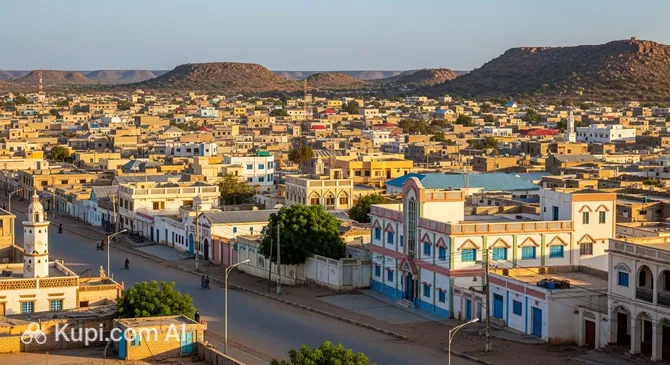
Kardho (also known as Gardo) is an important administrative and commercial hub located in the northeastern part of Somalia. The city is the heart of the district of the same name in the autonomous region of Puntland and attracts travelers with its authentic atmosphere of everyday life in the region. Although it is not a typical tourist center, its role as a regional hub makes it an interesting point for those who want to see the real way of life in Bari province.
Qardho. Illustration.
Source: Kupi.com AI
Geographically, the city is situated on a plateau home to a significant portion of the district's population, which totals nearly 300,000 people. The appearance of Kardho is shaped by modest buildings, bustling markets, and administrative structures. The rich history of this settlement dates back centuries, when similar cities in the north of the country served as vital points on trade routes.
A visit to Kardho allows you to experience the rhythm of life in a Somali city without embellishment: from the morning bustle in the central squares to quiet evenings in local tea houses. We invite you to explore this hospitable land, which opens doors to the world of traditions and culture of the northeastern region.
Weather Overview
The climate in Kardho is characterized as hot and semi-arid, typical for the country's northeastern region. Temperatures here remain high throughout the year, averaging between 28–30°C. The hottest period is usually May, when daytime highs can reach 32°C, and the coolest is January.
Two main seasons are distinguished throughout the year. The dry season lasts from May to October, bringing windy weather that can sometimes lead to sandstorms. The short rainy season usually occurs between November and April, with the most precipitation falling in May and October. Nevertheless, the total amount of moisture remains low, which is important to consider when studying the city's climate before your trip.
Expect mostly sunny and dry weather with low humidity. Due to the open terrain and limited greenery, the city can be dusty, so it is recommended to carry suitable accessories for face protection on windy days. Evenings bring pleasant relief when the temperature drops to a comfortable 15–20°C.
Average monthly temperature
Average monthly precipitation
Interesting Facts
Kardho is one of the oldest settlements in the northern part of the country, maintaining its status as an important center for many generations.
The city holds a prestigious 16th place in terms of population among all cities in the country and is the second-largest in Bari province.
The city's coordinates (9°30′ N 49°05′ E) indicate its strategic position deep within the northern region, away from the coastline but at the crossroads of inland routes.
While the urban population is approximately 47,000, the entire Kardho district is home to nearly 300,000 residents.
How to Get There
Transport accessibility to Kardho is primarily provided by air travel. This is the fastest and most comfortable way to reach the region, given the vast distances and landscape features. The city is an important hub for domestic flights connecting various parts of Puntland.
The key facility is the local airport (IATA: GSR), which regularly handles flights from major cities such as Garowe and Bosaso. A flight from the regional capital, Garowe, usually takes about one hour. We recommend checking current route information in advance, as schedules may change depending on the season.
Overland travel to Kardho is possible from Bosaso, a journey of about 150–200 kilometers. The trip by car takes between 3 and 5 hours. Due to the road conditions and terrain, it is highly recommended to use reliable 4x4 vehicles for such trips. Traffic in the region is light, so traffic jams are practically non-existent.
Main Attractions
Kardho is a city where the main attraction is everyday life itself. You won't find world-famous museums here, but the architecture of the administrative center and the layout of residential neighborhoods provide a complete picture of urban planning in modern Puntland. A walk through the central districts offers views of buildings typical for the region, which serve as hubs for district management.
The main points of interest for guests are the local markets and central squares. These are true centers of social activity where goods and news are exchanged. Here, you can observe traditional trade and meet local artisans whose products reflect the cultural code of northern Somalia.
For those interested in infrastructure, notable sites include modern administrative buildings and educational institutions that have been actively developing in recent decades. Despite the lack of specialized attractions, Kardho charms with its sincerity and the opportunity to see the region's life from the inside.
Local Cuisine
The culinary traditions of Kardho are closely tied to the region's nomadic past and Eastern influences. The diet is based on rice dishes, known locally as kangu, and pasta (baalo). These are typically served with generous portions of meat—most often tender camel or young goat, stewed with aromatic spices.
It is definitely worth trying the local flatbread called kanjo, which is served with almost every meal. A characteristic feature of the local cuisine is the use of cumin and other spices that give the dishes a unique flavor. Despite the distance from the sea, you can also find fish dishes in the city, brought from the coast in Bosaso.
The food culture in the city centers around small family-run establishments and street stalls at the markets. Locals highly value milk tea with spices, as well as freshly brewed coffee. Alcohol is not served in establishments, as all food strictly adheres to halal standards, and the emphasis is on simplicity, satiety, and the quality of natural products.
Travel Tips
A trip to Kardho is a unique opportunity to see Somalia's everyday side. To make your journey comfortable and safe, we have prepared some important tips.
Clothing and gear: Choose light clothing made of natural fabrics, but remember modesty—the dress code should be conservative out of respect for local traditions. Be sure to bring sunglasses and a hat.
Transport:Bajajs (motor rickshaws) are best for moving around the city. For trips outside the city, we strongly recommend renting a 4x4 with a local driver.
Finances: Bring US dollar cash (preferably small bills) or Somali shillings. ATMs are practically non-existent in the city, and international cards are not accepted.
Health and safety: Drink only bottled water and avoid ice in drinks. In the evening, it is better to stay in central areas and avoid planning trips to unlit outskirts.
Communication: The primary language is Somali. English is mostly understood by administration and airport staff. It is useful to learn a few phrases, for example, "Assalamu alaykum" for greeting.
Local etiquette: Always ask for permission before taking photos of people. Politeness and patience are the best tools for communicating with locals.
What to avoid: Do not engage in discussions on political topics and avoid visiting remote villages without an escort.
Connectivity: A local SIM card can be purchased at the market; this will provide you with mobile internet, which works fairly stably in the center.
May your introduction to Kardho leave only pleasant impressions and help you discover new facets of this amazing region!
Entertainment & Nightlife
The entertainment infrastructure in Kardho is primarily focused on local traditions and a relaxed pace of life. There are no noisy nightclubs or cinemas in the conventional sense, but the culture of tea houses is widespread. In these cozy establishments, residents gather in the evenings to discuss the day's events over a cup of aromatic tea, creating a special atmosphere of trust.
For those seeking more active leisure options, sports matches are periodically held in open areas, drawing many spectators and serving as an important element of social life. During holidays, you can find traditional gatherings in the squares featuring elements of folk art.
If you crave a more vibrant nightlife, it is worth noting that the nearest large cafes and busier venues are located in the port city of Bosaso. However, it is in Kardho that you can enjoy the silence and genuine communication that is highly valued by the local residents.
Parks & Museums
Due to climatic conditions and the city's status as a trade hub, classic parks with lush greenery are almost non-existent in Kardho. Greenery is minimal here, which is typical for a semi-arid region. Instead of traditional gardens, residents use open public spaces near markets and administrative buildings for walks and meetings.
The museum network in the city is currently not developed, so the role of history keepers is fulfilled by the streets themselves and the elders who are ready to share legends about the land. The city's cultural heritage is best explored through the architecture of the central districts and by visiting local community centers where traditional gatherings are held.
For those seeking natural beauty, the main interest lies in the landscapes outside the city limits. The surrounding plains and hills allow you to see the region's flora and fauna in their natural state, which in its own way replaces conventional urban amusement parks.
Getting Around
The transport system in Kardho is simple and adapted to local conditions. The main means of getting around the city streets are minibuses and motor rickshaws, locally called "bajajs." This is an inexpensive and fast way to get from one neighborhood to another, especially if you need to reach the central market.
For longer distances or travel to the suburbs, residents often use pickups and shared taxis. It should be noted that many roads in the city and its surroundings remain unpaved, so SUVs (4x4s) are considered the most comfortable transport here. Traffic jams in the city are very rare due to the low population density.
Fares are usually paid in cash directly to the driver. There are no fixed tariffs or unified transit cards, so it is better to discuss the cost of a private taxi trip in advance. Travelers are advised to use the services of trusted drivers and keep in mind that traffic may slow down during periods of sandstorms.
Accommodation
Accommodation options in Kardho are mainly geared towards transit travelers and professionals arriving on district business. You won't find luxury five-star hotels here, but you can choose from several guesthouses offering a basic set of amenities and a welcoming atmosphere.
The most convenient places to stay are concentrated around the central market area and near the airport. This location allows for quick access to the city's main transport hubs and retail points. Most establishments offer simple rooms at affordable prices, making them suitable for budget travel.
When planning your trip, keep in mind that modern online booking systems may not display all available options. The best solution is to arrange accommodation in advance through local operators or check availability directly upon arrival, as there is usually no surge in demand.
Nearby Cities
Kardho is an excellent starting point for those who want to explore Bari province and the Puntland region more deeply. The city's surroundings consist of typical semi-desert landscapes hiding small traditional settlements.
For a day trip, you can consider the town of Dan-Gorayo, located about 91 kilometers away. Also worth noting is the city of Garowe, which is the administrative capital of the region. A trip there will allow you to compare the rhythm of life in a quiet trade hub with Puntland's main political center.
If you have time, we recommend heading towards the port city of Bosaso to see the contrast between inland Kardho and the Gulf of Aden coast. Exploring these directions will help you better understand the diversity and character of the northern part of the country.
Shopping & Souvenirs
Shopping in Kardho primarily means visiting its colorful central markets. There are no massive shopping malls with global brands here, but the life of authentic Eastern bazaars is in full swing. The main market stalls are concentrated in the city center, where you can find everything from fresh produce to household appliances.
Tourists should look for traditional Somali fabrics, which feature bright colors and unique patterns. The city is also an excellent place to buy high-quality spices, frankincense, and leather goods. These items are brought here from various parts of the province and from the port of Bosaso, ensuring a wide selection.
Shops usually operate from early morning until sunset, with a break for afternoon prayer and rest during the hottest hours. Payment is predominantly made in cash (Somali shillings or US dollars). Bargaining at the markets is part of the local culture and is welcomed, allowing you not only to lower the price but also to interact with the vendors.