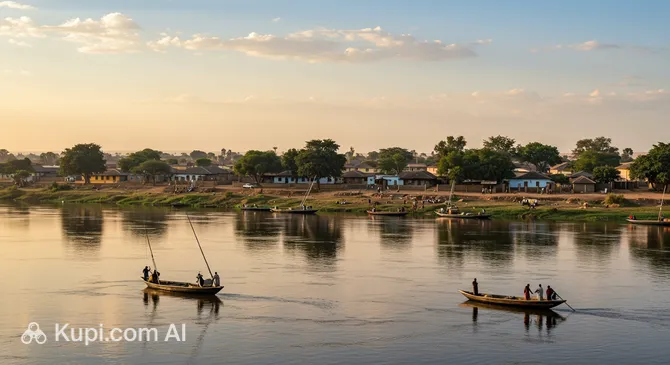
Bor is not just the administrative center of Jonglei State, but also the heart of regional life in South Sudan. Situated on the east bank of the majestic White Nile, the city is permeated with an atmosphere of river trade and the daily bustle of the Dinka people, who form the backbone of the local population. While the city is not a traditional tourist destination, it possesses a rugged and authentic energy that reflects the life of modern East Africa.
Bor. Illustration.
Source: Kupi.com AI
Geographically, the city lies at an altitude of about 300 meters above sea level. According to recent data, the city's population has grown significantly, reaching over 315,000 people, turning it into a major social and transport hub. The city's rich history is inextricably linked to the period of Anglo-Egyptian rule and the development of Christian missions in the region, a legacy that can still be traced in the local architecture.
For the traveler, Bor offers a unique opportunity to witness life on the edge of the great river. The main points of interest here are the shoreline with its boats and barges, as well as the central districts where administrative buildings stand alongside bustling markets. Visiting this city is an invitation to get acquainted with the authentic life of the region, far from glossy guidebooks.
Weather Overview
The climate in Bor is classified as tropical, and the proximity to the White Nile, as well as the vast Sudd swamps, leaves its mark on it. Heat prevails here all year round, and high humidity makes the temperature feel even more intense. If you are planning a trip, be sure to study the detailed weather in Bor to choose the right gear.
A typical year in the city is divided into dry and wet seasons. The hottest month is usually March, when daytime temperatures can reach +40°C. During the rainy season, which lasts from May to October, the region often suffers from flooding, and roads become difficult to navigate. Expect a very hot start to the year and heavy rainfall in the summer-autumn period, accompanied by high humidity.
For travel, it is best to choose the months from December to February, when dry weather sets in and the heat becomes slightly less grueling. During this time, humidity is at its lowest, and the risk of getting stuck due to washed-out roads is practically non-existent. Nevertheless, even in the dry season, temperatures rarely drop below +30°C during the daytime.
Average monthly temperature
Average monthly precipitation
Interesting Facts
The city was founded in 1905 by British missionary Archibald Tucker as a mission station during the Anglo-Egyptian Sudan period.
Bor is historically the primary cultural and political center for the Dinka, the largest ethnic group in South Sudan.
Over recent decades, the city has seen explosive population growth: from 18,000 people in 1983 to more than 315,000 according to modern estimates.
Due to its location on the east bank of the White Nile, Bor has remained a key strategic and transport hub for river communication for a century.
The city is in the UTC+3:00 time zone, which is the same as in many East African countries.
How to Get There
Transport accessibility to Bor largely depends on seasonal conditions and the whims of nature. The city is an important hub connecting the region with other parts of South Sudan; however, traveling here requires careful planning. You can learn more about logistics on the page detailing how to get to the city.
Air travel is served by the local Bor Airfield, though it's worth noting that regular commercial flights in the usual sense are very rare. Most flights are charter or humanitarian in nature, and their schedules depend heavily on weather conditions. The main hub for those arriving in the country remains the international airport in the capital.
The White Nile has traditionally been the main transport artery for Bor. The river route from Juba is one of the most reliable, though not the fastest, ways to travel. A journey on motorboats or barges can take anywhere from a few hours to a day. Land transport is limited to dirt roads, which often become impassable even for 4x4 vehicles during the rainy season.
Main Attractions
Although Bor is not a typical tourist hub, it offers several iconic sites that reflect its cultural and historical character. The main "artery" and primary attraction of the city remains the White Nile. A stroll along the bank allows you to see how the river dictates the rhythm of life for local residents, serving as both a road and a source of food.
Among the architectural landmarks, St. Andrew's Cathedral stands out. This building serves as a reminder of the city's missionary past when the foundations of the modern settlement were laid in the early 20th century. The cathedral remains an important spiritual center and a symbol of generational continuity for the people of Bor.
Another significant site is the Dr. John Garang Memorial Park. This place is dedicated to the memory of an important political figure and serves as a local gathering point. Although the leisure infrastructure here is minimal, the park holds deep symbolic meaning for all of South Sudan. Exploring the city is best complemented by a visit to the local markets, where the real life of the region pulses.
Local Cuisine
The gastronomic culture of Bor is an honest and simple look at the traditions of the Dinka people. The staple diet here consists of cereal crops such as sorghum and corn. One of the most popular dishes is assida—a thick porridge made from sorghum or cassava flour, usually served with various sauces or stewed meat.
Thanks to the proximity of the White Nile, river fish holds a place of honor at the table. Local tilapia, grilled over an open fire or sun-dried, is considered a delicacy. You should also try kui—a hearty meat dish (goat or beef) that is slow-stewed with vegetables and spices, gaining a rich flavor.
Food culture in the city is centered around markets and small street eateries where food is prepared in view of passers-by. Popular drinks include strong local tea and traditional sorghum beer. Travelers are advised to be cautious and consume only bottled water, as well as to try dishes in high-traffic areas where products are always fresh.
Travel Tips
A trip to Bor is a true adventure that requires good preparation and flexibility from the traveler. These tips will help make your visit more comfortable and safe.
Clothing and Essentials: Choose clothing made of light natural fabrics that cover the body as much as possible to protect against the sun and insects. Be sure to bring good shoes with thick soles and powerful repellents.
Transport: The main modes of transport are motor-rickshaws and boats. Always agree on the fare in advance, as there are no meters. In the rainy season, be prepared for flight cancellations and road delays.
Finance: Bring only cash US dollars (new series) and exchange them for South Sudanese pounds. Cards are useless here, and ATMs are a great rarity.
Health: Yellow fever vaccination is mandatory, and malaria prophylaxis is also highly recommended. Drink exclusively bottled water and avoid ice in drinks.
Communication: The main language is Dinka, but English is widely used in administrative circles. Buying a local SIM card is possible in the center, but the connection can be unstable.
Local Etiquette: Greetings are very important. Be polite and patient. Before photographing people or administrative buildings, be sure to ask for permission.
What to Avoid: Do not go out after dark and avoid peripheral areas without an escort. Never photograph military objects or bridges.
Extra Tip: Always have copies of your documents with you and be prepared for frequent road checks. Calmness and a smile will help you pass through any formalities faster.
Despite all the challenges, Bor will reveal South Sudan to you from its most sincere and direct side. Have a pleasant and safe journey!
Entertainment & Nightlife
In the traditional sense, the entertainment industry and nightlife in Bor are practically non-existent. You won't find modern nightclubs, bars, or theaters here. The city's life quietens down with the sunset, and the main evening leisure activities consist of home gatherings or quiet conversations by the river to the sound of the radio.
Daytime activities in Bor are focused on the outdoors. Popular pastimes among locals and the few visitors to the city include fishing on the White Nile or leisurely strolls along the waterfront, where you can watch the movement of river vessels. The atmosphere here is as authentic and peaceful as it gets, devoid of the noise of large metropolises.
For those seeking more organized leisure or vibrant nightlife, the only option is a trip to the country's capital, Juba. Safety at night requires special attention: due to poor lighting and road conditions, walking on the outskirts after dark is not recommended. In Bor, entertainment is the immersion itself into the slow rhythm of life on the banks of the great river.
Parks & Museums
The cultural infrastructure of Bor is currently in its development stage, so there are no classic museums or art galleries in the city at this time. The main site carrying historical and memorial weight is the Dr. John Garang Memorial Park. This is a small green area created in honor of the country's national hero, where locals can relax in the shade of the trees.
City greenery is mainly concentrated along the shoreline of the White Nile. Natural vegetation and river landscapes serve as organized city parks for the residents. The riverbank acts as an improvised recreation zone where one can watch birds and enjoy the coolness coming from the water.
Despite the lack of museum collections, the city of Bor itself can be viewed as an open-air museum, where the region's history is read in the layout of the quarters and the surviving buildings from missionary times. For those interested in ethnography, the best way to get to know the city's heritage is to visit the central market, where traditional lifestyle items are presented in their living use.
Getting Around
The transport system in Bor reflects its status as a regional hub adapted to difficult natural conditions. There is no metro, trams, or familiar bus routes here. The basis of urban and suburban movement consists of motor-rickshaws (tuk-tuks) and bicycles, which allow for maneuvering through dirt and often dusty streets.
For traveling longer distances, locals often use trucks or private 4x4 vehicles, which replace public transport. Fares are usually negotiable and paid in cash. In the city center, many sites are within walking distance, making walking the simplest way to get around, weather permitting.
River transport remains the most important alternative to roads, especially during the rainy season when land routes may be cut off by floods. Boats and small vessels regularly ply along the bank, carrying people and goods. Tourists should keep in mind that most types of transport do not have a strict schedule, so it is better to plan trips with plenty of extra time.
Accommodation
The hotel infrastructure in Bor is quite modestly developed and is primarily oriented toward employees of international organizations, government officials, and business travelers. There are no luxury five-star hotels here; however, in the central part of the city and along the riverbank, you can find several guesthouses and lodges offering a basic set of amenities.
Most accommodation options consist of simple rooms with a bed and a mosquito net. When choosing a place to stay, it is better to prefer establishments located closer to the center or administrative quarters, as the infrastructure there is slightly better. Many guesthouses operate on a long-term rental basis for expats, so it's best to check for availability in advance.
Accommodation prices can be disproportionately high compared to the level of service due to limited supply. Booking through international aggregators is often unavailable, so travelers usually arrange for a room on-site or through local contacts. When planning a trip to Bor, it is important to remember that comfort will be minimal, with the main emphasis placed on practicality.
Nearby Cities
Bor can serve as a starting point for exploring remote and authentic corners of the region, although moving between cities in this part of the country comes with certain difficulties. The region surrounding the city is rich in natural landscapes, including the famous Sudd swamps, which are one of the largest wetlands in the world.
Among the nearest settlements are the town of Pharajok, located about 80 kilometers away, and Yirol, which is about 124 kilometers away. These places allow you to see the traditional way of life in the rural areas of South Sudan. However, the most significant direction remains the trip to the capital, Juba, which is easiest to reach by river.
Exploring the outskirts of Bor requires patience and a readiness for long journeys on dirt roads or river routes. Despite the logistical challenges, such trips offer a rare opportunity to see the untouched nature of Africa and get to know the culture of local tribes in their natural habitat.
Shopping & Souvenirs
Shopping in Bor is primarily about visiting local markets, which are the center of the city's economic life. There are no shopping malls or brand boutiques here, but there is an abundance of essential goods and products made by local artisans. The main central market, located near the river, offers a unique experience of immersion in local trade.
Travelers should look for authentic souvenirs created by the Dinka people. These include handmade woven baskets, traditional fabrics with bright patterns, and wood carvings. In the food stalls, you can find fresh river fish, exotic fruits, and spices that give local cuisine its unique flavor.
Shops and market stalls typically operate from dawn to sunset. Payment is made exclusively in cash using the local currency—the South Sudanese pound. ATMs in the city are extremely rare, and international cards are practically not accepted, so it is important to have an adequate supply of cash. The process of buying at the market is often accompanied by bargaining, which is an integral part of local etiquette.