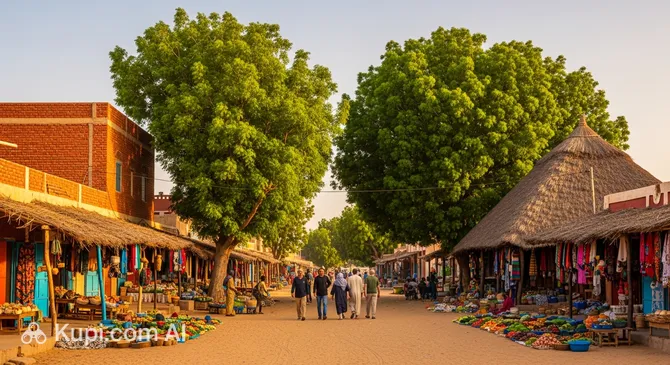
Ed Daein is an important administrative and economic hub located in the southwest of Sudan. The city is the capital of the East Darfur state and home to more than 260,000 people. It is a place with a unique character, where daily life is closely intertwined with the traditions of the Arab Rizeigat tribe, whose nomadic lifestyle and specialization in cattle breeding have largely shaped the region's identity.
Ad-Daein. Illustration.
Source: Kupi.com AI
While the city is not a typical tourist destination in the traditional sense, its authentic atmosphere attracts those who want to see the real, off-the-beaten-path Sudan. The history of this land is inextricably linked to the development of trade routes and the founding of settlements around key resource sources. Today, Ed Daein is known as one of the largest commercial hubs in Darfur, where the trade of agricultural products is concentrated.
The city's geographical position makes it an important transit point. Surrounded by savannas, Ed Daein lives at the rhythm of its vast markets selling peanuts, sesame, and livestock. If you are looking for a place to experience the spirit of traditional trade and get acquainted with the distinctive culture of local tribes, this city will be an interesting discovery on the map of Africa.
Weather Overview
Ed Daein is characterized by an arid climate typical of Sudan, with a strong savanna influence. The weather here is often extreme: summer temperatures frequently reach the 50°C mark. Dry weather prevails throughout the year, with a significant portion of precipitation falling only between July and September, which brings temporary relief from the heat.
Winter months, such as December and January, are the most comfortable for visiting. During this time, the average temperature is around 23–25°C, although nights can be quite cool (down to 15°C). March and April are the hottest months, when humidity is minimal and dust storms can significantly reduce visibility and air quality. The weather in the city dictates the rhythm of life: most trading operations at the markets are aimed to be completed before the midday heat sets in.
Average monthly temperature
Average monthly precipitation
Interesting Facts
Center of the Rizeigat Tribe: Ed Daein is the historical and cultural core of the Arab Rizeigat tribe, whose livestock traditions have shaped the economy of the entire region.
Railway Breakthrough: In 1959, a railway was laid through the city, instantly transforming it from a small settlement into a strategically important trade hub for Sudan.
Market Giant: The local livestock market is considered one of the largest in the country, playing a key role in animal exports.
Thirteenth Largest: Despite its remote location, the city ranks 13th in population among all cities in Sudan.
High Altitude Location: The city is located at an altitude of 449 meters above sea level, which slightly moderates the region's harsh climate compared to the lowlands.
How to Get There
Reaching Ed Daein is not the easiest task, but it is quite manageable for a prepared traveler. The main link to the outside world remains the railway. The line, built in the middle of the last century, provides regular, though not always fast, service to Khartoum and Nyala. A train journey is a great way to see the changing landscapes of the Sudanese savannas.
For those who prefer air travel, there is the option of using the small El Daein Airport (EDN). It is important to note that there are few regular commercial flights here, and chartered planes are the most frequent arrivals. The flight from the capital takes about an hour and a half to two hours, which is significantly faster than traveling by rail or car.
Road connections link the city to neighboring Nyala, located about 145 kilometers away. Roads in this part of Sudan are often unpaved, so the trip can take anywhere from 3 to 5 hours. It is best to check detailed information about routes and road conditions immediately before your trip, as weather conditions can lead to changes.
Main Attractions
Since Ed Daein is primarily an administrative and commercial center, you won't find standard monuments or museums here. The main "attraction" of the city is its Central Livestock Market. It is one of the largest markets in the country, where you can see thousands of animals and observe traditional trading methods that haven't changed for decades.
Another significant site is the Railway Station. The station building and the railway itself, which reached here in the mid-20th century, became a symbol of the region's industrial development. It is the heart of the city's transport system, connecting it with distant Khartoum and neighboring Nyala.
For those interested in culture, the local agricultural markets are well worth a visit. Here, huge mounds of peanuts, sesame, and millet create a unique local flavor. The surrounding savanna landscapes, where herds of Rizeigat nomads graze, are also an impressive sight, demonstrating the unbreakable bond between the local residents and nature.
Local Cuisine
The cuisine of Ed Daein consists of hearty and simple dishes characteristic of the Darfur region. The diet is based on local agricultural and livestock products. Be sure to try kilbu—traditional millet flatbreads—as well as asida—a thick sorghum porridge often served with milk or a meat-based sauce. Meat (beef and goat) is always fresh here thanks to the proximity of the massive livestock markets.
Ful—a fava bean mash with oil and spices—is a popular traditional breakfast for many Sudanese. For snacks, markets often offer foods featuring peanuts or sesame, which are grown here in huge quantities. The general character of the gastronomy is high-calorie and spicy, perfectly suited for the savanna climate.
For drinks, locals prefer strong tea and Arabic coffee prepared with ginger or cardamom. You can also find a local version of a fermented sorghum drink. The food culture is centered around street stalls and small eateries at the markets, where food is prepared right in front of you, ensuring maximum freshness.
Travel Tips
A trip to Ed Daein requires careful preparation, as the city is located in a remote region with a specific lifestyle. These tips will help make your trip more comfortable and safe.
Clothing and Protection: Bring light clothing made of natural fabrics, but make sure it is modest, covering shoulders and knees, out of respect for local Muslim traditions. Sunglasses and a scarf to protect against the dust often kicked up by the wind are also essential.
Transport: Rely on motor rickshaws within the city. For long-distance travel, use the train, as motor roads can be in poor condition.
Finance: Work only with cash in the local currency. International cards are practically not accepted here, and ATMs may not be available for foreign cards. Exchange your currency in Khartoum in advance.
Health: Drink only bottled water and always carry a supply of hand sanitizer. Avoid long exposure to the sun in the middle of the day, as temperatures can rise to 50°C.
Communication: The main language is Arabic. English is very limited, so learn basic phrases for greetings and trading.
Local Etiquette: Be polite and patient. Always ask for permission before taking photos of local residents, especially women.
What to Avoid: Do not visit outlying markets alone after dark. Avoid discussing political topics and maintain neutrality in your conversations.
Specific Tip: Visit the livestock market specifically in the morning hours—this is the best time to catch the most active phase of trading and take unique photos.
May your acquaintance with this distinctive land leave only bright and positive impressions!
Entertainment & Nightlife
The entertainment scene in Ed Daein has a specific local character. You won't find night clubs, cinemas, or conventional bars here. The centers of social life in the evenings are the local tea houses and small eateries located near the markets. This is where the city's residents gather to discuss the news over a cup of traditional coffee or tea.
Daytime activities are mostly centered around visiting the markets, which serve as a live theater of daily life. For more active recreation or modern entertainment, locals usually travel to larger cities like Nyala or the nation's capital. In Ed Daein itself, quiet conversation and family traditions are what's valued most.
Evening safety in the city requires some caution due to insufficient lighting on the outskirts. It is recommended to spend time in the central areas and use local taxi services for travel after sunset. This is a city that lives according to the rhythm of daylight, quieting down as darkness falls.
Parks & Museums
In Ed Daein, you won't find classic urban parks with manicured lawns or major art galleries. Due to the arid climate and the specific nature of the city's development, most greenery is concentrated around agricultural lands on the outskirts. The role of "natural zones" is filled by the endless savannas surrounding the city, which are used for livestock grazing.
The lack of museums is compensated for by the living history that can be observed right on the streets. The traditional architecture of the Rizeigat tribe and the way of life in the markets are ethnographic exhibits in their own right. Local residents carefully preserve their traditions, which are passed down from generation to generation without the involvement of museum curators.
For relaxation, city residents sometimes choose shady spots near fields or close to water bodies during the rainy season. If your goal is to get to know the flora and fauna of Darfur, the best option is to head outside the urban area accompanied by a local guide who can show you the hidden beauties of Sudanese nature.
Getting Around
The public transport system in Ed Daein is underdeveloped and mostly represented by private carriers. Within the city, the most popular ways to get around are motor rickshaws (tuk-tuks) and pickup trucks that serve as shared taxis. This is an inexpensive and fast way to get from the station to the central market or to remote residential neighborhoods.
Fares are always paid in cash to the driver. There are no universal travel passes or transport cards. Prices for trips are low, but tourists are advised to confirm the cost in advance, as it can vary depending on the distance and time of day. In the central part of the city, many people prefer to get around on foot, as the main commercial points are located quite compactly.
Intercity connections are provided by buses and the railway. Rail transport remains a priority for long-distance trips to Khartoum or Nyala due to its predictability on dusty roads. For those planning to move around the area a lot, the best option would be to rent a car with a local driver who knows the specifics of the landscape.
Accommodation
The hotel infrastructure in Ed Daein is primarily geared toward business travelers, traders, and employees of international organizations. There are no luxury hotel chains here; the bulk of the accommodation consists of modest guesthouses and small local-style hotels. Most of them are concentrated in the central part of the city, within walking distance of the railway station and the main markets.
Accommodation options offer basic amenities: a bed, a fan (sometimes air conditioning), and a shared or private bathroom. Room rates remain affordable, though the level of comfort reflects the city's status as a transit hub. For those planning to stay in the region longer, long-term apartment rentals are available.
Booking accommodation through international aggregators is practically impossible here. It is recommended to arrange stays on-site or through local intermediaries. If your visit coincides with major market days, you should take care of your lodging in advance, as the best spots in central guesthouses may be occupied by visiting traders.
Nearby Cities
Ed Daein can serve as a starting point for exploring the eastern part of the region, although the distances here are significant. Trips to neighboring cities allow for a better understanding of the diversity of the Sudanese provinces and show how the way of life changes depending on the proximity to trade routes or administrative centers.
Relatively nearby is El-Obeid, which, despite the formal distance on the map, is closely connected to Ed Daein by trade interests. It is also worth noting the city of En-Nahud, known for its gum arabic production, and Al-Fula, which is an important point on the way to the southern borders of the region.
Exploring the surroundings of Ed Daein requires good preparation and plenty of time, but it offers a unique experience of immersion into the real life of Darfur. Each of these destinations reveals new facets of the tribal cultures inhabiting the savannas of Sudan.
Shopping & Souvenirs
Shopping in Ed Daein primarily means visiting its grand markets. There are no shopping malls with global brands here, but natural products are available in abundance. The city is famous for its high-quality peanuts, sesame, and gum arabic. Buying these goods directly from the producers guarantees their freshness and authenticity.
The main shopping area is the zone around the central market and the railway station. Here you can find almost everything needed for daily life, from vibrant African fabrics to traditional kitchenware. Payment is made exclusively in cash in the local currency, and the process of bargaining is an obligatory and respected part of any transaction.
As souvenirs from Ed Daein, it is worth bringing back items made by local Rizeigat craftsmen. Handmade leather goods and woven accessories deserve special attention. While there are no specialized souvenir shops in the city, such items are often found in the craft rows at the general market. These will be truly unique pieces carrying the spirit of the real Darfur.