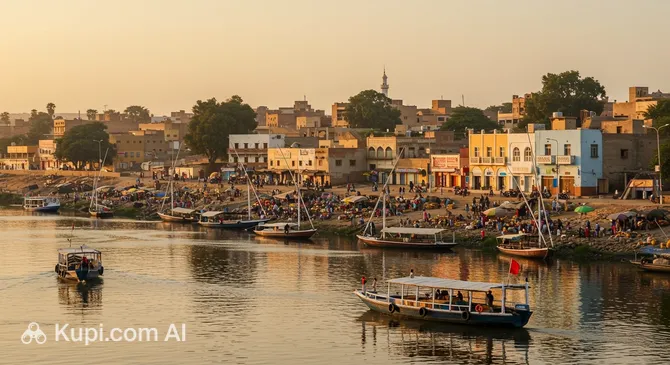
Located on the picturesque left bank of the White Nile, Kosti is one of the largest and most dynamically developing cities in Sudan. Founded in 1899 by the Greek merchant Konstantinos Mourikis, the city quickly grew from a small trading settlement into a major economic center. Today, it is the country's sixth-largest city, serving as the administrative center of the White Nile State and attracting attention for its role in industry and transport.
The city's geographical position defines its atmosphere: its proximity to the great river makes it a key river port. Kosti is not a classic tourist resort but rather an authentic industrial hub, where life revolves around the railway, the port, and sugar factories. The city's population is estimated at around 345,000, making it a lively and bustling place.
Kosti. Illustration.
Source: Kupi.com AI
The city's rich historical heritage is closely linked to the development of trade and industry in the region. Tourists may be interested in seeing the daily life of the Sudanese province, exploring the colonial architecture of the central districts, and observing the operation of massive sugar production facilities. We invite you to visit Kosti to experience the true rhythm of modern Sudanese life, far from the standard tourist routes.
Weather Overview
The climate in Kosti is typical of the central regions of Sudan and is characterized as tropical, hot, and dry. The city is located in a zone where the influence of the White Nile slightly softens the harshness of the desert, but temperatures remain high throughout the year. Summer here is truly scorching: between March and June, the thermometer often crosses the +40°C mark, and days are accompanied by bright sun and dry air.
The winter months, from December to February, are considered the most comfortable for a visit. During this time, the average daytime temperature fluctuates in a pleasant range from +25°C to +30°C, and nights bring long-awaited coolness (around +18°C). Precipitation in the region is extremely rare and falls mainly during the "rainy season" from July to October. Short but intense downpours are possible during this time, temporarily refreshing the city and reducing dust in the air.
When planning your trip, be sure to check the detailed weather in the city to choose the right wardrobe. Due to the proximity of the river and the operation of sugar factories, there may be increased dust during dry periods, so travelers with respiratory sensitivity should consider this factor when choosing their visit time.
Average monthly temperature
Average monthly precipitation
Interesting Facts
The city owes its name to the Greek merchant Konstantinos Mourikis (affectionately called "Kostas" by the locals), who founded a trading post here in 1899.
Kosti is rightfully considered the "sugar capital" of Sudan, as its surroundings are home to powerful sugarcane processing plants that supply the country with this vital product.
The city is a unique transport crossroads: major railway lines, highways, and the largest river port on the White Nile all converge here.
Despite being relatively young, Kosti is the sixth-largest city in the country by population, home to nearly half a million people.
The city has its own airport, which plays an important role in connecting this industrial hub with other regions of Sudan.
How to Get There
There are several ways to reach Kosti, given its status as an important logistics hub in Sudan. The most popular route is from Khartoum, located about 200–250 kilometers to the north. A trip by intercity bus or private car on the paved highway takes between 4 and 6 hours. Be aware that roads can be busy with heavy trucks heading to the sugar factories.
Although the city has its own airport, regular air service has been limited in recent years and mainly consists of domestic or charter flights for industrial employees.
Railway transport is an alternative to road travel. Kosti Railway Station is a key point in the national network, linking the southern and central regions of the country. Trains do not run frequently, but this mode of travel allows you to see the colorful landscapes of the Sudanese province.
Additional information on routes and tickets can be found on the page describing how to get to the city. It is also worth remembering the possibility of a river journey along the Nile, which, although it takes more time, offers unforgettable impressions of the great river's views.
Main Attractions
While Kosti is primarily known as a major industrial center, there is plenty for the curious traveler to see. One of the main attractions is the river port on the White Nile. This is the heart of the city, where you can watch ships being loaded and feel the river's importance to the entire region's economy. A walk along the bank allows you to see the Nile in all its majestic beauty.
For those interested in the past, the central districts of the city have preserved elements of colonial architecture from the turn of the 19th and 20th centuries. These buildings are a reminder of the era of the city's foundation and create a unique contrast with modern industrial facilities. Another important point of interest is the famous sugar factories. Although these are restricted industrial sites, their large-scale industrial landscapes are impressive and highlight the city's status as the country's sugar capital.
Lovers of local culture should visit Kosti's central markets. There are no exhibition halls here, but there is real life: bright fabrics, the aroma of spices, and the chance to observe traditional trade. The best way to end your introduction to the city is on the Nile promenade, which becomes the main meeting place for locals in the pre-sunset hours and offers beautiful views of the river.
Local Cuisine
The gastronomy of Kosti is a vibrant reflection of rich Sudanese traditions, focusing on simple yet hearty dishes. The local diet is based on porridges and flatbreads made from sorghum. You should definitely try tolla (a traditional porridge) or asyda, which is served with rich meat sauces. Another iconic dish is fuul, stewed fava beans with peanut oil, spices, and cheese.
The proximity of the White Nile gives the city its main culinary pride—fresh fish. Local eateries on the riverbank will offer you fish caught that morning and grilled with spices over an open fire. This is perhaps the most authentic gastronomic experience you can have in this region. A characteristic feature of the local table is also an abundance of desserts prepared using molasses from local sugarcane.
As for drinks, dairy products like rob are popular in Kosti and are excellent for quenching thirst. Alcohol is not common in the city due to strict local traditions, but jabana—fragrant Sudanese coffee with ginger and cinnamon, prepared in special clay pots—can be found everywhere. The best places to explore local cuisine are the small restaurants near the markets and on the promenade, which are always full of locals.
Travel Tips
A trip to Kosti will give you a unique experience of authentic Sudan, but it is wise to prepare for the journey in advance. These tips will help make your visit as comfortable and safe as possible.
Clothing and Essentials: Choose light clothing made from natural fabrics (cotton, linen), as the region is very hot. Women are recommended to wear clothing that covers the shoulders and knees to respect local traditions. Be sure to bring a wide-brimmed hat, sunglasses, and comfortable closed shoes for protection against dust.
Transport: The best way to get around is by tuk-tuks. Always agree on the price before getting into the vehicle. If you plan a trip to Khartoum, choose morning buses—they are more reliable.
Finance: Only cash Sudanese pounds are accepted in the city. ATMs may not work with international cards, so exchange enough money in the capital or at major banks upon arrival.
Health and Safety: Drink only bottled water. Use insect repellent in the evenings—the proximity of the river encourages insect activity. Pharmacies can be found at the central market.
Communication: The main language is Arabic. English is understood by employees of large enterprises and some traders. It is useful to learn basic phrases: "Salam Alaikum" (hello) and "Shukran" (thank you).
Local Etiquette: Sudanese people are very hospitable. It is customary to shake hands when greeting. Do not take photos of strategic facilities (bridges, factories, stations) without special permission.
What to Avoid: Do not plan active movements at noon, when the heat peaks. Avoid walking alone in industrial outskirts after dark.
Additional Tip: Try fresh fish from the Nile only in places with a high turnover of locals—this guarantees the freshness of the product.
Following these simple rules will allow you to fully enjoy the city's hospitality and see it at its best. Have a great trip!
Entertainment & Nightlife
Entertainment in Kosti is mostly quiet and traditional, due to the city's industrial nature. Nightlife in the conventional Western sense—with noisy clubs and bars—is practically non-existent here. In the evenings, the main leisure spots for residents and visitors are the numerous tea houses and open-air cafes located along the banks of the White Nile or near the markets.
The atmosphere in these establishments is very welcoming and relaxed. Locals gather here to discuss the news over a cup of traditional coffee or tea. This is the perfect time to enjoy the cool air after a hot day and observe the city's life. Most places close quite early, so it is best to plan your evening leisure between sunset and midnight.
Daytime entertainment includes walking along the promenade and visiting sports grounds where football matches—the region's most popular game—are often held. If you are looking for a more active cultural program with museums or theaters, keep in mind that it is better to head to the capital, Khartoum, which can be reached in a few hours. In Kosti itself, the main "decorations" remain the river and the daily hustle and bustle of the lively shopping streets.
Parks & Museums
Unlike major cultural capitals, Kosti does not have a network of classic museums or galleries. It is a city of living history that unfolds right on its streets and industrial sites. The main place for outdoor walks is the White Nile promenade. Despite the lack of formal park ensembles with manicured lawns, the riverbank is the main natural recreation area where you can enjoy the river breeze and views of the endless water.
Open spaces around the city and along the coastline are used by residents as improvised areas for picnics and gatherings. The lack of extensive greenery in the center itself is compensated for by the character of the riverside areas, where you can see traditional Nile boats and various birds. For those who appreciate industrial aesthetics, the historical buildings of the sugar factories and old railway depots serve as a kind of "open-air museum."
While there is a shortage of organized green zones in the city, local authorities are gradually working on improving public spaces. For now, the best way to escape the city dust remains a trip to the river in the pre-evening hours, when the heat subsides and the Nile fills with the reflections of the setting sun. This provides an opportunity to experience the primal beauty of Sudanese nature in the heart of an industrial region.
Getting Around
The public transport system in Kosti consists mainly of buses, minibuses, and motor rickshaws, which locals call "tuk-tuks." This is the fastest and most convenient way to move between the city's key points: the center, the port, and the railway station. A rickshaw ride around the city usually takes 15 to 30 minutes, and the fare should always be agreed upon with the driver in advance.
Payment for transport is by cash only. There are no ticketing systems or electronic cards here—money is handed directly to the conductor or driver. Tourists should keep in mind that during peak hours, when work shifts at the sugar factories begin or end, transport can be very crowded, and congestion occurs on main roads due to the abundance of trucks.
For more comfortable trips, you can use the services of private taxis, which are easily found at stands near crowded places. Car or bicycle rentals are not developed in Kosti, so tourists are better off relying on local transport. Getting around on foot is quite comfortable within the central districts; however, due to the intense heat and dust on the outskirts, it is recommended to use transport.
Accommodation
The hotel infrastructure in Kosti is primarily geared toward business travelers, engineers, and transit passengers. You won't find luxury five-star hotels here, but there is a decent selection of budget and mid-range accommodation options. Most hotels are concentrated in the central part of the city, near the railway station and the main markets, which is convenient for those planning a short stop.
Prices for accommodation in Kosti remain quite affordable and typically range from $20 to $50 per night. Hotel service is basic, but rooms generally have everything necessary for rest: air conditioning (which is critical in the local climate) and clean bedding. In areas where sugar industry specialists live, you can find apartment rental options for longer stays.
When planning your trip, it is recommended to book accommodation in advance, especially if your visit coincides with major industrial events or the peak sugarcane harvesting period. For searching and booking, it is best to use trusted regional services or arrange directly via hotel contacts. Be prepared for the fact that international booking systems may not display all available options in this region.
Nearby Cities
Thanks to its location in the heart of the White Nile State, Kosti serves as an excellent starting point for exploring the surroundings. Just a few kilometers away, on the other side of the river, lies the city of Rabak. This is the state's administrative center, and a trip there allows you to compare the atmospheres of two neighboring cities with different rhythms. You can get there very quickly via the bridge over the White Nile.
If you have time for a longer trip, you should head to historical Sennar, located about 111 kilometers to the east. This city is famous for its rich past as the capital of an ancient sultanate and its huge dam on the Blue Nile. Another interesting destination could be a trip to Al Manaqil, an important agricultural center in the region.
For those ready for a full-day journey, the road north leads to the country's capital, while the road south heads toward the border with South Sudan, for example, to the city of Renk. Exploring these directions will help you better understand the geographical and cultural diversity of the Nile basin.
Shopping & Souvenirs
Shopping in Kosti is primarily an immersion into the atmosphere of traditional oriental bazaars. You won't find huge shopping malls with global brands here, but you will fully enjoy the flavor of the central markets located near the river port and railway station. These are the city's main commercial arteries, where you can find everything from fresh tropical fruits to high-quality locally produced fabrics.
The main souvenir to bring from Kosti is undoubtedly local sugar and sugar-based products. As a center of the sugar industry, the city offers the best selection of sweets and molasses in the region. Also, look out for leather and wood handicrafts brought here from surrounding villages. Bargaining is not only appropriate here but is also an important part of the communication process with sellers.
Shops and stalls usually operate from early morning until sunset, with a small break during the hottest midday hours. Payment is made primarily in cash in Sudanese pounds, as bank cards are rarely accepted and only in very large outlets. Tax Free for tourists is not available in this part of the country, but the affordable prices at local markets more than compensate for its absence.