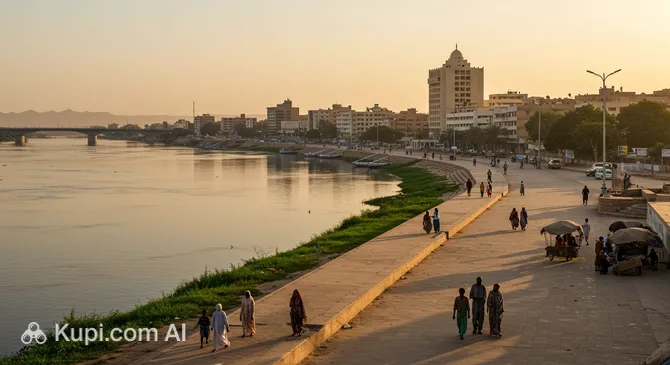
Located on the west bank of the Blue Nile, Wad Madani is one of the most significant economic and cultural centers of Sudan. This bustling city, the administrative center of Al-Jazira State, is often called the agricultural heart of the country. Life here is closely intertwined with the river and the famous Gezira Scheme—one of the largest irrigation projects in the world, which transformed arid plains into fertile fields of cotton, wheat, and peanuts.
Wad Medani. Illustration.
Source: Kupi.com AI
With a population of over 345,000, Wad Madani combines features of a modern industrial hub with those of a traditional Sudanese settlement. Its rich heritage dates back to the 18th century, when it originated as a Turco-Egyptian outpost. Today, the city draws attention with its authentic atmosphere, where traditional folk music can be heard on the streets, and daily life hums around the University of Gezira and lively markets.
For the traveler, this city reveals itself through walks along the Blue Nile waterfront and visits to local production sites that offer a glimpse into the region's agrarian past and present. Despite its primarily business and industrial status, Wad Madani charms with the genuine hospitality of local residents and the opportunity to see real, non-touristy Sudan at its most active.
Weather Overview
The climate in Wad Madani is characterized as hot and predominantly dry. Sunny weather prevails for most of the year, with the hottest period falling in April, May, and June. During this time, the thermometer often crosses the +40°C mark. If you are planning a visit, it is important to note that the weather in the city during these months requires special attention to sun protection and hydration.
The winter months, from December to February, bring welcome relief: average daytime temperatures become more comfortable, hovering around +28°C to +33°C, and nights can be pleasantly cool (about +20°C). The rainy season is short, occurring in July and August when most of the annual precipitation falls, temporarily refreshing the Gezira plain and promoting the active growth of agricultural crops.
The region is also characterized by periodic sandstorms typical of this part of Sudan. Due to the flat terrain and active farming, there can be an increased dust content in the air during dry periods. The most pleasant time to visit the city is considered to be from November to March, when the heat recedes and the sky remains clear and cloudless.
Average monthly temperature
Average monthly precipitation
Interesting Facts
Heart of world cotton production: After the launch of the Gezira Scheme in 1925, Wad Madani became one of the world's largest centers for cotton production, which defined the country's economy for decades.
Unique irrigation system: The city is the operational headquarters of the Gezira Scheme—the world's most extensive irrigation system under a single management, covering the lands between the Blue and White Niles.
Musical melting pot: Wad Madani is famous for its contribution to Sudanese culture as a center of folk music, where ethnic traditions from various regions of the country intertwine.
Academic hub: The local University of Gezira is considered one of the most prestigious universities in Sudan, especially in the fields of agricultural sciences and medicine.
Transport crossroads: Two major trans-African road routes pass through the city, linking different parts of the continent.
How to Get There
Wad Madani occupies a strategic position in Sudan, being a major transport hub linking the capital with the eastern and southern regions of the country. The city is integrated into a network of major highways, making land transport the most popular way to travel for locals and tourists alike. Detailed information about routes and logistics can be found on the page describing how to get to the city.
Air travel is served by the small Wad Madani Airport (IATA: DNI). The airport is primarily focused on domestic flights connecting the city with Khartoum. The flight time from the capital is about one hour; however, it is worth noting that flight frequency may be limited, and many travelers prefer road transport due to scheduling flexibility.
The railway is another important element of the city's transport system. A historic line connects Wad Madani with Khartoum, offering passengers a colorful way to travel. The journey by train or car from the capital takes from 2 to 4 hours, depending on road conditions and traffic, which is often filled with trucks carrying agricultural products from the Gezira region.
Main Attractions
Wad Madani is a city that reveals its beauty through everyday life and large-scale engineering projects rather than through classic tourist monuments. The main landmark and point of attraction here is the Blue Nile waterfront. Along the riverbank, you can find cozy spots to relax, offering views of the slow-moving water and the irrigation canals that feed the region's vast agricultural lands.
One of the key spots on the city map is the University of Gezira. Founded in 1975, it is not only the country's leading educational center but also shapes the character of the district, filling it with the energy of students and scholars. A walk through the university campus allows you to experience the academic atmosphere and the importance of Wad Madani as a center of knowledge.
For those who want to understand the economic soul of the city, the Central Markets and industrial zones are worth visiting. Cotton processing factories and trade hubs are concentrated here, where harvests from across the Gezira plain are distributed. These are places of incredible dynamics, where you can see the fruits of the labor of thousands of farmers and feel the rhythm of life in Sudan's largest agricultural hub.
Local Cuisine
The culinary identity of Wad Madani is inextricably linked to the wealth of the fertile lands of Al-Jazira State. The local cuisine is a celebration of fresh produce grown in the irrigated fields of Gezira. The staple diet consists of dishes made from sorghum and wheat. Be sure to try traditional kisra (thin sorghum pancakes) or assida (thick porridge), served with various meat and vegetable sauces known as mulah.
Meat lovers will enjoy dishes grilled or stewed with onions and aromatic spices, such as gorat. Thanks to the proximity to the river, freshwater fish is also part of the residents' diet. Local peanuts and sesame oil play an important role in cooking, giving dishes a characteristically rich flavor.
The drink culture in Wad Madani is represented by strong tea (shay) with milk or mint, as well as aromatic coffee, the preparation of which often turns into a small ceremony. On hot days, freshly squeezed tropical fruit juices—mango, guava, and grapefruit—are popular in the city's markets. Most eateries are concentrated around the markets and in the city center, where you can try real home-cooked food favored by the locals in simple yet cozy cafes.
Travel Tips
A visit to Wad Madani will give you a unique experience of discovering "non-touristy" Sudan, and these practical tips will help make your trip comfortable and safe.
Clothing and gear: Choose light, loose clothing made of natural fabrics, as temperatures often exceed 40°C. Remember modesty in the dress code: shoulders and knees should be covered. Be sure to bring a hat, sunglasses, and reliable shoes for dusty roads.
Transport: For getting around the city, it is most convenient to use taxis or tuk-tuks. Always agree on the fare before getting into the vehicle. For trips to other cities, it is better to use comfortable intercity buses.
Finances: The main currency is the Sudanese pound. Cards are rarely accepted, so always carry a sufficient supply of cash. It is best to exchange money at official banks or licensed exchange offices.
Health and safety: Drink only bottled water and avoid ice in drinks. Always carry a bottle of water with you in the heat. The city is safe, but watch your personal belongings in markets and crowded places.
Communication: The official language is Arabic. In the university and major hotels, many people understand English. Learn a few basic phrases: "As-salamu alaykum" (greeting) and "Shukran" (thank you)—this is highly appreciated by locals.
Local etiquette: Sudanese people are very hospitable. It is customary to shake hands and show respect to elders. If you are invited for tea, do not refuse—it is an important social ritual.
What to avoid: Do not take photos of government buildings, bridges, or military sites. Also, always ask for permission before taking a photo of local residents.
Specific advice: If you plan a trip to the Gezira irrigation fields, try to do it in the morning before the heat becomes exhausting, and be sure to bring insect repellent.
Your journey to this welcoming city will be unforgettable if you open yourself to local traditions and show respect for the way of life of the Nile Valley residents.
Entertainment & Nightlife
Leisure in Wad Madani is of a calm and traditional nature, reflecting the steady pace of life in this agricultural center. There are no noisy nightclubs or bars, as the city's social life is centered around family values and friendly interaction. As evening falls, the riverside cafes by the Blue Nile become the main draw, where locals gather to drink tea, discuss the news, and enjoy the coolness coming off the river.
One of the unique features of the city's cultural life is traditional folk music. Wad Madani often hosts informal musical evenings and gatherings where you can hear authentic Sudanese motifs. The University of Gezira also periodically organizes cultural events and lectures attended by local intellectuals and students.
Daytime entertainment includes strolling through central shopping districts, where you can observe the daily bustle and traditional crafts. For those seeking a more active nightlife or modern entertainment centers, the best option would be a trip to Khartoum, as Wad Madani remains a place where peace and a traditional way of life are valued.
Parks & Museums
Wad Madani is a city where nature and recreation are inextricably linked to the Blue Nile. While there are no large-scale amusement parks, the river's coastline serves as a natural green zone. Local residents often use the riverbank for picnics and evening relaxation under the shade of trees, enjoying the cool breeze. Walks along the Gezira Scheme irrigation canals also offer a unique view of agricultural landscapes, which are picturesque in their own way during the flowering season.
The city's museum life is modestly developed, as Wad Madani has always focused on the economy and production. The University of Gezira acts as the main guardian of history and knowledge in the region. The university occasionally hosts exhibitions dedicated to agricultural development and local culture. Historic buildings in the old part of the city, which have preserved features of colonial-era architecture, are also of interest to visitors.
For those seeking a deeper immersion into history and art, the main recommendation remains visiting the museums of Khartoum, but Wad Madani itself is valuable for its "living" history, which can be seen in the central market or the preserved old quarters, where time seems to slow its pace.
Getting Around
The transport system of Wad Madani is perfectly adapted to the needs of a business and agricultural center. The main means of getting around the city are minibuses, which locals call "Arbait," and regular buses. They connect the city center with the outskirts, industrial zones, and the University of Gezira campus buildings. The routes are quite extensive, but during peak hours, transport can be overcrowded due to the large flow of workers and students.
Taxis are the most convenient option for tourists. Cars can be found at stands near markets, the station, and major hotels. It is customary to agree on the fare in advance, as meters are rarely used. Three-wheeled motor rickshaws (tuk-tuks) are also popular in the city, which excel at navigating the narrow streets of the old quarters and are a budget alternative to taxis.
For travel between the state's cities and to Khartoum, residents use intercity buses or the railway. Getting around within the city itself usually doesn't take much time; however, it should be noted that road conditions in agricultural areas can be variable, and streets can be quite dusty during the dry season. Renting a car with a driver is a recommended option for those who want to comfortably explore the surroundings and irrigation fields without being tied to public transport schedules.
Accommodation
The hotel industry in Wad Madani is primarily oriented toward business travelers, agricultural specialists, and transit passengers. You won't find luxury international chain hotels here, but the city offers a decent selection of local mid-range hotels and budget guesthouses. Most popular accommodation options are concentrated in the central part of the city and along the Blue Nile waterfront.
For those looking for more comfortable conditions, we recommend choosing hotels located near the coastline—they offer the best views and fresher air. Areas near the University of Gezira are also convenient for staying, as the basic infrastructure there is well-developed: cafes, shops, and transport hubs. If you are planning a long stay, apartments for rent can be found in the city's residential neighborhoods.
When planning your trip, keep in mind that service in local hotels can be quite simple. It is recommended to book accommodation in advance, especially during periods of agricultural exhibitions or major events at the university. Payment is most often made in cash in the local currency, so it is worth taking care of money exchange beforehand.
Nearby Cities
Wad Madani is an excellent starting point for exploring the agricultural heart of Sudan and discovering the cities located along the banks of the Nile. The region around the city is crisscrossed by a network of canals and roads leading to distinctive settlements, each playing its role in the life of Al-Jazira State.
Just 60 kilometers away is the city of Al-Manaqil, an important agricultural center where you can see the scale of the irrigation system in action. To the south, at a distance of about 91 kilometers, lies the historic Sennar, known for its famous dam on the Blue Nile. A trip to these cities will allow you to better understand how the water of the great river transforms desert lands into blooming oases.
For those craving a more dynamic pace of life and cultural diversity, a trip to the country's capital, Khartoum, located about two or three hours' drive away, is always available. Exploring the surroundings of Wad Madani will give you a unique opportunity to see the country's rural life and appreciate the engineering genius of its irrigation systems.
Shopping & Souvenirs
Shopping in Wad Madani is primarily about visiting traditional Sudanese bazaars, where trade continues just as it did decades ago. There are no large modern shopping centers with international brands in the city, but there are huge central markets (souqs), which are the real hubs of the region's life. Here you can find everything from the freshest fruits and vegetables from the Gezira Valley to fabrics and household goods.
The main goods for which the city is famous are agricultural products. Be sure to look for local cotton and textiles—Sudan is famous for the quality of its fiber. In the markets, you should also look for traditional Sudanese spices, fragrant sesame, and the famous peanuts, which are sold here in many different forms. Traditional leather goods and woven baskets make excellent authentic souvenirs.
Shops and markets usually open early in the morning and work until sunset, with a break for the afternoon heat. Payment is almost everywhere made in cash in the local currency. Bargaining in the markets is not only appropriate but also part of the local culture of communication—it's a great way to meet the townspeople and feel the flavor of Sudan.