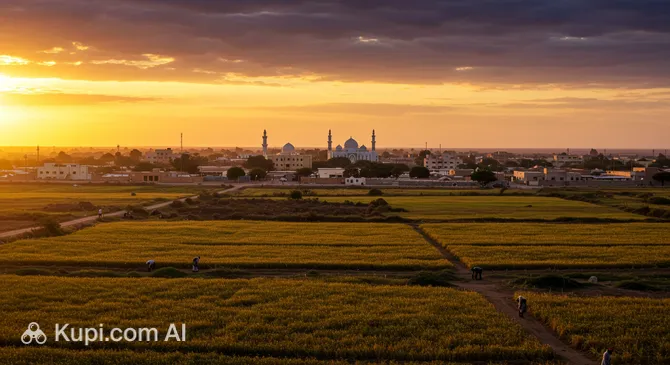
Gedaref is a vibrant agricultural and commercial hub in eastern Sudan, known as the "breadbasket of the country." The city is located approximately 400 kilometers southeast of Khartoum, on a flat plateau surrounded by picturesque mountains on three sides. Founded in the 1820s, it grew from a small settlement into an important administrative center with a population of over 350,000 people.
Gedaref. Illustration.
Source: Kupi.com AI
The city's atmosphere is permeated with the spirit of bustling trade and industriousness. Due to its geographical location and fertile lands, Gedaref plays a key role in the production of sesame, cotton, and sorghum. Travelers here can expect an authentic introduction to provincial life in Sudan, where the traditions of caravan trade harmoniously intertwine with the rhythm of a modern agricultural hub.
While Gedaref is not a typical tourist destination with an abundance of historical monuments, its rich heritage and status as the region's most important market make it interesting for those seeking a genuine, unembellished Africa. The city attracts visitors with its endless fields, surrounding mountain landscapes, and the hospitality of local residents, among whom you can meet representatives of Arab tribes, Nubians, and the Beja people.
Visiting Gedaref is a great opportunity to see how the economic heart of Eastern Sudan lives and breathes. We recommend stopping here on your way to the Ethiopian border to experience the unique flavor of this busy and hardworking region.
Weather Overview
A tropical arid climate, typical of Eastern Sudan, prevails in Gedaref. The city is characterized by a very hot dry season and a short rainy period. The highest temperatures are recorded between March and May, when the thermometer can rise to 40–42°C. Winter here is mild and sunny: in January, the average maximum is about 35°C, while at night, the temperature drops to a comfortable 20°C.
The rainy season in the region falls during the summer months, peaking in August. This is when the main rainfall occurs (about 150 mm), bringing temporary relief from the heat and filling the agricultural fields with life-giving moisture. Due to its location on a plateau and proximity to the mountains, the city is sometimes breezy, though in the dry season, winds can bring dust from the surrounding plains. The current weather in Gedaref will help you plan your visit dates more accurately.
For the most comfortable visit to the city, it is best to choose the period from November to February. During these months, the sky is almost always clear, and the heat does not reach its extreme values, which is ideal for walking through local markets and traveling around the surrounding area. There is practically no precipitation at this time, and the dry air is easier to bear than the summer humidity.
Average monthly temperature
Average monthly precipitation
Interesting Facts
Gedaref is the tenth most populous city in Sudan, making it one of the largest cities in the eastern part of the country.
According to one version, the city's name comes from the Arabic phrase "Souq Abu Sinn," which translates as "market of the father of the tooth"—the name given to this place during the heyday of caravan trade.
The city was founded in the 1820s by refugees from Egypt who sought asylum here and laid the foundations for the future trading settlement.
Gedaref is officially recognized as the center of mechanized agriculture in Sudan; it was here in the 20th century that the large-scale introduction of machinery for cultivating vast areas for sorghum and sesame began.
The city covers an area of about 65.3 square kilometers, making it quite expansive for a regional administrative center.
How to Get There
The transport accessibility of Gedaref is due to its importance as a vital economic hub on the way to the Ethiopian border. You can find detailed information about routes on the how to get to Gedaref page. Ground transport remains the primary way to connect with other regions of the country, linking the city with key destinations in Eastern Sudan.
For air travelers, the city is served by Gedaref Airport (IATA: GSU). Currently, regular air service is limited mainly to domestic flights, including those from Khartoum. Flight time from the capital is about 1–1.5 hours. The airport is located relatively close to the city, and you can reach the center by taxi.
Most tourists prefer to reach the city by intercity buses or minibuses from Khartoum. The distance of 400 kilometers is covered in 6–8 hours. The road surface on this stretch is in acceptable condition, but one should account for possible delays due to weather conditions or checkpoints. Railway service in the region is poorly developed and rarely used for passenger transport.
Main Attractions
Gedaref is primarily a "worker city," so there are few classic tourist sites in the traditional sense. The main center of attraction and the heart of the city are its central markets. Historically, Gedaref developed as an important caravan trade hub, and today the market squares continue this tradition, impressing visitors with the scale of trade in grain, sesame, and traditional fabrics. A walk through the market allows you to see the real life of the region in all its diversity.
The city's architectural appearance is shaped by its administrative center. This is where government buildings and squares are concentrated, serving as the main landmarks for navigation. Despite the absence of ancient ruins, the downtown buildings reflect the development of 20th-century Sudanese provincial architecture, when the city began to grow rapidly due to the mechanization of agriculture.
For nature lovers, the surrounding landscapes are of primary interest. Gedaref is located on an elevation, and the outskirts of the city offer impressive views of the surrounding mountains. A walk to the foothills of these elevations allows you to appreciate the scale of local fields, which during harvest season turn into an endless golden carpet of sorghum, underscoring the city's status as the country's main breadbasket.
Local Cuisine
The culinary traditions of Gedaref are closely linked to its status as an agricultural center. The basis of the local diet is sorghum (dura), which is used to prepare many dishes. You should definitely try assida—a thick sorghum porridge served with aromatic meat or vegetable sauces. Also popular is kisra—thin flatbreads resembling pancakes that serve as both the meal's base and an eating utensil.
The region is famous for sesame production, so it is frequently found in local sauces and pastes. In Gedaref, as in all of Sudan, ful medames (stewed beans with oil and spices) and tamia (a local version of falafel) are prepared everywhere. These dishes form the foundation of breakfasts and lunches and can be found in small cafes and street stalls around the markets.
As for drinks, locals prefer strong coffee with spices (jabana) and traditional tea. On hot days, natural juices from seasonal fruits like guava or grapefruit are very refreshing. The city's gastronomic scene is simple and authentic: family-run establishments and street food catering to locals predominate, guaranteeing honest flavors and generous portions.
Travel Tips
Preparing for a trip to Gedaref requires considering local specifics to ensure your journey is as comfortable and safe as possible. Here are some practical tips from experienced travelers:
Clothing and Sun Protection: Choose light, modest clothing made of natural fabrics that will protect you not only from the scorching sun but also from dust. Remember conservative norms: shoulders and knees should be covered. Be sure to bring a hat and high-quality sunglasses.
Transport: To get around the city, it's best to use tuk-tuks or taxis. If you plan to travel from Khartoum, choose morning bus departures to arrive in Gedaref before dark.
Finance: International cards practically do not work in the city, so be sure to carry a sufficient supply of cash in the local currency. It is best to exchange money at official points or banks in Khartoum or in the center of Gedaref.
Health: Always drink only bottled water and avoid ice in drinks. It is recommended to have a basic first-aid kit and something for dust, as dry air and winds can cause respiratory irritation.
Communication: The main language is Arabic. English is not widely spoken, mostly among bank employees or large agricultural firms. Learn a few basic phrases in Arabic—it will significantly simplify communication at the market.
Etiquette: Sudanese people are very hospitable. Greet people with your right hand. Before photographing locals or administrative buildings, always ask for permission.
What to Avoid: You should not walk alone in remote outskirts of the city after sunset. Also, refrain from discussing political topics or criticizing local customs.
Additional Tip: Visit Gedaref on a market day to see the city in its true glory, but be prepared for crowds and noise.
Following these simple rules will help you enjoy the authentic atmosphere of eastern Sudan and make your visit to Gedaref a pleasant memory.
Entertainment & Nightlife
Nightlife in Gedaref is virtually non-existent in the form residents of major metropolises are used to. The city lives according to the rhythm of the agricultural calendar: residents wake up early to work in the fields and markets, so establishments close quite early. The main form of evening pastime here is traditional open-air tea courts, where local men gather to drink coffee or tea, discuss the news, and crop prices.
For those seeking modern entertainment centers, cinemas, or clubs, Gedaref may seem too quiet. Social life is centered around family circles and religious communities. During the day, you can visit the central shopping districts, which are the main places for walking and socializing, but by evening, activity quickly fades. Local residents and visitors usually head to the capital for more diverse entertainment.
Safety in the city during the evening is generally good, especially in central, well-lit areas and near the markets. Nevertheless, tourists are advised to use taxis for transportation after dark and to avoid unlit outskirts. The atmosphere in Gedaref's establishments is exceptionally friendly, but it is important to remember local etiquette and a conservative dress code.
Parks & Museums
Museum infrastructure in Gedaref is currently not developed, as the city traditionally focuses on economy and trade rather than preserving historical heritage in an institutionalized form. Nevertheless, the city's old commercial center successfully serves as a living open-air museum, where the atmosphere and way of life themselves allow you to touch the history of the Sudanese East.
As for green spaces, there are few in Gedaref. Due to the arid tropical climate, creating and maintaining parks requires great effort. Small squares and landscaped areas can be found in the administrative quarter, but they serve more as places for a short rest in the shade than full-fledged amusement parks. Large-scale greenery in the city is limited, and the primary vegetation remains the agricultural lands beyond the city limits.
As an alternative to parks, tourists often choose walks to the nearby hills and mountains surrounding the plateau. These are natural areas that offer excellent panoramic views of the city and its endless sorghum fields. It is especially beautiful here during the period following the rainy season, when the sun-scorched earth is briefly covered in fresh greenery.
Getting Around
The public transport system in Gedaref is typical of large Sudanese cities and is based on informal but effective routes. The primary means of transport for locals are minibuses (boxes), which connect residential outskirts with the central market and administrative center. They operate without a fixed schedule, departing as they fill up.
For more comfortable and faster trips, tourists can use taxis or the three-wheeled rickshaws (tuk-tuks) traditional to Africa. Rickshaws are ideal for short trips through narrow streets and market quarters, and their fares are quite affordable. It is worth agreeing on the fare for taxis and rickshaws in advance, as meters are practically never used.
It should be noted that the roads in Gedaref are often dusty, and traffic in the market area can be chaotic. Public transport operating hours are limited to daylight hours; after sunset, the number of vehicles on the routes decreases sharply. Payment for any type of transport is made in cash to the driver. Car rentals without a driver are not common in the city, so for long trips, it is better to hire a private taxi for the whole day.
Accommodation
Accommodation options in Gedaref are primarily oriented toward business travelers, traders, and employees of international organizations working in the agricultural sector. You won't find luxury five-star hotels or famous international chains here, but the city offers several quite comfortable mid-range hotels and guesthouses.
The main places to stay are concentrated in the central part of the city, providing convenient access to government offices, banks, and the main market. For those planning an extended stay, apartments are available and are often chosen by expats. Facilities in such properties are usually basic but include all essentials: air conditioning, a shower, and often satellite TV.
Accommodation prices in Gedaref remain moderate compared to the capital. We recommend booking a room in advance if your trip coincides with major agricultural exhibitions or trade fairs, when the demand for quality rooms increases significantly. When choosing accommodation, it is worth checking for the presence of backup generators, as power outages occur in the region.
Nearby Cities
Gedaref is an excellent starting point for exploring the eastern reaches of Sudan and the border areas. Thanks to its location, the city allows tourists to take interesting trips to neighboring regions to see the diversity of nature and life on the border of two nations.
One available destination is the town of Khashm el-Girba, located about 118 kilometers away. It is known for its large dam on the Atbara River and an artificial lake that creates an unusual landscape for this arid region. It would also be interesting to visit border settlements such as Humera or Metema in neighboring Ethiopia, which allows for a comparison of the culture and lifestyle of the two countries (provided you have the appropriate visa).
For a longer journey, consider a trip toward the towns of El Faw or Er Rahad, which are centers of major irrigation projects. Exploring the surroundings of Gedaref will give you an understanding of how vital water and agriculture are to life in this hot but hospitable land.
Shopping & Souvenirs
Shopping in Gedaref is an unforgettable experience of visiting traditional African bazaars. The main place for shopping is the massive central market, which is considered one of the most important trade hubs in the eastern region. There are no familiar shopping malls with international brands here, but there is an abundance of goods reflecting the city's agricultural character.
As souvenirs from Gedaref, it's worth bringing back items made by local artisans, especially household objects of the Beja and Arab peoples. Look for handmade leather goods, traditional woven baskets, and jewelry. Gedaref is also the best place to buy high-quality sesame oil and spices. Local fabrics with characteristic Sudanese patterns make for an excellent and practical gift.
Shops and stalls usually open early in the morning and close at dusk, with many traders taking a break during the hottest midday hours. Payment is made in cash in the local currency; international bank cards are not accepted at most retail outlets. Don't forget that at the Gedaref markets, polite conversation and light bargaining with the seller are appropriate and even welcomed.