Support

Ubon Ratchathani International Airport

About the Airport

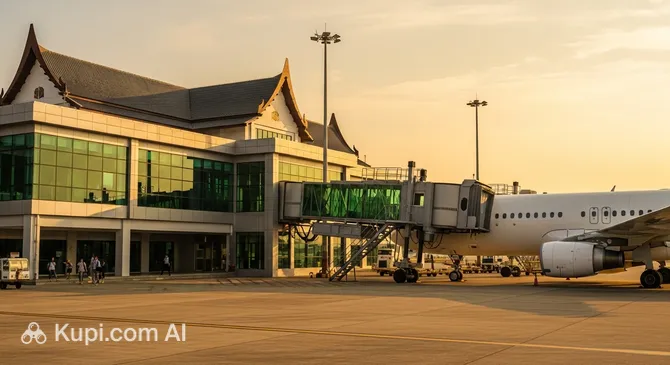
Ubon Ratchathani International Airport. Source: Kupi.com Binoculars

Ubon Ratchathani International Airport (UBP) serves as the main aerial gateway to the southern part of Isan — a distinctive and colourful region in northeastern Thailand. Located just a few minutes' drive from the city, this airport offers travellers an immediate immersion into the atmosphere of the famous "Emerald Triangle," where the borders of Thailand, Laos, and Cambodia meet. There is no hustle and bustle of huge metropolitan hubs here; instead, from the very first steps, one feels the hospitality and measured rhythm of life characteristic of this province.

IATA Code UBP
ICAO Code VTUU
City Ubon Ratchathani
Distance to Centre 3 km
Status International
Annual Passengers Approx. 1.3 million (2023)
Schedule Daily

Features and Advantages of the Airport

The key advantage of this air harbour is its exceptional proximity to the city. The terminal is located practically within the Ubon Ratchathani city limits, so the transfer to most hotels takes no more than 10–15 minutes, and a trip by official taxi is available at a fixed and very reasonable price.

The terminal building is notable for its compactness and simple navigation, allowing all formalities to be completed very quickly. Inside the terminal, travellers can find not only the usual coffee shops and car rental counters but also shops featuring local goods. It is worth paying attention to the famous Isan silk and local gastronomic souvenirs here, while the decoration of the halls often recalls the grand Candle Festival for which this region is renowned.

Contact Information

For your convenience, we have compiled the main contact information for Ubon Ratchathani International Airport (UBP).

  • Official Website: Up-to-date information on flights, services, and airport regulations can be found on the official website: minisite.airports.go.th/ubonratchathani.
  • Information Service Phone: For immediate information, you can call: +66 4524 5612.
  • Airport Address: 9 Senanikom Road, Nai Mueang, Mueang Ubon Ratchathani District, Ubon Ratchathani 34000, Thailand.
  • Email: For written enquiries, you can use the email: ubonratchathani@airports.go.th.
  • Social Media: Follow news and updates on the official airport page on Facebook.
  • Lost Luggage Information: If your luggage was lost or damaged during the flight, you should first contact your airline's representative. For items left in the terminal, please contact the airport's lost and found service.
  • Passenger Support Contacts: For general questions related to your stay at the airport, please contact the information service at the phone number listed above.

How to Get to the Airport

Ubon Ratchathani International Airport (UBP) is located in the immediate vicinity of the city, making the journey to it quick and convenient. There are several ways to get to the terminal, suitable for any budget and travel style.

The most common and fastest option is a taxi. A trip from the centre of Ubon Ratchathani to the airport will take no more than 10-15 minutes. The cost of a trip by meter is usually around 80–120 Baht. Taxis can easily be found on the street or ordered via mobile apps popular in Thailand, such as Grab. An alternative could be a ride on a tuk-tuk, which adds local flair. It is important to agree on the price with the tuk-tuk driver in advance, before the journey begins.

For budget travellers, songthaews — local shared pick-up trucks — are suitable. Although they do not have a direct fixed route to the airport, you can take a songthaew to the major street nearest the airport and walk the rest of the way or take a taxi. Some songthaew drivers may also agree to a private trip directly to the terminal for an agreed fee.

If you prefer maximum comfort, many hotels offer an organised transfer service. This option should be booked in advance through your hotel reception. For those travelling by rental car, the road to the airport is straightforward. Most major rental companies have counters at the airport where you can conveniently return the car before departure. There is also parking for private vehicles on the airport grounds.

Terminals and Map

Ubon Ratchathani International Airport (UBP) is a compact and convenient aviation hub that is easy to navigate even for an inexperienced traveller. Its main feature is one passenger terminal, which handles all flights, both domestic and international.

The terminal layout is extremely simple and intuitive. The building is divided into several main zones. Upon entering, you find yourself in the general hall, where airline check-in counters and ticket offices are located. After checking in, passengers proceed to pre-flight security screening, after which they enter the "airside" area — the departure hall. The arrival zone with baggage claim belts and the exit to the city is also clearly marked and separated from the departure zone.

Since the airport has only one terminal, the issue of transfers between them is irrelevant, which significantly simplifies navigation. All necessary services — from check-in to boarding — are within walking distance of each other. Due to the small size of the airport, the time required to complete all formalities, including check-in and security screening, is usually minimal. On average, this process takes from 20 to 40 minutes, however, during peak hours or holidays, it is recommended to arrive in advance — 1.5-2 hours before departure.

For convenient navigation through the terminal, simply follow the signs, which are duplicated in English. Finding the necessary check-in counter, boarding gate, or baggage claim area will not be difficult. The main advice is to simply follow the standard route: check-in → security → waiting hall → boarding. It is practically impossible to get lost here.

Airport History

The history of Ubon Ratchathani International Airport (UBP) is closely linked to key events of the 20th century in Southeast Asia. Its initial infrastructure was established in the 1940s, during World War II, and was used for military purposes. After the war, the facility was transferred to the Royal Thai Air Force and remained primarily a military airfield for a long time.

The most significant stage in the airport's history occurred during the Vietnam War era. From 1965 to 1974, it was known as Royal Thai Air Force Base Ubon and served as one of the main frontline bases for the US Air Force. The famous 8th Tactical Fighter Wing, known as the "Wolfpack," was based here. The airbase played a strategic role in conducting air operations, which left a deep mark on its history and infrastructure.

After the end of the war and the withdrawal of American troops in 1975, the airport began to actively develop as a civil facility. Parallel to military use, commercial flights began to be serviced here, connecting Ubon Ratchathani province with Bangkok and other regions of the country. In subsequent decades, modernisations of the runway and navigation equipment were carried out.

A key reconstruction that defined the modern look of the airport was the construction of a new passenger terminal, which was opened to serve the growing flow of tourists and local residents. Today, Ubon Ratchathani International Airport is a modern transport hub that successfully combines two functions: it remains an important base for the Royal Thai Air Force and simultaneously serves as the key aerial gateway for the entire northeastern Isan region, contributing to its economic and tourism development.

Services and Facilities

Ubon Ratchathani International Airport (UBP) offers passengers all the necessary services for a comfortable wait for their flight. Despite its relatively small size, the airport is well-equipped and ready to satisfy the basic needs of travellers.

Within the terminal, you will find several cafes and restaurants where you can have a snack before departure. They serve both local Thai dishes and more familiar European snacks. In small shops, you can purchase souvenirs, travel essentials, and products from local artisans. For those seeking more comfortable conditions, VIP lounges are available where you can relax in silence and utilise additional services.

Passengers can stay connected thanks to free Wi-Fi, which is available throughout the terminal. Special counters and sockets are provided in waiting areas for charging electronic devices. The airport also has ATMs and currency exchange counters, which is particularly convenient for tourists arriving in the region.

The airport cares for all categories of passengers. Mother and child rooms are equipped for travellers with children. Passengers with reduced mobility are provided with the necessary assistance, and the terminal infrastructure includes ramps and specially equipped toilets. In case of necessity, you can contact the medical point for first aid.

Although there are no hotels directly within the airport building, several hotels are located in the immediate vicinity, which can be reached in a few minutes by taxi. Specialised conference halls are not provided in the terminal, however, basic conditions for work can be found in the VIP waiting lounges.

Where to Eat

At Ubon Ratchathani International Airport (UBP), despite its relatively small size, travellers can find several convenient options for a snack or a full meal. The main focus is on Thai cuisine, allowing guests to enjoy local flavours right before departure or immediately upon arrival.

Most dining establishments are concentrated in the public area (landside), before passing security control. Here, you can usually find several small restaurants and food courts offering authentic Thai dishes: from noodle soups to rice with chicken and various curries. This is the best place for a full lunch. We recommend trying local Isan dishes if they are on the menu. Also in this zone, there are often coffee shops where you can order drinks and pastries, and small shops similar to 7-Eleven, offering packaged sandwiches, snacks, and drinks at affordable prices.

After passing security screening, in the sterile departure zone (airside), the choice becomes more limited. Typically, one or two cafes operate here, where you can get coffee, tea, soft drinks, as well as light snacks such as sandwiches, pastries, or crisps. This is an ideal option for those who have little time left before boarding and need a quick snack.

Regarding special dietary requirements, finding certified Halal, vegan, or gluten-free dishes in a small regional airport might be challenging. However, in establishments serving Thai cuisine, you can often ask for a vegetarian version of a dish (for example, fried rice with vegetables). Prices at Ubon Ratchathani Airport are higher than in the city but remain moderate by airport standards. Most cafes and restaurants operate according to the flight schedule, opening early in the morning and closing after the departure of the last aircraft.

Travel Tips

To ensure your journey from Ubon Ratchathani goes smoothly and without unnecessary stress, take advantage of our tips. Ubon Ratchathani Airport serves primarily domestic flights, so procedures here usually take less time than in major international hubs.

Arrival Time at the Airport: For domestic flights, it is recommended to arrive 1.5-2 hours before departure. This time will be sufficient to calmly check in, drop off luggage, and pass security screening.

Check-in and Control: To save time, use online check-in on your airline's website. This will allow you to avoid queues at the counter. When passing control, be prepared to remove laptops and other large gadgets from your hand luggage, as well as liquids in containers up to 100 ml, packed in a transparent bag.

Seat Selection on the Plane: If you want to admire the views, choose a window seat. If you value comfort and the ability to stretch your legs, your choice is an aisle seat. Seats at emergency exits offer more space but often come at an additional cost and with certain restrictions.

Hand Luggage: Carefully check your hand luggage for prohibited items (sharp objects, flammable liquids). Remember that power banks are allowed to be carried only in hand luggage.

Passengers with Transfers: Ubon Ratchathani Airport is not a major transit hub. If you have a transfer to a flight of another airline, you will most likely have to collect your luggage and check in again. Always verify this information with your carrier in advance.

Customs Control: When flying internationally, entering Thailand or leaving the country, be prepared for customs inspection. Familiarise yourself with the rules for importing and exporting currency and goods to avoid delays and fines.

Saving Time and Money: Order a taxi via a mobile app — this is often cheaper than using services at the airport counter. Prices for food and drinks in the departure zone are higher, so it is better to have a snack before arriving at the airport. Bring an empty water bottle with you to fill it after passing security.

In Case of Flight Delay: If your flight is delayed, first find a representative of your airline. They will provide the most up-to-date information and explain your rights to drinks, meals, or hotel accommodation depending on the duration of the delay. Remain calm and keep your boarding pass at hand.

Reached the end of the page?

That means the route is fully explored