Support

Ronald Reagan National Airport

About the Airport

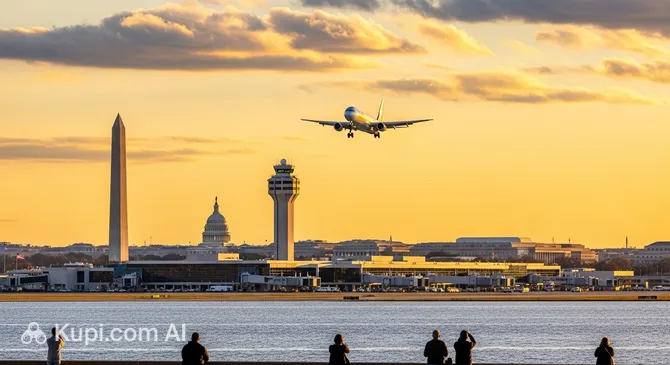
Ronald Reagan National Airport. Source: Kupi.com Binoculars

Ronald Reagan Washington National Airport (DCA) is arguably the most convenient arrival point for those heading to the American capital, as it is located practically in the centre of the action. Landing here often turns into an excursion in itself: planes approach the runway along the Potomac River, offering passengers breathtaking bird's-eye views of the National Mall, the Capitol, and the White House. Thanks to its compact size and unique location, this aviation hub allows travellers to be at a business meeting or start sightseeing literally 20–30 minutes after landing.

IATA Code DCA
ICAO Code KDCA
City Arlington (serves Washington, D.C.)
Distance to centre ~5 km
Status National (domestic flights and flights from Canada)
Passengers per year over 25 million
Schedule Current schedule available on the official website

Features and Benefits of the Airport

Ronald Reagan Airport stands out from other air harbours in the region due to its incredible transport accessibility and cosy atmosphere.

  • Proximity to the capital: This is the only airport located in the immediate vicinity of downtown Washington. A taxi ride to the main attractions takes mere minutes.
  • Direct Metro access: The airport has its own Metro station connected to the terminals by covered pedestrian bridges, allowing you to reach the city quickly and without traffic jams.
  • Scenic approach: The famous "River Visual" route gives passengers sitting by the window some of the best views of Washington's monuments.
  • Easy navigation: Unlike huge international hubs, it is relatively easy to orient yourself here, and distances between check-in areas and boarding gates are covered quite quickly.

Contact Information

For your convenience, we have compiled the main contact information for Ronald Reagan Airport (DCA), which serves the capital of the USA and surrounding areas.

  • Official Website: You can find the most up-to-date information on flights, services, and rules on the official website www.flyreagan.com.
  • Help Desk Phone: For general information, you can call +1 (703) 417-8000.
  • Airport Address: 2401 Ronald Reagan Washington National Airport Access Rd, Arlington, VA 22202, USA.
  • Email: The airport does not provide a public email address. It is recommended to use the feedback form on the official website for communication.
  • Social Media: You can follow news and updates on the airport's official pages on X (Twitter) and Facebook. Links are available on their website.
  • Lost and Found Information: If your items were lost within the airport (excluding luggage checked with an airline), you should contact the Lost and Found service. If the problem concerns checked baggage, you must contact your airline directly.
  • Customer Support Contacts: For general questions, you can contact the main phone number. In case of problems with tickets or flights, you should contact representatives of your airline at the check-in counters or boarding gates.

How to Get to the Airport

Getting to Ronald Reagan Airport (DCA), located in the immediate vicinity of downtown Washington, D.C., is possible via several convenient methods. Thanks to its location, the journey from the city usually does not take much time, making it one of the most accessible airports in the USA.

Public Transport

The most popular and economical way to get to the airport is the Washington Metrorail. The airport has its own station, "Ronald Reagan Washington National Airport," which is served by the Blue and Yellow lines. A direct covered pedestrian bridge connects the station to Terminals B and C. The trip from the city centre will take only about 15–20 minutes. This is an ideal option if you are travelling light and want to avoid traffic. Additionally, Metrobus routes connect the airport with the surrounding districts of Anacostia and Virginia.

Taxis and Transfers

Official taxis are always available at the terminal exits. A trip to downtown Washington will cost approximately $20–$30 and take from 15 to 30 minutes depending on traffic conditions. Popular ride-hailing services such as Uber and Lyft also operate at the airport. They have designated passenger pick-up zones clearly marked with signs. This is a convenient option for those travelling with a large amount of luggage or in a small group.

Car Rental and Parking

If you plan to travel around the region, renting a car can be a good solution. All major rental companies have counters right at the airport, and rental car parks are within walking distance of the terminals. For those arriving in their own vehicle, the airport provides several types of parking: hourly (Terminal), daily (Daily), and economy (Economy). The cost of parking varies depending on proximity to the terminal and duration of the stay. It is recommended to book a parking space online in advance to get a more favourable rate.

Ronald Reagan Airport serves domestic flights excellently. However, for many international flights, travellers often choose larger hubs, such as Washington Dulles International Airport (IAD) or Baltimore/Washington International Thurgood Marshall Airport (BWI), located further from the city.

Terminals and Map

Ronald Reagan Airport (DCA) is distinguished by a well-thought-out and relatively compact structure, making navigation through it quite simple. The airport consists of two main terminals: the historic Terminal 1 and the modern Terminal 2, which in turn includes several concourses (formerly known as Terminals B and C).

Ronald Reagan National Airport. Source: Kupi.com Binoculars

Terminal 1 (Gates A1-A9)

This is the original, historic airport building, which has preserved its unique architectural style. It is significantly smaller than Terminal 2 and serves a limited number of airlines, such as Southwest and Air Canada. Check-in and screening processes here usually go faster due to lower passenger traffic. The terminal structure is simple: one level for all operations — from check-in to boarding.

Terminal 2 (Gates B10-E59)

This is a large modern complex serving most airlines, including American Airlines (which has a major hub here), Delta, United, and JetBlue. The terminal has a clear three-level structure:

  • Level 3 (Upper): Airline check-in areas and baggage drop-off.
  • Level 2 (Middle): Security checkpoints (TSA) and direct access to all boarding gates.
  • Level 1 (Lower): Baggage claim area and exits to ground transport (taxis, shuttles, buses).

Important point: after passing security control in Terminal 2, you gain access to all its concourses (B, C, D, E). This allows you to move freely between gates without leaving the "secure" zone, which is very convenient for transfers.

Moving Between Terminals

You can move from Terminal 1 to Terminal 2 (and vice versa) only before passing security control. Free airport shuttles run between them, or you can walk outside (about 10-15 minutes). After passing screening, there is no direct connection between Terminal 1 and Terminal 2. If you have a transfer between flights departing from different terminals, you will have to leave the "secure" zone, move to the other terminal, and go through screening again.

Recommendations and Timing

DCA Airport is known for its efficiency, but it can also be very busy, especially during morning and evening rush hours. It is recommended to arrive at the airport 1.5-2 hours before a domestic flight departure. Navigation is intuitive thanks to clear signs. The main thing is to check in advance from which terminal (1 or 2) and which gate (A, B, C, D, or E) your flight departs, so you can head straight to the right zone.

Airport History

The history of Ronald Reagan National Airport in Anacostia is not just a chronicle of the development of a transport hub, but a reflection of the history of the capital of the USA itself. The airport was officially opened on June 16, 1941, under the name Washington National Airport. Its construction, initiated by President Franklin D. Roosevelt, was completed in record time to meet the capital's growing need for air travel on the eve of World War II. From the very beginning, it stood out for its convenient location just a few kilometres from downtown Washington.

The post-war years and the advent of the jet age posed new challenges for the airport. Due to proximity to residential areas and government buildings, strict restrictions were introduced: the "perimeter rule," limiting the distance of non-stop flights, and the "slot rule," limiting the number of take-offs and landings per hour. These measures, still in effect today, made the airport unique by directing long-haul and international flights to other airports in the region, such as Dulles.

Ronald Reagan National Airport. Source: Kupi.com Binoculars

A key moment in the airport's modernisation was a massive reconstruction in the 1990s. In 1997, a new, spacious Terminal B/C building (now Terminal 2) was opened, designed by famous architect César Pelli. This architectural marvel with its high vaulted ceilings and panoramic windows radically changed the airport's appearance and passenger experience. A year later, in 1998, the airport was given its current name in honour of the 40th US President, Ronald Reagan.

The tragic events of September 11, 2001, left a deep mark on the airport's history. Due to its strategic position near the Pentagon and the White House, DCA was closed for several weeks and reopened with some of the strictest security measures in the country. This event forever changed operational protocols and highlighted the airport's special significance for national security.

Despite its compact size and operational constraints, Ronald Reagan Airport is constantly evolving. The recent "Project Journey," completed in 2021, added two new security halls and a new regional terminal, improving logistics and comfort for millions of passengers. Among interesting facts, it is worth noting that the airport has had a direct Metro station since 1977, making it one of the most convenient for travellers in the USA. And the approach along the Potomac River, known as the "River Visual," is considered one of the most picturesque in the world, offering stunning views of Washington's monuments.

Services and Amenities

Ronald Reagan Airport (DCA) offers passengers a full range of services and amenities to make waiting for a flight as comfortable as possible. The terminals house numerous restaurants, cafés, and bars, where you can have a quick snack or a full meal. For shopping enthusiasts, there are various shops, including souvenir stalls, newsstands, electronics stores, and boutiques of famous brands.

Free Wi-Fi is available throughout the airport, and a large number of power outlets and USB ports are provided for charging gadgets. Passengers preferring enhanced comfort can visit airline lounges, such as the American Airlines Admirals Club, Delta Sky Club, and United Club. They offer snacks, drinks, convenient workspaces, and a quiet atmosphere for relaxation.

To handle financial matters, there are ATMs and currency exchange points in the airport. Travellers with children will appreciate the presence of nursing rooms equipped with everything necessary. The airport is fully adapted for passengers with disabilities: a barrier-free environment has been created, and special assistance services are available. A medical station is available in case of unforeseen situations.

Although there are no hotels directly within the terminals, there are many hotels in the immediate vicinity of the airport, most of which provide free shuttles. For business travellers, there are convenient workstations in the airport, while full-scale business centres and conference rooms are easy to find in nearby hotels.

Where to Eat

At Ronald Reagan Airport (DCA), passengers will find plenty of dining options to suit every taste: from cafés with quick snacks to full-service restaurants. It is important to note that the majority of establishments are located in the areas after passing security (airside), while the selection in the public area (landside) is more modest.

Where to eat before security (Landside)

If you want to grab a bite before screening or are meeting arrivals, the cafés The Cafe at DCA North and South operate in this zone, offering sandwiches, salads, snacks, and drinks. Additionally, the District Bar is located in the public area — one of the few places with table service in this zone.

Restaurants and cafés after security (Airside)

After passing through security, travellers have access to a wide selection of establishments where they can have a quick snack or a full lunch.

  • Local Cuisine: To taste famous dishes of the Chesapeake Bay region, head to the Legal Sea Foods restaurant. They serve excellent crab cakes, crab sandwiches, and other fresh seafood delicacies. Another iconic taste of the capital can be found at Ben's Chili Bowl — a legendary Washington establishment known for its "half-smoke" hot dogs and signature chili.
  • For a quick snack: Numerous coffee shops, such as Starbucks and Peet's Coffee, are perfect for a short stop. For healthy food, you can check out CAVA, which prepares Mediterranean bowls, or use Farmer's Fridge vending machines with fresh salads.
  • For a full lunch: If you have enough time, you can enjoy a substantial meal. Wolfgang Puck Bar & Bites offers modern cuisine dishes, while wine connoisseurs can visit the Vino Volo wine bar with exquisite snacks. Burger lovers should pay attention to Elevation Burger, which specialises in organic burgers.

Special Dietary Preferences

The airport offers options for passengers with special dietary needs. For vegetarians and vegans, CAVA, Elevation Burger, and Farmer's Fridge machines are suitable. Ben's Chili Bowl also has vegetarian and vegan options. Passengers following a gluten-free diet will find suitable dishes at CAVA, and Legal Sea Foods is known for its gluten-free breading for fried seafood. Halal food options may be limited; it is recommended to verify information directly at the establishments.

Prices and Opening Hours

Prices range from budget-friendly in coffee shops and fast-food outlets to mid-range and high-end in full-service restaurants. Most establishments are open from early morning until late evening, adjusting to the flight schedule. Nevertheless, it is recommended to check current opening hours on the official airport website before your visit.

Travel Tips

Planning a trip through Ronald Reagan Airport becomes easier if you take a few tips into account. Given its proximity to downtown Washington and high traffic, it is recommended to arrive at the airport at least 2 hours before a domestic flight departure. During peak hours, for example, on weekday mornings or before holidays, it is better to add another 30-40 minutes to calmly go through all procedures without rushing.

Ronald Reagan National Airport. Source: Kupi.com Binoculars

To save time, check in for your flight online and download your boarding pass in advance. The TSA PreCheck programme operates in USA airports, allowing you to pass through screening via an expedited procedure — this is an excellent investment for frequent flyers. When passing standard control, be prepared to remove laptops and other large electronics from your carry-on luggage, and observe the rule for carrying liquids (no more than 100 ml in containers, packed in a transparent bag).

When choosing a seat on a plane departing from or arriving at DCA, consider its unique location. Window seats (especially on the left side when landing and on the right when taking off, depending on the direction) often offer incredible views of Washington's monuments. If comfort and the ability to leave the cabin quickly are important to you, choose an aisle seat. As for carry-on luggage, do not pack sharp objects in it, but lithium-ion batteries and power banks, conversely, must only be carried with you in the cabin.

Ronald Reagan Airport serves primarily domestic flights, so for most passengers, transfers will be quick and simple. Shuttles run between terminals. Customs and border control here are only passed by passengers arriving from a few airports in Canada and the Caribbean with pre-clearance options. If you are flying to Anacostia from another country, you will most likely pass customs at your first airport of arrival in the USA.

To save money, book parking online in advance — it is often cheaper than paying on-site. The most budget-friendly and convenient way to get to the airport is the Metro (Blue and Yellow lines). Bring an empty water bottle to fill it after the security zone, and light snacks, as prices in the airport are traditionally higher. In case of a flight delay, first of all, monitor updates via your airline's app. For long waits, do not hesitate to ask carrier representatives about the possibility of receiving food vouchers. There are enough shops and restaurants in the airport itself to pass the time.

Reached the end of the page?

That means the route is fully explored