Support

Simmons Army Airfield

Airports in the city

About the Airfield

Simmons Army Airfield is not merely a runway near the city of Fayetteville, but a key military transport hub in the United States. It is a strategic facility providing air support to one of the largest military bases in the world — Fort Liberty (formerly Fort Bragg). Unlike civilian airports, its rhythm of life is set not by tourist flights, but by the operational tasks of the US Army, making it a unique and vital element of the national defence infrastructure.

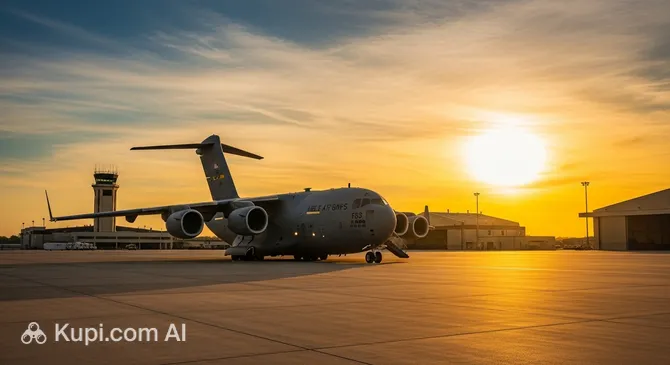
Simmons Army Airfield. Source: Kupi.com Binoculars
IATA Code FBG
ICAO Code KFBG
City Fayetteville
Distance to Centre About 15 km
Status Military Airfield
Annual Passengers Serves exclusively military personnel; data on civilian passenger flow is not applicable.
Popular Airlines Does not serve commercial airlines; used for US Army operations.

The main feature of Simmons Army Airfield lies in its exclusively military designation. It does not receive or dispatch regular commercial flights, so tourists planning to visit Fayetteville should look towards Fayetteville Regional Airport (FAY). Simmons Airfield is equipped to handle heavy military transport aircraft, such as the C-17 Globemaster III and C-130 Hercules, and plays a central role in the deployment of troops and cargo, as well as in conducting exercises for airborne units.

For a traveller, information about this airbase is important primarily to avoid confusing it with a civilian airport. Although it is located in close proximity to the city, its infrastructure and activities are entirely subordinate to military needs. Thus, Simmons is a prime example of a powerful logistical machine supporting the combat readiness of the American army, but it remains a closed facility for civil aviation.

Contact Information

It is important to understand that Simmons Army Airfield (FBG) is an active military airfield of the United States Army, located within the Fort Liberty military base (formerly Fort Bragg) near the city of Fayetteville. It is not a civilian airport and does not serve regular commercial passenger flights. Therefore, standard contact details for tourists are not applicable here. Information is provided in the context of a military facility.

  • Official Website: The airfield does not have a separate public website. Information is generally part of the official portal of the Fort Liberty military base.
  • Inquiry Service Phone: There is no public inquiry service for passengers. For general questions unrelated to flights, one may attempt to contact the Fort Liberty base operator.
  • Airport Address: Simmons Army Airfield, Fort Liberty, Fayetteville, NC, USA. Access to the territory is strictly regulated and permitted only for authorised personnel.
  • Email: There is no public email address for general inquiries. Communication is conducted through official US Department of Defense channels.
  • Social Media: For general unclassified information, one can follow the official accounts of the Fort Liberty military base on social media.
  • Lost Luggage Information: Since the airport does not serve commercial airlines, there is no baggage tracing service for civilian passengers. Military personnel resolve such issues through their units.
  • Passenger Support Contacts: There is no support service for civilian passengers. All matters related to military transport are coordinated through the relevant army transportation offices.

How to Get to the Airfield

Getting to Simmons Army Airfield, located within the Fort Bragg military base, has its own peculiarities, as access to the facility is strictly controlled. When planning a trip, it is important to study the current entry rules for civilians in advance. Below are the main ways to reach the airfield from the city centre of Fayetteville, located in the United States.

Public Transport

There is no direct public transport connection to Simmons Army Airfield. City buses of the FAST (Fayetteville Area System of Transit) system operate within Fayetteville and its surroundings, but their routes do not enter the closed territory of the military base. This option is categorically unsuitable for ordinary travellers, as it does not solve the main task — passing through the security checkpoint.

Taxi and Transfers

Taxis or ride-sharing services (such as Uber or Lyft) are one of the more realistic options. A trip from the centre of Fayetteville to the airfield will take about 15–25 minutes, excluding time for security checks. The estimated cost is $25–40. Key point: not all drivers have permission to enter Fort Bragg territory. It is recommended to book a specialised transfer in advance or arrange with a driver who has a pass. Otherwise, you will only be taken to the Visitor Control Center at the checkpoint.

Car Rental

Renting a car offers the greatest flexibility. You can hire a car both in the city and at the nearby Fayetteville Airport (FAY). To enter the base, you will need to obtain a temporary pass at the Visitor Control Center by presenting a driving licence, vehicle documents (rental agreement), and insurance. Allow extra time for this procedure. This method is ideal if you plan to move around the base territory and beyond.

Parking and Recommendations

Parking spaces at Simmons Army Airfield are intended for military and authorised personnel. There are no familiar public car parks for long-term vehicle storage here, as found at civilian airports. If someone drops you off in a private vehicle, this will be the simplest solution. Given the specific nature of the facility, for most civilian flights, travellers use Fayetteville Airport (FAY) or the larger Raleigh-Durham International Airport (RDU), located 84 km away.

Terminals and Layout

When planning your journey, it is important to consider that Simmons Army Airfield (FBG) is not a commercial passenger airport. It is an active military airbase belonging to the United States Army and primarily serving military needs, specifically units based at Fort Liberty (formerly Fort Bragg) near the city of Fayetteville.

Since this is a restricted access facility, there are no civilian passenger terminals, departure and arrival zones for tourists, or standard check-in and security screening procedures familiar to travellers here. The entire infrastructure of the airfield, including buildings and runways, is designed for carrying out military operations and transporting personnel and cargo.

Tourists planning to visit Fayetteville and its surroundings should look towards Fayetteville Regional Airport (FAY). It is this airport that serves regular commercial flights and provides all necessary services for passengers, including terminals, check-in counters, waiting lounges, and transport connections to the city.

History of the Airfield

The history of Simmons Army Airfield is inextricably linked with US military history and the Fort Bragg base (now Fort Liberty) which it serves. Construction of the airfield in the city of Fayetteville began in 1952, and the official opening took place on June 2, 1954. The airbase was named in honour of Warrant Officer Herbert W. Simmons Jr., a pilot who died in a plane crash in 1942. Initially, the airfield was created to support airborne and special operations based in this region.

Since its opening, Simmons Airfield has played a key role in the deployment of troops and equipment during major military operations. It was a crucial logistical hub during the Vietnam War, ensuring the deployment of units of the famous 82nd Airborne Division. Later, the airfield was used for operations Urgent Fury in Grenada (1983), Just Cause in Panama (1989), as well as "Desert Shield" and "Desert Storm" in the Arabian Gulf (1990–1991).

In the 21st century, especially after the events of September 11, 2001, the role of the airbase as a strategic centre for deploying forces to Iraq and Afghanistan increased significantly. This led to large-scale modernisation programmes: the runway was expanded and strengthened to accommodate heavy transport aircraft such as the C-17 Globemaster III, and taxiways and lighting systems were updated. One of the most important stages was the construction of a new, modern control tower, completed around 2011.

Today, Simmons Army Airfield remains one of the busiest and most significant military airfields in the United States. Its history is a chronicle of the development of the US Army's airborne troops and special forces. The airfield is not just a transport facility, but a symbol of the readiness and mobility of the American armed forces, a starting point for thousands of service members heading on missions around the world.

Services and Facilities

It is important to note that Simmons Army Airfield (FBG) is an active military airfield which is part of the Fort Liberty military base in Fayetteville, USA. It is not a commercial airport and does not serve regular civilian passenger flights. Consequently, standard services designed for tourists are absent from its territory.

As this is a closed military facility, there are no public passenger terminals with restaurants, shops, VIP lounges, or currency exchange points here. Access to the airbase is strictly regulated and permitted mainly for military personnel and individuals holding special permission.

For travellers heading to this region, the main civilian airport is Fayetteville Regional Airport (FAY). It is there that passengers can make use of all necessary amenities, including cafes, car rental, waiting lounges, Wi-Fi, and other standard airport services.

Where to Eat

It is important to consider that Simmons Army Airfield (FBG) is an active military facility serving the needs of the US Army (located within Fort Liberty, formerly Fort Bragg). As such, the infrastructure here differs significantly from civilian commercial airports: there are no familiar tourist terminals with galleries of restaurants and bars. Access to dining facilities is limited and oriented primarily towards service members and authorised personnel.

Nevertheless, for those who have access to the territory, basic catering options characteristic of American military facilities are available:

Dining Facilities (DFAC) and Cafeterias

The main places for meals are military dining halls (DFAC). These are self-service establishments offering a hearty and simple menu.

  • Assortment: Traditional American cuisine. Breakfast usually features omelettes, bacon, and pastries; lunch and dinner offer meat dishes (chicken, beef), side dishes, burgers, and soups.
  • Dietary Options: Most dining halls have salad bars, allowing for a light lunch for vegetarians. Specialised vegan, gluten-free, or strictly Halal dishes are harder to find, so people with strict dietary restrictions are advised to bring food with them.
  • Opening Hours: Strictly regulated (usually breakfast from 06:30 to 09:00, lunch from 11:30 to 13:00, dinner from 17:00 to 18:30); at other times they may be closed.

Quick Snacks

In waiting areas or administrative buildings, one can find vending machines with crisps, chocolate bars, bottled water, and fizzy drinks. Also, small "Express" or "Shoppette" format stores may operate on the base territory, selling ready-made sandwiches, hot dogs, coffee, and snacks. This is the best option for those arriving outside of regular hours.

Prices and Recommendations

The price range on the base territory is low, as food is partially subsidised or oriented towards a soldier's budget. Payment is usually made in cash (US Dollars) or by card.

If you plan to depart or arrive via Simmons Army Airfield and wish to enjoy a full gastronomic experience, it is strongly recommended to eat in the nearby city of Fayetteville. There you can try a local attraction — North Carolina style barbecue (pork slow-cooked in a vinegar-pepper sauce), which is difficult to find in a standard airfield canteen menu. Note: This local specialty contains pork and is not Halal.

Travel Tips

Travelling through Simmons Army Airfield in Fayetteville has its own specifics, as it is an active military facility. Procedures here are stricter than at civilian airports, and passenger comfort often takes a back seat to operational tasks. To ensure your trip goes smoothly, it is important to consider a number of recommendations.

Arrival Time and Access

Unlike ordinary airports, here you need to allow extra time not only for check-in but also for passing through the base security checkpoint. It is recommended to arrive at the airfield at least 3 hours before departure. Note that there may be a queue for vehicle inspection and document checks at the entrance to Fort Liberty (where the base is located).

Check-in and Security

The screening process here is as thorough as in major international hubs.

  • Documents: Keep your identification (military ID or passport) and flight orders ready. Documents may be checked several times.
  • Dress Code: If you are a service member, check the uniform requirements (uniform or civilian) in advance. For civilians, modest, comfortable clothing and shoes that are easy to remove during screening are recommended.

Seat Selection on the Plane

On flights operated from Simmons Airfield (charter or military transport), online seat pre-booking systems are often unavailable. Boarding may be carried out on a "first come, first served" basis or according to rank and priority. If you have the option to choose, try to take aisle seats for more legroom, as cabin configurations may be tighter than on commercial lines.

Hand Luggage: Dos and Don'ts

Rules for carrying liquids and prohibited items (sharp objects, weapons without appropriate documents) here coincide with civil aviation standards.

  • Electronics: Laptops and tablets should be removed from bags during screening.
  • Batteries: Lithium-ion batteries and power banks must be carried only in hand luggage; checking them into the hold is prohibited for fire safety reasons.

Tips for Connecting Passengers

Simmons Army Airfield is usually the end or start point of a route and is not intended for connecting flights in the civilian sense. If, after arriving in Fayetteville, you have a flight scheduled from another airport (for example, Fayetteville civilian airport or Raleigh-Durham), allow at least 4–5 hours for the transfer between airports, as taxis and car-sharing services may have limited access to the base territory.

Customs Control

If you are arriving from abroad, customs procedures take place directly at the airfield or at the first point of entry into the USA. Be prepared to fill out a declaration. The import of fresh fruit, meat, and seeds is strictly prohibited — service dogs on military bases work very efficiently.

Saving Time and Money

Since there are no expensive restaurants or Duty-Free shops on the base, you won't spend much money, but you may face a shortage of goods.

  • Food: Bring an empty water bottle (fill it after security) and snacks (nuts, bars), as opportunities to buy food may be limited by canteen opening hours.
  • Connectivity: Do not rely on public Wi-Fi; it may be absent. Download films, books, and maps to your phone in advance.

What to Do in Case of Flight Delay

Delays at military airfields happen often for technical or operational reasons. There may be few information boards. The main advice is to stay close to terminal representatives or the group leader. Keep a fully charged power bank and a warm jumper with you, as waiting areas (hangars) can be cool, and the wait may drag on.
Reached the end of the page?

That means the route is fully explored