Support

Pioneer Museum--Arizona Historical Society

About

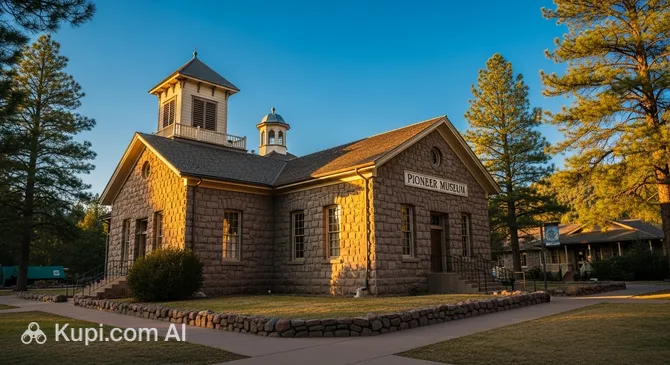
Located in a picturesque part of Flagstaff, Arizona, the Pioneer Museum invites travelers to immerse themselves in the atmosphere of the Wild West and the history of the USA's westward expansion. It is not just an exhibition space, but a unique architectural monument housed in the former Coconino County Hospital, built in 1908 from rugged volcanic rock.
\n\n
Pioneer Museum. Source: Kupi.com AI
\n\n

Managed by the Arizona Historical Society, the museum's mission is to preserve the authentic stories of the people who once came to this high-altitude region. Here, the lives of the early settlers come to life, and Northern Arizona's historical heritage is presented without unnecessary romanticization—honest, deep, and inspiring.

\n\n

The museum's unique character is emphasized by its connection to nature: the building literally "grew" from stone quarried at the base of Mount Elden. Today, the museum serves as an important cultural center where every exhibit tells a story of the challenges, innovations, and daily lives of the pioneers who laid the foundation of modern Flagstaff.

Contacts

To confirm current event information or book a group tour, you can use the official contact details. The museum is managed by the Arizona Historical Society, which carefully preserves the state's heritage.

\n\n\n \n \n \n \n \n \n \n \n \n \n \n \n
Address2340 N Fort Valley Rd, Flagstaff, AZ 86001, USA
Phone+1 928-774-6272
Websitearizonahistoricalsociety.org

What to Do

Inside the museum, an engaging journey awaits you through the Decade Rooms, which vividly show how the daily lives of Flagstaff residents changed over time. The restored operating room and hospital ward are particularly impressive, preserving the atmosphere of early 20th-century medical facilities. Here, you can see rare medical instruments, including a massive iron lung.

\n\n

Tech enthusiasts should definitely stop by the entrance, where guests are greeted by the majestic Baldwin Locomotive No. 12, built in 1929. This locomotive has become a symbol of the region's industrial past, reflecting the era of rapid development in logging and rail transport.

\n\n

In addition to permanent exhibitions, the museum regularly comes to life with themed workshops and festivals. The Flag Wool & Fiber Festival is considered the highlight of the year, where you can learn about traditional crafts. Even if you visit on a regular day, the rich collection of archival photographs and household items of the first settlers will keep you engaged.

Getting There

The museum is located at 2340 North Fort Valley Road, in the northern part of the city, surrounded by scenic high-altitude pines. If you are coming from downtown, head north on Humphreys Street for about 0.6 miles until you reach Fort Valley Road.

\n\n

Driving is the most convenient way to get there, and parking is available on the museum grounds. However, keep in mind that parking spots may be limited during major festivals or peak tourist season, so it is best to arrive early.

\n\n

For those who prefer public transport or a taxi, the ride from the central districts takes very little time. Since the city is quite compact, a taxi from downtown is reasonably priced and allows you to enjoy the surrounding views without being distracted by the road.

History & Facts

The building that houses the exhibition today has a fascinating past. It was erected in 1908 as the Coconino County Hospital for the Indigent. At that time, Flagstaff was actively developing as a logging center and railroad hub, which was accompanied by high industrial injury rates and a need for qualified medical care.

\n\n

The museum's walls are built from unique volcanic rock quarried at the foot of Mount Elden. This gives the structure a rugged and monumental appearance that fits perfectly into the Northern Arizona landscape. In 1938, the building was expanded with new wings, highlighting its growing importance for the region's rapidly increasing population.

\n\n

In 1968, after a modern medical center opened, the old hospital closed and was briefly used as a boarding house. The building found its second life in 1970 when it came under the stewardship of the Arizona Historical Society. Transforming a place of healing into a repository of memory was a logical step for a community striving to preserve its roots.

Time Needed

For a thoughtful tour of the main exhibition and a study of the historical artifacts, most visitors find 1 to 2 hours sufficient. The museum is quite compact, making it easy to include in a busy sightseeing day.

\n\n

If you plan to attend one of the special events, such as the Flag Wool & Fiber Festival, or wish to study the archival photographs and personal stories of the settlers in detail, you should budget a bit more time. Viewing the outdoor area with the historic locomotive will also take an additional 15–20 minutes.

Working Hours

Currently, the Pioneer Museum is listed as temporarily closed. This may be due to restoration work or exhibit updates, so you should plan any upcoming visits with caution.

\n\n

Before visiting, we strongly recommend checking the current schedule on the official website of the Arizona Historical Society or calling them directly. Keep in mind that hours may change depending on the season and special community events.

Nearby

After immersing yourself in pioneer history, you can continue exploring the surrounding area. The district around the museum is rich in historical monuments and scientific centers that help provide a complete picture of the region's development.

\n\n\n \n \n \n \n \n \n \n \n \n \n \n \n \n \n \n \n \n \n \n \n \n \n \n \n \n \n \n \n \n \n \n \n \n \n \n \n \n \n \n \n \n \n \n \n
NameDistance (km)
Historic David Babbitt Home2.5
Lowell Observatory2.6
Weatherford Hotel2.9
Babbitt's Backcountry Outfitters2.9
Masonic-Temple2.9
Flagstaff Ghost Tours & Haunted Pub Crawls3.0
Route 66 Historical Marker5.8
Flagstaff Extreme Adventure Course9.6
Historic fort Tuthill quad9.8

Reached the end of the page?

That means the route is fully explored