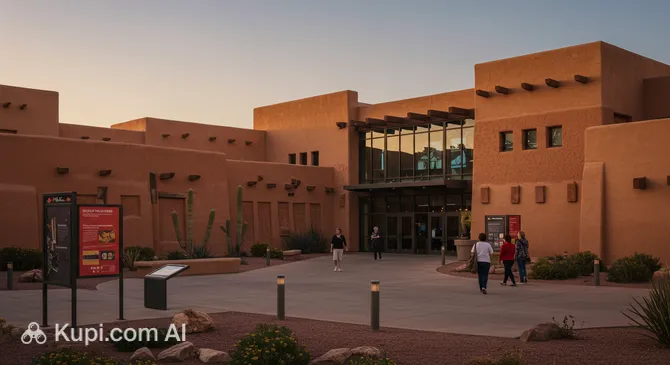
When traveling through Arizona, it’s impossible to miss this remarkable place where time seems to stand still. S’edav Va’aki Museum (formerly known as Pueblo Grande) is a unique archaeological park in Phoenix, recognized as a National Historic Landmark in the USA.
S'edav Va'aki Museum. Illustration.
Source: Kupi.com AI
Traveler photos:
This open-air museum is located directly on the site of an ancient Hohokam settlement that is over 1,500 years old. The main attraction is the preserved "Great House" platform, which is impressive in scale, as well as replicas of traditional dwellings that allow you to see firsthand the daily lives of ancient craftsmen and farmers. The name S'edav Va'aki translates from the indigenous language as "Central House," emphasizing the sacred status of this site.
Here, you can learn about the legacy of "ancient engineers" who managed to turn a harsh desert into a blooming land by creating one of the most complex canal systems in the New World. The museum is a true point of pride for the local community and offers a rare opportunity to touch the history of the Valley of the Sun in its original form.
Contacts
For further details before your visit or to organize group tours, you can contact the administration directly.
The main experience at S’edav Va’aki is the opportunity to walk along an authentic trail leading to the top of an ancient platform mound. From this height, you get an excellent view of the ruins of living quarters where life once thrived. You can see a ball court and look into full-size reconstructions of adobe houses built using traditional clay and stone technologies.
Inside the museum building itself, interactive exhibits await visitors. Artifacts found during excavations are on display here: pottery, tools, and jewelry belonging to the ancient inhabitants. Special attention is paid to the connection between eras — modern O'odham communities actively participate in creating the displays, sharing their oral traditions and cultural experiences.
For families with children, the walk turns into a real adventure: videos and visual models help explain how the complex irrigation system worked. This place is perfect for those who don't just want to look at exhibits behind glass, but want to literally walk through the pages of history under the Arizona sky.
Getting There
Getting to this unique historical park is easy, as it is located just a few minutes' drive from downtown and Sky Harbor International Airport. If you prefer to drive, follow Washington St — there is convenient visitor parking available on the grounds of the archaeological park.
For those using public transportation, buses from the Phoenix Valley Metro network (routes No. 13 and No. 29) stop within walking distance. You can also quickly reach the site by taxi or by using Uber and Lyft services; the trip from the center takes about 10–15 minutes.
Active travelers can reach the museum by bicycle — there are convenient bike paths from the central districts, and the entire journey will take no more than half an hour. However, be sure to check the museum's operational status before your trip, as it may currently be temporarily closed.
Nearest city: Phoenix
History & Facts
The history of this site began about 1,500 years ago when members of the Hohokam culture settled here. These ancient inhabitants were the master engineers and farmers of their time: they created one of the largest and most complex irrigation canal systems in pre-Columbian America within the Sonoran Desert.
The settlement's centerpiece is the "Great House" — a massive platform about the size of a football field that once held residential and public spaces. Archaeologists have determined that this structure once reached three stories in height. Remarkably, many structures have been preserved in almost their original state, allowing us to see the original masonry made of local stone and adobe today.
Interestingly, a significant portion of the artifacts was discovered by chance in the mid-20th century during an airport expansion. In 2023, the museum received its current name, S’edav Va’aki, which means "Central House" in the O'odham language. This renaming highlighted the site's deep connection to the living traditions of Arizona's indigenous peoples.
Time Needed
To see all the exhibits and walk through the outdoor grounds without rushing, we recommend allowing 2 to 3 hours for your visit. This is plenty of time to explore the indoor galleries featuring artifacts and walk the archaeological trails.
If you are planning a visit with children or want to study the replicas of ancient dwellings and the ball court in detail, your visit may last up to 4 hours. A walk through the park grounds is especially pleasant in the morning hours when the sun is not yet too hot.
Working Hours
Currently, the museum has the status of being temporarily closed (CLOSED_TEMPORARILY). During normal times, the complex's doors are open to visitors throughout the day; however, the schedule may vary depending on the season or the holding of indigenous cultural events.
We strongly recommend checking for up-to-date information on the City of Phoenix official website or calling the contact number before planning your trip to ensure that access to the archaeological park is open.
Nearby
Exploring the area around the archaeological park will allow you to get an even better feel for the Arizona atmosphere and diversify your leisure time. Within a radius of a few kilometers, you'll find excellent places for family vacations, water parks, and entertainment centers.