Support

The Fort Museum and Frontier Village

About

Imagine the opportunity to take a journey back in time and find yourself in the heart of the Wild West in the mid-19th century. The Fort Museum and Frontier Village is a unique non-profit historical site located in the city of Fort Dodge, USA. It is a detailed reconstruction of an 1850 military post and its adjacent settlement, allowing guests to see firsthand how life was built on the edge of civilization.
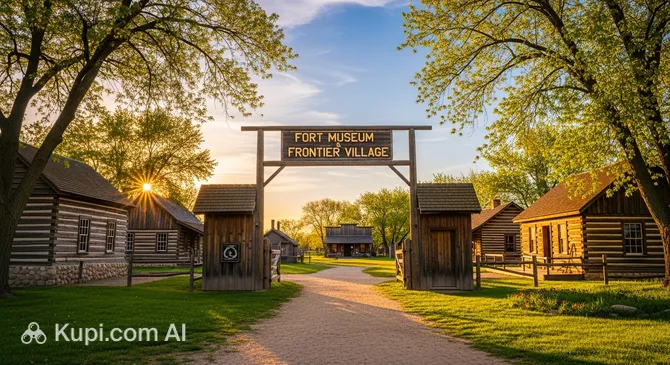
The Fort Museum and Frontier Village. Source: Kupi.com AI

Approximately 18 authentic and restored buildings are gathered across the extensive grounds of this open-air museum. Here you will find not only the rugged walls of the stockaded fort but also a cozy schoolhouse, an old church, a blacksmith shop, and even a jail. The museum's collection is impressive in its diversity: from military relics and Native American artifacts to rare furniture of that era. This place is rightfully considered a living monument to the region's pioneers.

One of the most curious and unusual displays in the complex is the story of the "Cardiff Giant." This famous 19th-century hoax is closely linked to local gypsum mined near the city. Visiting the museum is a great way to combine an educational walk with a fascinating immersion into the history of Iowa, making it a popular destination for family vacations.

Contacts

To help plan your visit to The Fort Museum and Frontier Village, it’s useful to have current contact information on hand. You can check the schedule in advance or book a group tour by phone or through the organization's official website.

Below is the primary contact information for reaching the complex administration:

Address 1 Museum Rd, Fort Dodge, IA 50501, USA
Phone +1 515-573-4231
Website https://www.fortmuseumfv.com/

What to Do

The main activity at the museum is the leisurely exploration of 18 historical buildings, each filled with the spirit of the past. You can peek into an 1850s log home, sit at the desks in the old schoolhouse, or imagine yourself as a resident of a frontier town by visiting the general store, drug store, or print shop. The workshops—pottery, cabinetry, and blacksmithing—evoke a special sense of wonder, as if the craftsmen have just stepped away from their tools.

Be sure to find time to examine the artifact collection. It features not only items from the Civil War era but also prehistoric finds and a rich exhibition dedicated to Native American culture. Fans of curiosities should visit the exhibit dedicated to the Cardiff Giant—one of the most grand and amusing hoaxes in American history, carved from local gypsum.

For those who want to learn as much detail as possible, guided tours are available and should be booked in advance (at least two weeks). In the summer, interactive events often take place on the grounds, bringing frontier life to life. Don't forget your camera: the authentic interiors and the main street of the pioneer settlement serve as a magnificent backdrop for atmospheric photos.

Getting There

The Fort Museum and Frontier Village is located at 1 Museum Rd, on the scenic southwestern edge of the city, near the confluence of the Des Moines River and Lizard Creek. For travelers by car, it is most convenient to reach the site via US-20 or I-35; the drive from the central part of the city takes no more than 10–15 minutes. Free parking is provided for visitors on-site.

If you plan to use public transport, keep in mind that the nearest regional airport (FOD) is approximately 15–20 kilometers from the museum. From there, as well as from the city center, it is easiest to get there by taxi or by using the Uber service. Greyhound intercity buses also make a stop in the city, after which a short taxi ride (about 10 minutes) will be required.

A walk from the center to the museum is about 4–5 kilometers, which can be tiring, so it is recommended to use a private vehicle or a taxi for the most comfortable visit to the attraction.

History & Facts

The history of this location dates back to 1835, when a group of dragoons under the command of Lieutenant Colonel Stephen Kearny explored the banks of the Des Moines River. They were the first to note the strategic importance of the territory near Lizard Creek. However, the military fortification itself, originally named Fort Clarke, was not erected until 1850 by Major Lewis Armistead. The post was later renamed in honor of Senator Henry Dodge, giving rise to the name Fort Dodge.

Interestingly, life at the fort was devoid of major battles. The garrison, consisting of 3 officers and 75 soldiers, was mainly engaged in patrolling the territories, hunting, and dealing with desertion—many soldiers at that time abandoned their service, succumbing to the temptation of heading to the California gold fields. In 1853, the fort was decommissioned, and its buildings were purchased by William Williams, who laid the foundation for the future city.

The modern museum complex is a meticulous reconstruction of that 1850 fort. It has successfully preserved and restored unique structures, including an original mid-19th-century log cabin. Particular attention should be paid to the cabin dedicated to Armistead, who served here as a quartermaster long before becoming a well-known general during the Civil War era.

Time Needed

To fully enjoy the atmosphere of the old frontier and view all the exhibits, a typical visitor needs about 1.5 to 2 hours. If you prefer to carefully examine every artifact and read the descriptions in each of the 18 buildings, set aside a bit more time for your visit.

For those who decide to book a full guided tour, the visit may extend to 3 hours. Such a pastime allows you to not just see the ancient walls, but also hear fascinating stories about the pioneers' daily lives, making the experience much more immersive and educational.

Working Hours

Currently, the museum is open to the public according to the following schedule: Friday and Saturday from 10:00 AM to 5:00 PM, and on Sunday the doors are open from 11:00 AM to 4:00 PM. On weekdays (Monday through Thursday), the attraction is usually closed to the general public.

It is important to keep in mind that during the winter period and the off-season, the schedule may change significantly. Before your trip, we strongly recommend checking for current information on the official website or calling by phone, as the site may be temporarily closed for maintenance or a seasonal break.

Nearby

Exploring the surroundings after visiting the museum will allow you to delve deeper into the region's atmosphere and spend a pleasant evening. Near the historical complex, you'll find both cultural landmarks and popular spots for relaxation where you can discuss what you've seen over a cup of coffee or lunch.

Below is a list of interesting sites located in the immediate vicinity of the museum:

Attraction Name Distance (km)
Old Arnold House Historical Marker 0.1
Fourth Street Depot 1.6
ShinyTop Brewing 2
Main Street Fort Dodge 2.3
Brass Monkey 2.3
Sneakers Eatery and Pub 2.5
Bootleggers 2.6
Applebee's Grill + Bar 3.6
Buffalo Wild Wings 3.7
Rides Bar & Grill 4.1

Reached the end of the page?

That means the route is fully explored