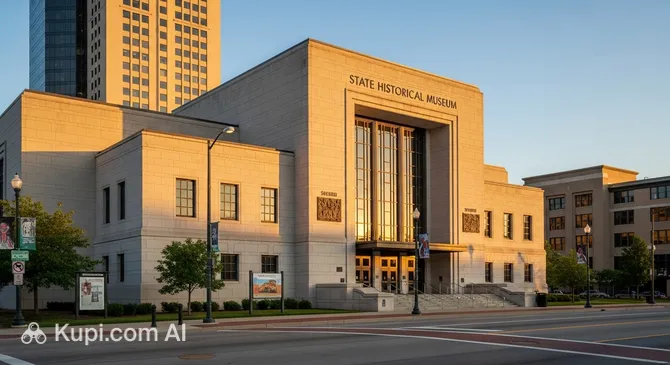
To truly understand the heart of the Midwest, a visit to Des Moines, home to the State Historical Museum of Iowa, is a must. This central cultural institution serves as the primary guardian of the region's rich heritage. In the USA, such museums play a crucial role in preserving national identity.
State Historical Museum. Illustration.
Source: Kupi.com AI
Traveler photos:
The museum is housed in the majestic State Historical Building—a significant architectural landmark located in the heart of the capital. The building draws attention with its scale and serves as a major attraction for tourists wishing to learn about the history and culture of this land.
For visitors, this place opens the doors to a world of amazing discoveries: from ancient artifacts to modern exhibitions. As one of the state's main cultural centers, the museum offers a deep look at the events and figures that shaped modern Iowa.
Contacts
For your convenience, we have gathered up-to-date information to help you quickly contact the administration or find your way to the museum. Official representatives are always ready to provide details about exhibitions or assist with booking tours for large groups. Below is a table with the key details for planning your visit.
Museum guests are invited to take a fascinating journey through time, exploring extensive collections dedicated to the region's development from ancient times to the present day. Here, you can see unique artifacts, original documents, and everyday items that literally bring the pages of history books to life. Interactive exhibits make the learning process easy and engaging, which is especially appreciated during family visits.
Special attention is given to the state's role in the development of agriculture and industry. Visitors can explore displays telling Iowa's contribution to American culture and get acquainted with archival materials reflecting key moments in the region's life. Detail lovers will appreciate the chance to closely examine rare exhibits not found in other collections.
Additionally, educational programs and themed tours are regularly held here, allowing for a deeper immersion into the context of the objects on display. You can not only observe but also interact with many exhibition elements, turning a simple museum visit into a full cultural adventure.
Getting There
Finding your way to the museum is easy, as it is located in the heart of the city at 600 E Locust St. For those traveling by private or rental car, convenient parking is available near the building. The museum is located in an area with well-developed road infrastructure, making it easily accessible from any part of the city.
If you prefer public transportation, the museum is within walking distance of central transit hubs. Main bus routes pass nearby, and a walk from the main streets of downtown takes only 10–15 minutes. You can also always use taxis or popular ride-sharing services to reach the entrance with maximum comfort.
Nearest city: Des Moines
History & Facts
Conceived as the main bastion for preserving the region's cultural heritage, this complex became the embodiment of the state's educational mission. The decision to create it was driven by the need to consolidate scattered archival data and unique artifacts under one roof, so that future generations could know their roots. Over time, the building has become an integral part of Iowa residents' identity.
Notably, the State Historical Building occupies a strategic position in the city's historic center, serving as an architectural bridge between the past and the future. Its monumental walls hold not only everyday objects but also invaluable documents that played an important role in shaping American culture in the Midwest. Each stage of the collection's expansion reflected the growing public interest in their origins.
Today, this center is a key element of the capital's cultural landscape. The museum doesn't just store memories; it actively popularizes the state's history through modern exhibition projects. For researchers and tourists, this place serves as an indispensable source of information on how the region has evolved and changed over centuries.
Time Needed
To explore all the exhibitions at a relaxed pace and immerse yourself in the atmosphere of the past, we recommend setting aside 2–3 hours for your visit. This is quite enough time to tour the main halls, review archival documents, and participate in interactive programs.
If you are short on time, you can focus on the main exhibitions, which will take about an hour and a half. However, given the richness of the collection and the detail of many exhibits, it is worth leaving a little extra time to finish your walk without rushing and catch all the interesting corners of the building.
Working Hours
The museum typically welcomes visitors Tuesday through Friday from 09:00 to 16:30. On Saturdays, the hours are slightly shorter—doors are open from 09:00 to 15:00. Please note that the institution is closed on Mondays and Sundays.
Since the schedule may change due to public holidays or special events, we strongly recommend checking the current working hours on the official website before planning your trip. This will help avoid any inconveniences and make your visit as productive as possible.
Day
Working hours
Monday
Закрыто
Tuesday
09:00–16:30
Wednesday
09:00–16:30
Thursday
09:00–16:30
Friday
09:00–16:30
Saturday
09:00–15:00
Sunday
Закрыто
Nearby
Exploring the surroundings after visiting the museum will allow you to feel the state's atmosphere more deeply and see the capital's iconic monuments. The area around the museum is filled with interesting sites, most of which are within a pleasant walking distance.
You will see majestic government buildings and memorials that complete the region's historical picture. Below is a list of nearby attractions worth visiting: