Support

Fort Polk (Polk AAF)

About the Airport

Fort Polk Airport, known as Polk Army Airfield (Polk AAF), is not the kind of air hub where tourists look for their boarding gate with souvenirs in hand. It is a strategically important military airfield serving as the air gateway for one of the largest training bases of the USA Army — Fort Polk. Its primary mission is to ensure mobility and logistics for the Joint Readiness Training Center (JRTC), receiving and deploying military personnel and cargo. For thousands of soldiers undergoing training here, this airfield serves as the main point of arrival and departure.

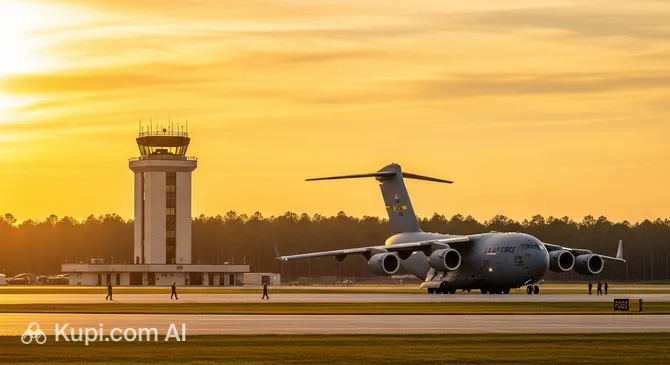
Fort Polk (Polk AAF). Source: Kupi.com Binoculars
IATA Code POE
ICAO Code KPOE
City Fort Polk South
Distance to Center ~2 km (located within the military base)
Status Military
Passengers per Year Data not published (military facility)
Popular Airlines US Military transport aviation, charter carriers (e.g., Atlas Air, Omni Air International)

The key feature of the Fort Polk airfield is its narrow specialization. The runway and infrastructure are designed to accommodate heavy military transport aircraft, such as the C-17 Globemaster III and C-5 Galaxy, which are rarely seen at civil airports. The entire operation of the airport is subordinate to the training schedule and operational needs of the army.

For ordinary travellers, it is important to know that Fort Polk Airport does not serve scheduled commercial flights. If your goal is to visit this region of Louisiana, you should focus on the nearest civil airports. These include Alexandria International Airport (AEX), located approximately 80 km away, or Lake Charles Regional Airport (LCH), located at a distance of about 90 km.

Contact Information

It is important to understand that Polk Army Airfield is a military facility, not a civil commercial airport. Therefore, most standard public contacts for passengers, such as commercial information desks or customer support, are absent here. Information is provided in a limited capacity and primarily through official US Army channels.

  • Official Website: The airfield does not have a separate website. All official information is published on the website of the Fort Polk military base (Joint Readiness Training Center and Fort Polk).
  • Information Desk Phone: There is no direct telephone line for passengers. You can use the Fort Polk switchboard number to contact the base, but it is not intended for resolving civil aviation queries.
  • Airport Address: The airfield is located within the Fort Polk military base, Louisiana, USA. Access to the territory is strictly limited.
  • Email: There is no public email address for general inquiries.
  • Social Media: Official social media pages, if maintained, relate to the entire Fort Polk military base rather than specifically to the airfield.
  • Lost Luggage Information: Issues related to luggage are resolved exclusively through internal military channels and protocols. There is no public lost and found service.
  • Passenger Support Contacts: Passenger support (typically for military personnel and staff) is carried out through their command or the relevant transport departments of the US Armed Forces.

How to Get to the Airport

When planning a trip to Fort Polk South, it is important to realize that the local Polk Army Airfield (POE) is a military base of the USA Army and does not serve commercial passenger flights. Most travellers fly into one of the major regional airports and then use ground transport for the final leg of the journey. The main gateways are Lake Charles Airport (LCH), located approximately 100 km away, and Shreveport Airport (SHV), located at a distance of about 170 km.

Car Rental. This is the most convenient and recommended way to get to Fort Polk and travel around its vicinity. You can rent a car directly at the arrival airport, for example at Lafayette Airport or Lake Charles. A car trip will give you maximum freedom of movement. Please note that entering the Fort Polk military base territory may require special documents and a pass, which must be arranged in advance. The travel time from the nearest city, Leesville, to the central part of the base is about 15-20 minutes.

Taxi and Transfer. A taxi or pre-booked transfer is another option. The cost of a trip from regional airports will be quite high due to the long distance. For instance, a trip from Lake Charles Airport may cost 100-150 US dollars or more. It is important to check with the taxi service in advance if the driver has permission to enter the military base, or arrange to meet at the main control point (Gate).

Public Transport. There is no direct public transport connection (buses, trains) to the Fort Polk military base. This is typical for military facilities in the USA. You can take an intercity bus to the nearest city, Leesville, but from there you will still need to take a taxi or ask to be picked up by a private car.

Parking. Parking on the territory of the Fort Polk military base and airfield strictly regulated. Special guest parking spaces are usually provided for visitors. It is recommended to clarify parking rules with the host party or at the base visitor centre when issuing a pass. Do not leave your vehicle in unauthorized places, as it may be towed.

Terminals and Map

It is crucial to understand that Fort Polk (Polk Army Airfield, POE) is primarily an active military airbase, not a commercial airport for civil transport. It serves the needs of the US Army associated with the Fort Polk base and does not accept scheduled passenger flights for the general public. Therefore, the infrastructure familiar to tourists, such as civil terminals, is absent here.

Instead of passenger terminals, the airfield territory houses functional buildings designed for military needs: hangars for equipment, administrative blocks, and structures for receiving and dispatching military personnel and cargo. Access to the territory is strictly limited and permitted only to authorized persons. Consequently, there are no duty-free zones, restaurants, or waiting lounges for civil passengers here.

Check-in and security control procedures are conducted in accordance with military protocols and do not resemble those in civil airports. All arrival and departure operations are coordinated by military authorities. Concepts of "departure and arrival zones" in the tourist sense do not exist here, as all movements are related to the execution of official tasks.

For travellers planning a trip to this region of Louisiana, the nearest major civil airport is Alexandria International Airport (AEX), located about an hour's drive from Fort Polk South. It is this airport that should be considered when planning a flight to this part of the USA.

Airport History

The history of Fort Polk Airport (Polk AAF), located in the city of Fort Polk South, is inextricably linked with the military base of the same name. The airfield was founded in 1941 alongside the creation of Camp Polk, which served as one of the main centres for training American troops for World War II. From the very beginning, its main task was to support large-scale military exercises, including the famous Louisiana Maneuvers, which became a dress rehearsal for many army units before deployment to the front.

A new significant stage in the development of the airfield began in the 1960s during the Vietnam War. Fort Polk was transformed into a major infantry training centre, and the airfield became a key transport hub for the deployment of thousands of soldiers. It was from here that recruits were sent to the "Tigerland" training complex for intensive preparation simulating jungle conditions, after which they were deployed to Southeast Asia. During this period, the airfield operated at maximum capacity.

Since 1993, Fort Polk has been the home of the Joint Readiness Training Center (JRTC). In this regard, the airfield has gone through several stages of modernization to meet the requirements of modern military logistics. Its runways were adapted to accommodate heavy transport aircraft, such as the C-17 Globemaster III. Today, Polk AAF continues to fulfil its main mission — ensuring the rotation of troops and equipment for conducting realistic tactical exercises.

Unlike civil airports, the achievements of Polk AAF are measured not by passenger traffic, but by the number of successfully conducted military operations and trained soldiers. An interesting fact: the airfield has practically never been used for scheduled commercial flights, remaining a strategically important military facility throughout its history. Its work is completely subordinate to the needs of the US Army, making it unique in the region's transport system.

Services and Facilities

When planning a trip through Polk Army Airfield (POE), it is important to consider that this is an active military facility. The range of services here is oriented primarily towards the needs of military personnel and their families, so it differs from the services offered at major civil airports.

Dining and shopping opportunities on the airfield territory are generally limited. Passengers can expect the presence of a small cafeteria or buffet serving basic meals and snacks, as well as vending machines with drinks and snacks. There are no large restaurants or duty-free shops here.

Basic amenities are provided in the terminal for comfortable waiting. Free Wi-Fi is usually available, as well as stations for charging electronic devices. Specialized VIP halls or business lounges for civil passengers are absent, although there are general waiting areas.

Financial services at the airfield are present in minimal volume. Currency exchange points are not provided here, but an ATM for cash withdrawal may be installed. In case first aid is needed, a medical point operates on the territory.

For passengers travelling with children, basic amenities such as changing tables in restrooms may be available. The airfield is also equipped for the needs of passengers with disabilities in accordance with accessibility standards, including ramps and specially equipped restrooms.

There are no hotels directly in the terminal building. The nearest accommodation options can be found on the territory of the military base (appropriate permission required) or in neighbouring towns, for example, in Leesville. Conference room rental services or business centres for the general public are not provided at the airfield.

Where to Eat

When planning a trip through Fort Polk Airport (Polk AAF), it is important to understand that this is primarily a military airfield, not a large commercial airport. Consequently, the choice of dining establishments directly on its territory is extremely limited and not comparable to what civil aviation hubs offer.

The airfield buildings lack the restaurants, cafes, or lounges familiar to travellers. Snacking options are typically limited to vending machines with drinks and packaged snacks. Specialized dietary options (vegetarian, Halal, gluten-free, etc.) are practically impossible to find here. All facilities on the territory are intended mainly for serving military personnel.

Travellers are strongly advised to eat in advance, before arriving at the airfield. The nearest full-service cafes and restaurants offering a variety of dishes, including local Louisiana cuisine, are located outside the base in nearby settlements such as Leesville. Plan your time considering the need to find food outside the Fort Polk territory.

Travel Tips

Travelling through Fort Polk Airport (Polk AAF) in Louisiana requires some preparation to ensure your flight goes as smoothly as possible. Since this is a small airfield, processes here may differ from major international hubs, but the basic US aviation security rules remain unchanged. We have gathered key recommendations to help you avoid stress before departure.

Arrival Time and Check-in. We recommend arriving at the airport at least 1.5–2 hours before the departure time indicated on your ticket. Even with low passenger traffic, document checks and security screening procedures can take time. Keep your passport and boarding pass handy (in paper or electronic form). Please note that strict identity verification standards apply in the USA, so ensure your documents meet TSA (Transportation Security Administration) requirements.

Security Screening. To speed up the security check process, remove your outerwear, belt, and shoes in advance if required by staff. Electronics larger than a smartphone (laptops, tablets) should be taken out of bags and placed in a separate tray. Remember that metal objects, coins, and keys are best put in your carry-on luggage before passing through the metal detector frame.

Carry-on Luggage. Pay close attention to the contents of your bag. Liquids, gels, and aerosols can only be transported in containers with a volume of no more than 100 ml (3.4 oz), and they must all be packed in one transparent plastic bag with a zip lock. Sharp objects, piercing tools, and sports equipment should be checked in. Medicines and baby food are allowed in reasonable quantities, but it is worth notifying the security officer about them.

Seat Selection. If you appreciate views during takeoff and landing, choose a window seat — the landscapes of Louisiana can be quite picturesque. For those who prefer more legroom or plan to get up often during the flight, an aisle seat is more suitable. It is better to book specific seats online in advance, as the choice may be limited at check-in.

Tips for Transit Passengers. If Fort Polk is only the starting point of your route and you have a transfer in a major hub, ensure the connection time is at least 2–3 hours. This will give you a time buffer in case of a delay of the first flight or the need to change terminals in a large airport. Check if your luggage is checked through to the final destination so you do not have to collect it at the intermediate airport.

Customs Control. Customs control is not required for domestic flights within the USA. However, if you are flying abroad with a transfer, the main customs procedures will take place at the airport of departure from the country or at the point of first landing upon return to the USA. Always declare cash amounts exceeding 10,000 dollars and food products if required by the rules.

Economy and Comfort. To avoid overpaying at the airport, bring an empty reusable water bottle with you — you can fill it for free at drinking fountains after passing security. It is also wise to bring a light snack (nuts, bars), as the choice of food in small terminals may be limited (and Halal options scarce). Download movies or music to your phone in advance so as not to depend on Wi-Fi availability.

In Case of Flight Delay. Remain calm and follow updates on information boards or in the airline's mobile app. If the delay is lengthy, contact a representative of the carrier to clarify information about meals or alternative flight options. Always have a phone charger with you to stay connected.
Reached the end of the page?

That means the route is fully explored