Support

Tyler Pounds Regional Airport

About the Airport

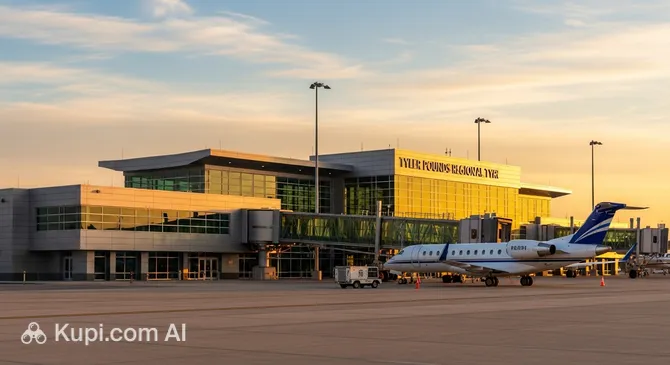
Tyler Pounds Regional Airport. Source: Kupi.com Binoculars

Tyler Pounds Regional Airport is not merely a transport hub, but a cozy aerial gateway to the famous "Rose Capital of America." Here, in the heart of East Texas, your journey begins without the hustle and endless queues typical of metropolises, offering passengers an atmosphere of tranquility and genuine Southern hospitality. It is the perfect launchpad for those who value their time and wish to start their trip in comfort, enjoying views of the picturesque surroundings even before takeoff.

IATA Code TYR
ICAO Code KTYR
City Tyler
Distance to center ~10 km
Status Regional
Annual Passengers Over 100,000
Schedule

Airport Features and Benefits

The main pride of Tyler Pounds is its combination of rich history and modern functionality. One of the unique features of the airport is the Historic Aviation Memorial Museum located on its grounds. Passengers with a little free time before their flight can immerse themselves in the past by exploring military and civil aviation exhibits, turning a standard wait into an educational excursion.

A key advantage for travelers remains the incredible compactness and speed of service. Thanks to the small size of the terminal, the journey from the parking lot to the boarding gate takes just a few minutes. Security screening procedures here are quick and efficient, eliminating stress, while the friendly staff creates an almost home-like atmosphere rarely found in large international hubs.

Contact Information

For the most up-to-date information on the operation of Tyler Pounds Regional Airport (TYR), please use the following contact details:

  • Official Website: www.flytyler.com
  • Information Desk Phone: +1 (903) 531-2343
  • Airport Address: 700 Skyway Blvd, Tyler, TX 75704, USA
  • Email: To contact the airport administration, it is recommended to use the contact form on the official website.
  • Social Media: You can follow updates on the airport's official Facebook page.
  • Lost and Found: If items were lost within the terminal building, please contact the administration via the main phone number. For luggage left on board the aircraft, you must contact your airline's representative directly.
  • Passenger Support Contacts: For general questions about airport operations, call the information desk. For issues related to booking, flight check-in, or special assistance, please contact your airline.

How to Get to the Airport

Getting to Tyler Pounds Regional Airport (TYR) from Tyler, a city in the USA, is straightforward. The most convenient and popular method is by taxi or ridesharing services such as Uber and Lyft. The trip from the city center to the terminal usually takes about 15–20 minutes, making this the fastest option. This is especially convenient for travelers with luggage or those who value comfort and predictability. The cost of the trip is quite affordable, although it may vary depending on the time of day and demand.

For a more budget-friendly journey, you can consider public transport. The Tyler Transit city bus network serves the city, however, direct routes to the airport may be limited or require transfers. Before traveling, we strongly recommend checking the current schedule and route map on the carrier's official website to plan your time accurately. This option is the most economical but may prove to be the least convenient.

If you are traveling in your own or a rented vehicle, the road to the airport is well-organized. This option provides maximum flexibility, especially if you plan to travel around East Texas. Representatives of major car rental agencies operate at Tyler Pounds Airport, where you can return the car right before departure. For those arriving in a personal vehicle, both short-term and long-term parking are available with different rates depending on the duration of the stay.

Terminals and Map

Tyler Pounds Regional Airport (TYR) is a compact regional airport characterized by a simple and clear structure. Its main advantage for travelers is having one passenger terminal that serves both departing and arriving flights. Such an organization makes navigation intuitively understandable and eliminates the need to move between different buildings.

The terminal layout is very simple. Upon entering the building, you immediately find yourself in the general area where airline check-in counters and baggage drop-off points are located. After checking in, passengers proceed to the single security screening point. Since the airport is small, all service areas are within walking distance of each other, and getting lost here is practically impossible.

Departure and arrival zones are clearly separated but located in the same building. After passing security control, passengers enter the secure area — a small waiting hall with boarding gates. The arrival zone is located in another part of the terminal and includes the baggage claim belt. Next to the baggage claim area, you will usually find car rental counters and the exit to the parking lot and taxis.

One of the main virtues of Tyler Pounds Airport is the speed of completing all formalities. Check-in and screening procedures generally take significantly less time than in major international hubs. Nevertheless, it is recommended to arrive at the airport approximately 90 minutes before a domestic flight departure to check luggage and pass through control without rushing.

To navigate the terminal, simply follow the signs — they are simple and clear. Thanks to the compact size and linear layout, the path from the airport entrance to the boarding gate takes just a few minutes. Transfers between terminals are not required, making travel through TYR maximally comfortable and fast.

Airport History

The history of Tyler Pounds Regional Airport (TYR) begins in 1930, when it was opened under the name Pounds Field. It received its name in honor of one of the pioneers of local aviation, Jack Pounds. Initially, the airfield served as a base for private planes and quickly turned into an important center for pilot enthusiasts in East Texas.

A significant turn in the airport's history occurred during World War II. It was transferred to the jurisdiction of the US Air Force and used as a training base for glider pilots. After the war ended, the airfield returned to civil use, and soon the first commercial passenger flights began operating here, marking a new era in its development and laying the foundation for future growth.

Over the following decades, the airport was repeatedly expanded and modernized. A key stage was the construction of a new, modern passenger terminal, which was completed in 2002. This large-scale reconstruction, along with the lengthening of runways to accommodate jet aircraft, significantly increased passenger comfort and the capacity of the air harbor.

Today, Tyler Pounds Regional Airport is an important transport hub playing a key role in the economic life of the city of Tyler and the entire region. It ensures convenient air connections with major hubs, such as Dallas/Fort Worth, and proudly continues its long history, serving as a gateway to the sky for residents and guests of East Texas.

Services and Amenities

Tyler Pounds Regional Airport (TYR) offers passengers all necessary amenities for a comfortable wait for their flight. Despite its compact size, the terminal is designed so that your stay here is pleasant and convenient. For travelers, The Skyline Cafe is available, where you can have a full lunch or drink coffee with a view of the runway, as well as purchase snacks and drinks for the road. In small shops, you can find press and souvenirs.

Free Wi-Fi is available throughout the terminal, allowing you to stay connected or work while waiting for departure. Special stations are provided for charging electronic devices. Although there are no specialized VIP lounges in the airport, the general waiting areas are quite comfortable. ATMs are installed for financial transactions. Currency exchange services are usually not provided, so it is recommended to take care of this in advance.

The airport is equipped for the needs of passengers with special requirements: there are ramps, accessible restrooms, and staff assistance provided during boarding and disembarking. Families with children can use mother-and-child rooms for changing and feeding. In case first aid is needed, you should contact any airport employee who will call the appropriate services.

There are no hotels directly in the airport building, however, in the immediate vicinity, a few minutes' drive away, there are many hotels to suit any taste and budget. Specialized conference rooms are also not provided in the terminal, but the presence of Wi-Fi and comfortable waiting zones allows for addressing work issues remotely.

Where to Eat

Tyler Pounds Regional Airport (TYR) is a small regional air station, so the choice of dining establishments here is quite compact. The main options for a snack or a full meal are concentrated in one place, which is convenient for passengers waiting for their flight.

In the main part of the terminal, typically after passing security control (airside), you will find the airport's main establishment — the restaurant and bar, The Skyline Cafe. Here, travelers can find a menu focused on classic American cuisine. It is an excellent place for both a quick snack and a heartier lunch. The assortment usually includes sandwiches, burgers, salads, and various snacks. Sometimes you can find dishes with local flavor, for example, something in the style of Texas barbecue.

For those in a hurry, ready-made snacks, pastries, and, of course, coffee are offered. If you have time, you can order a full hot meal. Prices are in the average range for US airports — slightly higher than in the city, but quite acceptable. The restaurant's operating hours are usually tied to the flight schedule; it opens early in the morning and serves passengers until the last departure.

Regarding special dietary needs, choices may be limited. Vegetarians will likely find a salad or vegetable snack on the menu. However, for vegans, as well as for people requiring gluten-free or Halal dishes, specialized options are generally not available. In such cases, it is recommended to bring a suitable snack with you to avoid inconvenience.

Travel Tips

To ensure your journey through Tyler Pounds Regional Airport goes as smoothly and comfortably as possible, take advantage of our tips. Planning ahead will help avoid stress and save time, allowing you to enjoy the anticipation of your trip across the USA or beyond.

For domestic flights, it is recommended to arrive at the airport at least 90 minutes before departure. Although regional airports are generally less busy, extra time will be your insurance against unforeseen queues at check-in or security. To save time, complete online check-in for your flight in advance and save the boarding pass on your phone or print it out.

When passing through security control, be ready to present your ID and boarding pass. In carry-on luggage, all liquids must be in containers of no more than 100 ml and packed in a single transparent bag (the 3-1-1 rule). Laptops and other large electronics will likely need to be placed in a separate bin. Remember that carrying sharp objects, flammable substances, and weapons in carry-on luggage is strictly prohibited. When choosing a seat on the plane, consider your preferences: a window seat offers beautiful views, while an aisle seat offers more legroom and the ability to stand up without disturbing neighbors.

Since the airport in Tyler mainly serves domestic flights, most passengers make connections in larger hubs. Ensure you have enough time between flights (at least 1-1.5 hours). There is no customs control for domestic flights. If you are arriving from abroad, you will pass customs and immigration formalities at the first airport of arrival in the US.

To save money, book tickets and airport parking in advance. Bring an empty water bottle with you to fill it after passing security, so you don't overpay for drinks. Light snacks that are not liquids or gels are also permitted to be brought on board.

In case of a flight delay, first contact your airline representative for information on the new departure time and possible options. Keep an eye on updates on the display boards and in the airline's app. Carry a portable charger for your gadgets and something to help pass the time — a book or downloaded movies, as leisure opportunities in a small airport may be limited.

Reached the end of the page?

That means the route is fully explored