Support

Austin (Austin Executive)

About the Airport

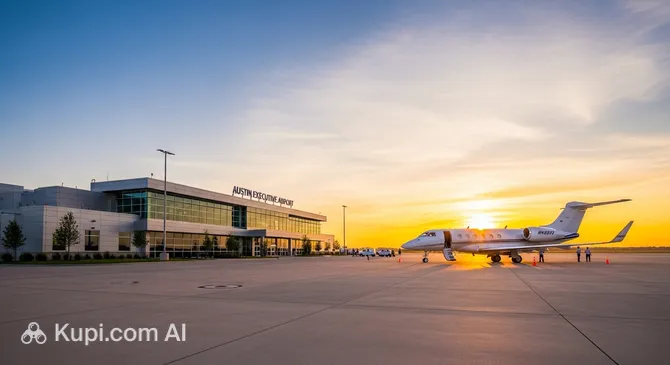
Austin Executive Airport. Source: Kupi.com Binoculars

Austin Executive Airport is an elite aviation hub designed specifically for business aviation and private pilots who value exceptional comfort and privacy. Unlike noisy international hubs, an atmosphere of tranquillity and premium service prevails here, where every guest feels like a VIP immediately upon landing. Located away from the city bustle, the airport serves as the ideal gateway to Texas for business professionals, Formula 1 guests, and anyone who prefers travelling by private jet.

IATA Code EDC
ICAO Code KEDC
City Austin
Distance to Centre ~23 km
Status General Aviation
Annual Passengers No data (serves private flights)
Schedule Online board

Austin Executive Airport stands out with a range of unique features that make it attractive for discerning travellers:

  • Unique Canopy: One of the airport's calling cards is the massive canopy over the arrival area, covering more than 1,600 square metres, which protects passengers and aircraft from the hot Texas sun or rain.
  • Premium Service: The airport is renowned for its Fixed Base Operator (FBO) — Henriksen Jet Center, which offers a luxurious lounge, concierge services, and high-class service for crews and passengers.
  • Strategic Location: Thanks to its proximity to the SH-130 toll road, you can reach the Austin business centre or the Circuit of the Americas racing track faster from here than from the main airport, bypassing major traffic congestion.
  • Infrastructure: The airport operates around the clock and boasts one of the highest quality runways in the region, capable of accommodating large business jets.

Contact Information

  • Official Airport Website: austinexecutiveairport.com
  • Help Desk Phone: +1 (512) 247-7678 (24/7, Henriksen Jet Center)
  • Airport Address: 6012 Aviation Drive, Pflugerville, TX 78660, USA
  • Email: csr@austinexecutiveairport.com
  • Social Media: Official Henriksen Jet Center pages are available on Facebook and Twitter (X) for tracking news and events.
  • Lost Luggage Information: There is no separate lost and luggage department at the airport as it serves private flights. For questions regarding forgotten items, please contact the FBO reception desk or call the main line at +1 (512) 247-7678.
  • Passenger Support Contacts: All concierge services (transfer booking, hotels, catering) are provided through the FBO dispatch service by calling +1 (512) 247-7678.

How to Get to the Airport

Since Austin Executive Airport is oriented towards private and corporate aviation, transport logistics here differ significantly from ordinary passenger terminals. The main focus is on individual transfers and car rentals, ensuring maximum comfort and speed of movement for arriving guests.

The airport is located approximately 23–25 kilometres northeast of Austin city centre. The travel time by car to downtown is usually about 25–35 minutes, although it may increase during peak hours. It is important to note that the airport is located next to the SH-130 toll highway, which allows you to quickly reach your destination, bypassing traffic jams on the free I-35 route.

Taxi and Transfer

This is the most popular way to leave the airport territory for those who do not plan to drive. Staff at Henriksen Jet Center can arrange for a car to be brought directly to the aircraft steps in advance.

  • Limousines and Executive Cars: Private drivers and limousine services are standard practice for guests of this airport. The cost of a trip to the city centre in an executive class car starts from $100–150.
  • Ridesharing (Uber / Lyft): Popular taxi apps operate in this area. A car can be called directly to the FBO terminal. The cost of a "Comfort" level trip to central Austin will be approximately $40–60, depending on demand.

Car Rental

For those who prefer freedom of movement, rental services are available at the airport. A key feature of the service at Austin Executive is the ability to receive a rental car (Go Rentals or Enterprise) directly at the aircraft (a service known as ramp-side service). You will not have to go to a counter or take a bus to the parking lot — the keys will be waiting for you upon arrival. It is recommended to book a car in advance through the airport concierge service.

Public Transport

It is important to know that there is no direct public transport connection to the airport. The nearest bus stops are at a significant distance, and Capital Metro city network routes do not enter Aviation Drive. Tourists are strongly advised not to rely on buses or trains when planning a route to this airport.

Parking

Convenient parking is provided for those seeing off or meeting passengers, or leaving their car for the duration of a flight. The drop-off and pick-up zone is protected by a massive canopy, which saves you from the Texas heat or rain. Typically, valet parking services are provided for private aviation clients, and vehicle safety on the premises is ensured by round-the-clock security.

Alternative Airports Nearby

If your flight is diverted or you are planning a complex route through Texas, it is useful to know the locations of other air hubs in the region:

Terminals and Map

Unlike large commercial airports with confusing gate systems and multiple buildings, the structure of Austin Executive Airport (EDC) is extremely simple and logical. All passenger flow and flight handling are concentrated around one main terminal, which eliminates the possibility of getting lost or missing a flight due to complex navigation.

Number of Terminals and Layout

The airport has one main terminal, which functions as a business aviation centre (FBO — Fixed Base Operator). It is a modern two-storey building with an area of over 2,500 square metres, known as the Henriksen Jet Center. Its architecture and interiors resemble the lobby of a five-star hotel rather than a standard waiting hall:

  • Ground Floor: Here you will find the reception desk, a relaxation area for passengers with a fireplace, meeting rooms, and a pilots' lounge. This is also where guests are greeted and all ground services are coordinated.
  • First Floor: Administrative offices and crew areas, including rest rooms and a meteorological office (WSI weather briefing room).

Departure and Arrival Zones and the Unique Canopy

A key architectural feature forming the airport's structure is the massive Canopy. This is a grandiose structure adjoining the terminal building directly. It acts as a combined departure and arrival zone:

  • Direct Access: The canopy allows cars to drive right up to the aircraft steps (if approved by security). Passengers are protected from precipitation and the scorching Texas sun all the way from the car door to the jet cabin.
  • No Transfers: There are no jet bridges, shuttle buses, or long corridors here. The distance from the terminal entrance to the aircraft is measured in tens of metres.

Check-in and Security Procedures

Austin Executive lacks the usual TSA security zones with metal detector frames and queues typical of commercial flights. The specifics of private aviation imply a different regulation:

  • Arrival Time: You do not need to arrive 2–3 hours early. Usually, arriving 15–20 minutes before the scheduled departure time is sufficient. If you are late, the aircraft will wait for you (within a reasonable and agreed schedule).
  • Processing: The registration procedure is simplified to the maximum. Often, pilots meet passengers personally at the entrance or directly on the airfield. Passport control (for international flights) is conducted quickly and confidentially by customs officers upon prior request.

Navigation Recommendations

Orienting yourself within the territory of Austin Executive Airport is very easy. Follow the signs to the main entrance from Aviation Drive. The road will lead you directly to the grand entrance of the Henriksen Jet Center under the canopy. A valet or concierge staff member will meet you at your car. If you are departing, simply state the tail number of your aircraft or your surname at the reception desk, and you will be escorted to the aircraft immediately.

Airport History

The history of Austin Executive Airport is an inspiring example of how a modest regional airfield can be transformed into a world-class transport facility thanks to private initiative and strategic vision. Unlike many municipal airports funded by the state, this project became the embodiment of the idea of creating ideal conditions for business aviation using private investment.

The "Bird's Nest" Era

For a long time, this site, located amidst the farmlands of Pflugerville, was home to a small airfield known as Bird's Nest Airport. It was founded in the 1960s and served as a home for amateur pilots and light aviation. Infrastructure was minimal: short runways, hangars for small planes, and a lack of any premium service. By the early 2000s, Austin was growing rapidly as a technology hub, and the need for a specialised airport for corporate flights was becoming increasingly acute, especially against the backdrop of the closure of the old Robert Mueller Municipal Airport.

Grand Reconstruction and Opening

A new chapter in history began when the facility attracted the attention of Ron Henriksen, an experienced pilot and entrepreneur from Houston. His company, the Henriksen Group, bought the old airfield with an ambitious plan for complete redevelopment. Large-scale reconstruction began in 2010. Investors poured about 33 million dollars into the project, effectively rebuilding the airport from scratch.

The official opening of the renovated Austin Executive Airport (EDC) took place in June 2011. This event was a landmark for the transport system of Central Texas. The short runways disappeared from the old airfield, replaced by a modern runway and a luxurious terminal.

Key Stages of Development and Modernisation

During construction and further development, key engineering solutions were implemented that defined the airport's status:

  • Construction of a New Runway: The main achievement was the extension of the runway to 1,836 metres (6,025 feet). This required massive earthworks to level the terrain. Now the airport could accept not only light Cessnas but also heavy business jets.
  • Creation of Henriksen Jet Center: A terminal with an area of over 2,500 sq. m was erected, designed with the aesthetics of five-star hotels in mind rather than utilitarian stations.
  • Unique Canopy: In 2011–2012, the installation of the giant canopy over the ramp was completed, becoming the architectural dominant of the complex.

Interesting Facts

The history of Austin Executive is full of curious details that distinguish it from other US airports:

  • Private but Public: Although the airport is privately owned and funded by private capital, it has "public-use" status. This is a rare model that allows combining exclusivity with accessibility for the aviation community.
  • World War II Heritage: When designing the terminal interiors and logo, the owners were inspired by the aesthetics of 1930s–40s aviation, paying tribute to the golden age of flight.
  • Speed of Implementation: The transformation from the abandoned "Bird's Nest" into an ultra-modern hub took record-breaking short times — less than two years of active construction, which is an outstanding indicator for the aviation industry.

Services and Amenities

The infrastructure and service at Austin Executive Airport (EDC) differ radically from what scheduled airline passengers are accustomed to. Since the airport serves exclusively private and business aviation, there are no noisy shopping galleries or overcrowded waiting halls here. The entire complex of services is concentrated in the Henriksen Jet Center building and is aimed at ensuring maximum privacy, speed, and personal comfort.

Restaurants, Cafés, and Shops

The terminal lacks the usual chain cafés, fast food restaurants, or Duty-Free shops. The dining concept here is structured differently:

  • Lounge Zone: In the main lobby, guests are offered complimentary soft drinks, freshly brewed coffee, tea, and light snacks (biscuits, fruit) free of charge. Ice and popcorn machines are also installed.
  • In-flight Catering: For a full meal during the flight, a bespoke catering service is used. Concierge staff can organise the delivery of dishes from Austin's best restaurants directly to your aircraft. It is recommended to place an order in advance through the FBO operator.
  • Shops: Retail is limited to a small display (Pilot Shop) at the reception desk, where you can purchase essentials for pilots, souvenirs with airport symbols, or maps.

Lounges and VIP Service

The entire airport terminal is a high-comfort zone by default, so separate access cards (Priority Pass and similar) are not required here. The interior resembles the lobby of a fashionable hotel:

  • Main Hall: A spacious room with high ceilings, a fireplace, soft leather sofas, and a panoramic view of the airfield.
  • Pilot Rest Area: A separate space for crews with comfortable recliner chairs (Snooze Room) and shower cabins, allowing them to restore energy before a flight.
  • Cinema Room: A unique feature of the terminal is its own mini-cinema (Theater Room) with a huge screen and surround sound, where passengers can pass the waiting time.

Connectivity and Work: Wi-Fi and Business Centre

The airport is perfectly adapted for business people who need to stay connected:

  • Internet: Free high-speed Wi-Fi operates throughout the terminal and on the apron under the canopy.
  • Conference Rooms: Modern conference rooms equipped with audiovisual equipment are available for negotiations. They can be rented upon prior request.
  • Charging Stations: Sockets and USB ports are located in sufficient quantities next to the armchairs in the waiting area, allowing you to charge laptops and gadgets before departure.

Financial Services

There are no ATMs, currency exchange points, or bank branches in the terminal building. Payment for airport services (fuel, parking) is made by card at the reception desk. Passengers are strongly advised to arrange for cash or currency exchange in advance while in the city.

Medical Services

There is no specialised medical centre or pharmacy at the airport. Staff are trained in first aid, and kits for emergency situations (first aid kits, defibrillators) are available. In case of serious health problems, staff will call the city ambulance service. The nearest major hospitals are located in Round Rock and North Austin, a 10–15 minute drive away.

Services for Passengers with Children

Although there are no specialised playrooms at EDC, the calm atmosphere makes staying with children comfortable. The absence of crowds and queues reduces stress for young travellers. Cartoons can be played in the cinema room, and water and sweets are always offered at reception.

Accessible Environment

The airport fully complies with ADA (Americans with Disabilities Act) standards:

  • The terminal building is single-level or equipped with lifts, providing barrier-free access for wheelchairs.
  • Restrooms are specially equipped for people with reduced mobility.
  • The main advantage is the ability to drive a car directly to the aircraft steps, which minimises the need to move around the territory. Staff are always ready to provide physical assistance with boarding and disembarking.

Hotels Near the Airport

There are no hotels on the airport territory itself, but thanks to its convenient location near the highway, hotels can be reached in 5–10 minutes. The nearest accommodation options are in the Pflugerville and Tech Ridge areas:

  • Courtyard by Marriott Austin Pflugerville — a modern business-class hotel with a conference centre.
  • Best Western Plus Pflugerville — a comfortable option for a short stopover.
  • Hawthorn Suites by Wyndham — suitable for those who need a room with a kitchenette.

FBO staff can book a room for you at any hotel in Austin, including luxury hotels in the city centre (for example, The Driskill or Four Seasons), and organise a transfer to them.
Where to Eat

It is important to understand that Austin Executive Airport (EDC) is a specialised business aviation hub, and the classic dining scheme familiar to regular airports is completely absent here. You will not find food courts, chain fast food outlets, or full-service restaurants in the terminal. The dining concept here is built on two principles: light snacks in the lounge and individual food orders (catering) on board.

Lounge Zone in the Terminal (Henriksen Jet Center)

In the main and only terminal of the airport (the landside zone, accessible immediately upon entry), a self-service area is organised for guests and crews. This is the only place directly in the building where you can have a snack.

  • Assortment: Freshly brewed coffee (several types), tea, soft drinks, water, and ice are always available here. Food offerings include light snacks: freshly baked cookies (a signature "feature" of the terminal), popcorn from a machine, fruit, nuts, and crisps.
  • Cost: All drinks and snacks in the lobby are provided to passengers and pilots free of charge.
  • Opening Hours: The zone is accessible round the clock, 24/7, in sync with terminal operations.
  • Recommendation: This is an excellent option for a quick snack or a cup of coffee before departure, but not suitable for a full breakfast or dinner.

Full Meals: Catering and Food Ordering

Since private jet passengers prefer to dine during the flight, the main way to eat is by ordering food on board. The airport cooperates with the best restaurants in Austin and specialised catering companies.

  • How it works: Orders must be placed in advance through the FBO concierge service. Dishes are delivered directly to the aircraft steps in special packaging, ready for serving.
  • Menu and Local Delicacies: You are not limited to the menu of a specific café. Guests often order famous Texas barbecue (for example, beef brisket from Franklin Barbecue or Terry Black's) or authentic Mexican cuisine (Tex-Mex) to enjoy local flavour in the sky.
  • Special Diets (Vegan, Halal, Gluten-Free): Thanks to an individual approach, you can order dishes that strictly comply with any dietary requirements. Simply inform the dispatcher of your preferences (vegan, lactose-free, Halal, Kosher, etc.), and the food will be sourced from the appropriate specialised restaurant in the city.

Where to Eat Near the Airport

If you need to have a full lunch on the ground before departure or after arrival, you will need to use establishments outside the airport territory. Thanks to the proximity to the city of Pflugerville, the journey will take only 5–10 minutes by taxi or rental car.

Recommended Options Nearby:

  • Pecan Street Station (approx. 6 km from the terminal) — a classic American café with burgers and sandwiches. Suitable for a hearty lunch. Average bill: $15–25.
  • Iron Fish Sushi & Grill (approx. 7 km) — an excellent option for lovers of Asian cuisine and sushi. Vegetarian options are available. Average bill: $20–40.
  • Rio Grande Tex-Mex (approx. 8 km) — a place where you can try traditional Tex-Mex dishes, fajitas, and enchiladas. Average bill: $15–30.

Thus, if you are planning a departure from Austin Executive, count on either a light snack in the luxurious lobby or take care of pre-ordering exquisite dishes through the concierge service for a meal on board.

Tips for Travellers

Travelling through Austin Executive Airport (EDC) differs radically from the experience of flying through large commercial hubs. Since this airport serves private aviation, its own rules of etiquette and logistics apply here. To ensure your visit goes as smoothly as possible, we have prepared a number of recommendations taking into account the specifics of a VIP terminal.

Arrival Time Recommendations

Forget the rule of "arriving 3 hours early". The main advantage of private aviation is saving time. Usually, pilots and ground services are ready for departure in advance.

  • Optimal Time: Arrive 15–20 minutes before the scheduled departure time. This is enough to greet the crew, load luggage, and settle into the cabin.
  • If You Are Late: Be sure to contact the pilot or the Henriksen Jet Center concierge service. Unlike scheduled flights, a private jet will generally wait for you, but this depends on departure slots and crew working hours.

Check-in and Security Features

At Austin Executive, there are no long queues, metal detector frames, or requirements to remove shoes.

  • Procedure: You pass through the terminal lobby or, if approved, drive directly to the steps in your car (ramp-side access).
  • Documents: Despite the simplified regime, always have identification with you (passport for international flights or driving licence for domestic ones). The pilot is obliged to check the documents of all passengers before departure.
  • Privacy: Luggage screening is conducted quickly and discreetly, away from prying eyes.

Tips on Seat Selection and On-board Comfort

Private jets do not have boarding passes with seat numbers. Seating is arbitrary, but there are nuances:

  • The Main Seat: If you are flying with partners or guests, the "host seat" is usually located on the starboard side, facing the direction of travel.
  • Negotiations: For business meetings, choose the "club zone" (four seats facing each other with a table), if the aircraft configuration allows.
  • Connectivity: Check with the crew in advance about the availability of Wi-Fi on board. Although the internet in the terminal is excellent, not all aircraft are equipped with satellite communications in the air.

What You Can and Cannot Carry in Hand Luggage

Private aviation rules are much more lenient than TSA requirements for commercial flights:

  • Liquids: The "100 ml" rule does not apply here. You can take your preferred beverages or full-sized cosmetic products with you.
  • Pets: Your pets can fly with you in the cabin, not in the luggage hold. The main thing is to notify the flight operator in advance.
  • Restrictions: The ban applies only to dangerous goods (explosives, weapons without a permit). Bulky luggage (golf clubs, skis) may not fit in the luggage compartment of a specific jet model — check the vessel's capacity when booking.

Customs Control Features (For International Flights)

If you arrive in Austin from abroad (for example, from Mexico), customs control is as comfortable as possible:

  • US Customs and Border Protection (CBP) officers arrive at the airport upon prior request.
  • Document checks are often carried out directly on board the aircraft or in a separate room of the terminal, which eliminates crossing paths with other passengers.
  • Ensure that your operator has submitted all necessary data to customs in advance to avoid delays upon arrival.

Recommendations for Transit Passengers

It is important to remember that Austin Executive Airport is not connected to scheduled airlines.

  • Changing Airports: If your onward journey involves a commercial flight, you need to get to Austin-Bergstrom Airport (AUS). Allow at least 30–40 minutes for a taxi transfer (excluding traffic).
  • Helicopter Transfer: For maximum speed, you can order a helicopter taxi to other points in Texas directly from the EDC terminal.

Tips for Saving Time and Money

  • Use the Toll Road: The airport is located next to the SH-130 highway. This is a toll road with the highest speed limit in the USA. Using it instead of the free I-35 will save you a lot of time and nerves, especially during peak hours.
  • Empty Legs: If you want to save on a private flight, ask brokers about the availability of flights under the Empty Legs system (repositioning flights) from or to Austin Executive. This can reduce the flight cost by up to 75%.
  • Catering: Ordering food from city restaurants through the airport concierge can be cheaper and tastier than the standard on-board menu of catering companies, but requires ordering at least 24 hours in advance.

What to Do in Case of Departure Delay

Delays in private aviation happen rarely and are most often related to weather conditions or Air Traffic Control (ATC) restrictions.

  • Do Not Panic: You do not need to sit at the gate. Settle into the luxurious lounge by the fireplace.
  • Entertainment: Visit the cinema room (Theater Room) on the ground floor of the terminal. It has excellent soundproofing and a huge screen.
  • Direct Contact: Communicate directly with the aircraft commander. In private aviation, the pilot personally informs passengers about the flight status and forecasts, giving more accurate information than scoreboards in ordinary airports.

Reached the end of the page?

That means the route is fully explored