| IATA Code | SAT |
| ICAO Code | KSAT |
| City | San Antonio |
| Distance to Centre | ~13 km |
| Status | International |
| Passengers per Year | over 10.6 million (2023) |
| Schedule | Online Flight Status |
San Antonio International Airport
About the Airport
Contact Information
Below you will find useful contact details for planning your journey through San Antonio International Airport (SAT).
- Official Website: flysanantonio.com
- Information Desk Phone: +1 210-207-3433
- Address: 9800 Airport Blvd, San Antonio, TX 78216, USA
- Email: To contact the airport administration, it is recommended to use the contact form available on the official website.
- Social Media: Follow airport news and updates on official accounts on Facebook, X (formerly Twitter), and Instagram.
- Lost Luggage Information: If your belongings were lost in the terminals, parking lots, or airport shuttles, you should contact the Lost and Found department at +1 210-207-3451. For baggage left on board the aircraft, you must contact your airline directly.
- Passenger Support Service: For general enquiries and assistance, you can call the main airport phone number: +1 210-207-3433.
How to Get to the Airport
Getting to San Antonio International Airport (SAT) from the city centre is quite simple, as it is located just 14 kilometres north of the business district of San Antonio. Travellers have access to several convenient transport options, varying in cost and travel time.
Public Transport is the most budget-friendly way to reach the airport. The VIA Metropolitan Transit city bus system offers Route #5, which directly connects the city centre with the airport terminals. The journey takes about 30 minutes, but time may vary depending on traffic. Bus stops are located at the exits of both terminals, making this option very accessible. This is an excellent choice for budget-conscious tourists and those travelling light.
Taxis and Ridesharing Services, such as Uber and Lyft, offer a faster and more comfortable way to reach your destination. A trip from the city centre to the airport without traffic will take just 15-20 minutes. The cost will be significantly higher than the bus, but the comfort and speed justify the price difference. Designated zones for boarding taxis and rideshare vehicles are located at the exits of the arrival zones of each terminal.
For those planning to actively move around the city and its surroundings, the best solution would be car rental. Offices of all major rental companies are represented at San Antonio Airport. You can book a car in advance online or choose a suitable option upon arrival. A rented car gives complete freedom of movement throughout Texas and the entire southern USA.
If you are arriving at the airport in your own vehicle, several parking options are at your service. There are both short-term parking lots located in immediate proximity to the terminals, and more affordable long-term parking lots, from which free shuttles run to the terminals. It is recommended to check current rates and availability on the official airport website before your trip.
Terminals and Map
San Antonio International Airport (SAT) has a simple and passenger-friendly structure consisting of two terminals — Terminal A and Terminal B. Both terminals are located in the same building, which significantly simplifies navigation and movement between them. Passengers do not need to use shuttles or trains for transfers — everything is within walking distance.
Terminal A is the primary and largest terminal at the airport. It serves the majority of domestic flights, as well as all international arrivals and departures. The main bulk of airlines is concentrated here, including Alaska Airlines, Allegiant, Delta, Frontier, Southwest, Spirit, and others. Terminal A houses a greater number of gates, shops, and restaurants. Arrival zones for international flights are equipped with customs and border control points.
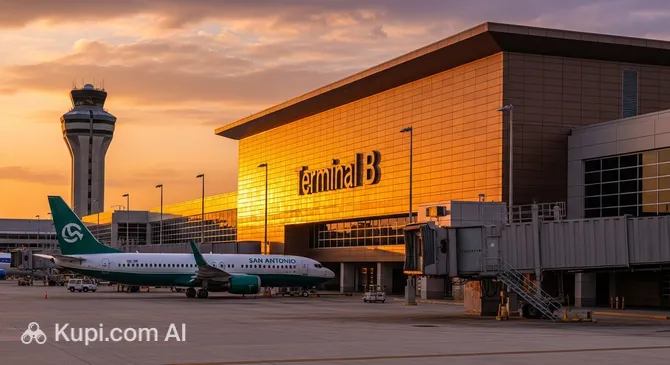
Terminal B is newer, modern, and compact. It is mainly used by American Airlines and United Airlines. Due to its smaller size and passenger flow, passing through registration and screening procedures here often takes less time. Although the selection of cafes and shops in Terminal B is more modest, it offers a comfortable and tranquil atmosphere.
You can move between terminals both before and after passing security control. The departure zones of both terminals are connected by a special corridor, so if you have time after screening, you can freely visit shops or dining venues in the neighbouring terminal. Check-in and baggage claim zones for each terminal are on different levels, but clear signage helps you orient yourself easily.
On average, one should allocate about 45-60 minutes for check-in and security screening at San Antonio Airport. However, during peak hours (early morning, holidays), this time may increase. For domestic flights, it is recommended to arrive at the airport 1.5-2 hours before departure, and for international flights — at least 2.5-3 hours, to complete all formalities without rushing.
Airport History
The history of San Antonio International Airport (SAT) begins in 1941, when city authorities acquired a plot of land for the construction of a new airfield. However, World War II altered these plans: the facility was almost immediately transferred to the United States Army Air Forces and was named Alamo Field. During these years, it functioned as a key base for training pilots and aviation cadets.
With the end of the war in 1946, the airfield returned to civil management, and its transformation into a full-fledged passenger airport began. A crucial stage of this period was the opening of a new terminal in 1953, which at that time was considered one of the most modern in the country. This allowed the airport to accept a growing number of flights and passengers, contributing to the development of tourism and business ties in the city.
The true flourishing came with the jet age. In 1984, to meet new requirements, the airport underwent massive modernisation. A new, more spacious terminal was opened (known today as Terminal A), and the airport received its modern name — San Antonio International Airport. An interesting fact: during this period, in the 1980s and 1990s, the legendary supersonic airliner "Concorde" landed here several times, which was a landmark event for all of Texas.
In the 21st century, development did not stop. In 2010, another major reconstruction was completed, within which Terminal B was built and the old terminal from 1953 was demolished. This modernisation was aimed at increasing capacity, optimising logistics, and raising the level of comfort for travellers. Today, the airport continues to develop, serving millions of passengers and remaining an important transport hub in the southern USA.
Services and Amenities
San Antonio International Airport (SAT) offers passengers a wide range of services to make waiting for a flight as comfortable and productive as possible. The airport infrastructure is thought out to the smallest detail and oriented towards the needs of various categories of travellers.
For those feeling hungry, there are numerous restaurants, cafes, and dining outlets operating in the terminals. Here you can find both popular fast-food chains and establishments offering dishes of local Texan and Mexican cuisine. In airport shops, you can purchase souvenirs, books, electronics, and travel essentials. Duty-free shops are also available for international flight passengers.
Free Wi-Fi is available throughout the airport, allowing you to stay connected or work while waiting for departure. For charging gadgets, numerous sockets and special stations are conveniently located in rest zones and at boarding gates.
Passengers preferring enhanced comfort can utilise the services of lounges. For example, the United Club offers a cosy atmosphere, snacks, beverages, and business services. There is also a USO Lounge for military personnel and their families. For financial matters, ATMs and currency exchange points are located in the terminals.
The airport takes care of passengers with children. Special nursing rooms are equipped for them, where you can feed and change a baby in a quiet environment. For travellers with disabilities, a barrier-free environment has been created: ramps, elevators, adapted restrooms, and the ability to request escort services.
Although there are no hotels directly within the terminal buildings, many hotels of various price categories are located in the immediate vicinity of the airport, which can be easily reached by shuttle. Business travellers may access business centre services in lounges or nearby hotels.
Where to Eat
At San Antonio International Airport (SAT), passengers will find diverse dining options, from a quick snack to a full meal. Catering establishments are conveniently located in both terminals, offering both famous Texan cuisine and familiar international chains.
Most restaurants and cafes are located in the areas after passing security control (airside). In Terminal A, which serves the majority of airlines, the selection is the widest. Here you can find popular fast-food chains like Whataburger, where it is worth trying a classic Texan burger, as well as restaurants with local flair offering Tex-Mex dishes, such as enchiladas or famous breakfast tacos. In Terminal B, the selection is somewhat smaller, but there are also coffee shops, lounges, and places where you can sit comfortably while waiting for your flight.
For those in a hurry, coffee shops such as Starbucks or kiosks with sandwiches and salads will be the ideal solution. If you have time, you can settle into one of the full-service restaurants or sports dining venues. This is a great opportunity to try local beverages and enjoy the atmosphere before departure. The opening hours of most establishments are adapted to the flight schedule, starting from early morning until late evening.
Passengers with specific dietary preferences also have various options available. In many cafes, you can order vegetarian or gluten-free dishes, for example, salads, bowls, or sandwiches on special bread. It is recommended to study the menu in advance or check the ingredients with the staff. The price range at the airport varies from moderate in fast-food outlets to medium and higher in full-service restaurants, which is standard for most airports.
Traveller Tips
To ensure your journey through San Antonio International Airport goes as smoothly as possible, take advantage of these proven tips. Planning in advance will help save time, money, and stress, allowing you to focus on the pleasant impressions of your trip.
Arrival Time at the Airport. For domestic flights within the USA, it is recommended to arrive at the airport at least 2 hours before departure. If you have an international flight, allow at least 3 hours. During peak periods, such as holidays or early mornings, it is better to add another 30-45 minutes to clear all formalities.
Check-in and Security. The fastest way to check in for a flight is to do it online 24 hours before departure and save the boarding pass on your phone. This allows you to go straight to the baggage drop counter or, if you are travelling light, to the security checkpoint. When passing through security control (TSA), have your ID and boarding pass ready. Be prepared to remove laptops and large electronics from your carry-on luggage, and observe the 3-1-1 rule for liquids (containers up to 100 ml/3.4 oz in a transparent bag). Members of the TSA PreCheck programme can undergo screening via an expedited procedure.
Seat Selection on the Plane. If the airline allows you to choose a seat, consider your preferences. Window seats are excellent for those who like to admire the views or sleep leaning against the wall. Aisle seats are convenient for those who value the ability to stretch their legs or stand up freely without disturbing neighbours. Seats in the front part of the cabin usually allow for a quicker exit from the aircraft upon arrival.
Carry-on Luggage. Be sure to put all valuables, documents, medicines, chargers, and essential items in your carry-on luggage. Remember that besides restrictions on liquids, it is prohibited to carry sharp objects, flammable substances, and other dangerous materials. Make sure to check the current weight and size limits for carry-on luggage on your airline's website to avoid extra charges at the airport.
Passengers with Connections. San Antonio International Airport is quite compact, making transfers relatively convenient. Study the airport map in advance and check which terminal and gate your next flight will be at. If you have a short connection, do not linger in shops or cafes on the way to your gate.
Customs Control. Upon arrival on an international flight, you will have to pass through passport control (CBP). Have your passport and completed customs declaration (if required) ready. After this, you will collect your luggage and pass through customs. To speed up this process in the future, consider registering for the Global Entry programme.
Saving Time and Money. Book parking online in advance — this is often cheaper. Bring an empty reusable water bottle to fill it after passing security and avoid spending on drinks. Light snacks brought from home will also help save money. Compare prices for taxis and rideshare services to choose the most advantageous way to get to the city.
In Case of Flight Delay. Remain calm. Follow updates on information screens and in your airline's app. Check with the carrier's representative for the reason for the delay and your rights as a passenger — in some cases, you may be provided with vouchers for food or accommodation. Use the free time to have a snack, read a book, or use the free Wi-Fi at the airport.
Airports in nearby cities
- George Bush Intercontinental Airport
- Austin-Bergstrom International Airport
- William P. Hobby Airport
- Corpus Christi International Airport
- Killeen–Fort Hood
- Laredo International Airport
- Quetzalcoatl International Airport
- Easterwood Airport
- Waco Municipal Airport
- San Angelo Regional Airport
- Piedras Negras International Airport
- Del Rio International Airport
- Victoria Regional Airport
- Matagorda Island (National Wildlife Refuge) Airport
- Beeville (Chase Field Industrial)
- Austin (Austin Executive)
- Del Rio (Laughlin AFB)
- Corpus Christi (NAS(Truax Field))
Reached the end of the page?
That means the route is fully explored
