Support

Kaneohe Bay MCAS

About the Airport

Kaneohe Bay Airfield, known as Marine Corps Air Station (MCAS) Kaneohe Bay, is not an ordinary air gateway, but a unique facility located on the picturesque Mokapu Peninsula in Hawaii. Unlike civilian airports, its runways are surrounded not by terminals, but by the azure waters of Kaneohe Bay and the Pacific Ocean. This airfield serves as a key base for the United States Marine Corps on the island of Oahu, combining strategic military power with incredible tropical beauty.
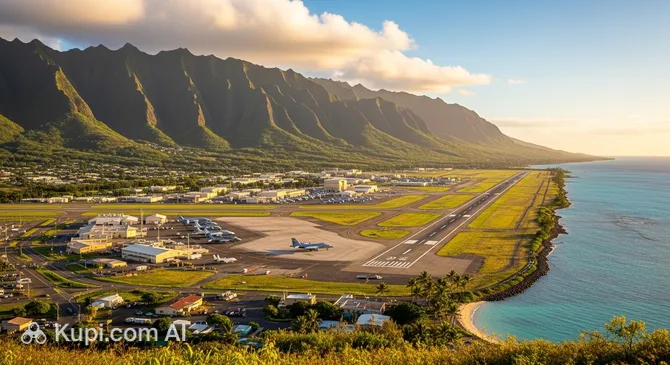
Kaneohe Bay MCAS. Source: Kupi.com Binoculars
IATA Code NGF
ICAO Code PHNG
City Kaneohe
Distance to centre approx. 5 km
Status Military
Annual Passengers Civilian passenger data is unavailable as this is a military facility
Popular Airlines Serves units of the United States Marine Corps

The main feature of Kaneohe Bay Airfield is its exclusively military purpose. It is an active air station, so access to its territory for civilians is strictly restricted. Travellers cannot use this airfield for commercial flights; however, it plays a vital role in ensuring security in the Pacific region. It can often be seen from the water during boat tours of the bay or from observation decks along the coast.

Despite its closed status, the airfield is a significant part of the island's landscape and history. Its location on the Mokapu Peninsula, considered one of the oldest geological formations on Oahu, makes it truly unique. For tourists, Kaneohe Bay is more of an impressive landmark and a reminder of the strategic importance of the Hawaiian Islands than a transport hub.

Contact Information

It is important to note that Kaneohe Bay Airport (NGF) is a United States Marine Corps Air Station and is not a commercial civilian airport. The contact information and services provided reflect its military status.

  • Official Website: Basic information about the base, including the air station, can be found on the official Marine Corps Base Hawaii website: www.mcbhawaii.marines.mil.
  • Information Service Phone: For general inquiries about the base, you can call the operator at: (808) 257-7111.
  • Airport Address: Marine Corps Base Hawaii, Kaneohe Bay, HI 96863, USA.
  • Email: There is no public email address for general inquiries. It is recommended to use the contact forms on the official website or contact by phone.
  • Social Media: News and updates can be followed on the base's official page on Facebook.
  • Lost Luggage Information: As this is a military facility, there is no standard baggage tracing service for passengers here. For items lost on base premises, one should contact the Provost Marshal's Office (Military Police).
  • Passenger Support Contacts: There is no specialised support service for civilian passengers. All issues related to flights and service are handled through official military channels.

How to Get to the Airport

There are several ways to get to the Marine Corps Air Station Kaneohe Bay (MCAS), but it is crucial to remember that this is an active military base. Access to the territory is strictly controlled, and civilians generally require an escort by a service member (sponsor) or a pre-arranged pass to enter. This rule applies to all modes of transport.

Public Transport TheBus system operates on the island of Oahu. This is the most budget-friendly way to reach the vicinity of the base. Several routes pass near the main entrance of Marine Corps Base Hawaii (MCBH). You will have to walk from the bus stop to the gate. There is no direct bus service to the terminals inside the base for the general public. Please check the official TheBus website for current routes and schedules. The trip from the centre of Kaneohe will take 10-15 minutes, and from Honolulu, it takes over an hour.

Taxi and Ride-sharing (Uber, Lyft) A taxi or a car from a ride-sharing service can easily take you to the main gate (checkpoint) of the base. However, a driver without a special permit will not be able to drive onto the premises. You will need to exit at the gate and proceed through security on your own or meet your sponsor. The cost of a trip from Honolulu will be approximately 50-70 US dollars, depending on traffic.

Car Rental Renting a car is the most convenient way to move around Oahu and the best option for travelling to the base if you have entry permission. To drive through the checkpoint in a rental car, you will need to present a driving licence, vehicle documents, and insurance, as well as a valid reason for entry (for example, a temporary pass or a sponsor's ID). This method provides maximum freedom of movement both on the way to the base and within its territory. Travelling by car allows you to enjoy the scenic views of the island, as the United States is famous for its roads and nature. The drive from Honolulu International Airport usually takes 30-40 minutes, excluding traffic jams.

Parking at the Airport There are designated visitor parking areas within the military base. Typically, your sponsor or host will instruct you in advance on exactly where you can leave your vehicle. Unlike civilian airports, there are no commercial short-term or long-term parking lots here; parking is regulated by internal base rules.

Terminals and Map

Kaneohe Bay MCAS (NGF) is primarily a military air station, not a civilian commercial airport. This impacts its structure and accessibility. Passenger transport here mainly serves military personnel, their families, and other authorised persons under the Space-Available (Space-A) programme. Therefore, the infrastructure with multiple terminals familiar to tourists is absent here.

Instead of several buildings, the airport typically has one passenger terminal, often referred to as the Air Mobility Command (AMC) terminal. It is a functional, compact building designed for efficient passenger processing rather than for long waits or entertainment.

Structure and Navigation:

  • Terminal: One main building where all services are concentrated. Navigation inside is extremely simple — it is practically impossible to get lost.
  • Arrival and Departure Zones: Check-in, security screening, waiting, and baggage claim processes take place in the same building but in different, clearly marked zones. Check-in counters, a security screening area, and a small waiting hall constitute the main structure.
  • Procedures: Check-in for flights and security screening at military facilities can be stricter and take longer than at civilian airports. It is recommended to arrive at least 2-3 hours before the scheduled departure, carrying all necessary documents (military ID, orders, passports).

Since there is only one terminal, the question of transfers between them is irrelevant. Everything inside is within walking distance. The main advice for navigation is to carefully follow the signs and instructions of the staff, who are military personnel. They will always help you orient yourself and answer your questions. Do not expect to find Duty-Free shops, a variety of restaurants, or lounge zones typical of major international airports here. Infrastructure is limited to the bare essentials: a waiting area, restrooms, and possibly vending machines with drinks and snacks.

Airport History

The history of Marine Corps Air Station Kaneohe Bay (MCAS Kaneohe Bay), located in the city of Kaneohe, reflects the military history of the United States in the 20th century. The land for the future airfield was acquired in 1938, and it was originally built as a Naval Air Station. The official opening took place in 1939, and the base quickly became a vital centre for naval aviation in the Pacific.

A key and tragic event in the airfield's history was the date 7 December 1941. The air station in Kaneohe was one of the first targets during the attack on Pearl Harbor, with the assault on it beginning minutes before the main strike on the fleet. Despite significant losses in aircraft and personnel, the base's aviators were among the first to get fighters into the air to repel the attack. This day forever inscribed the airfield into the annals of American history.

After World War II, the facility's role changed. In 1949, the Navy vacated the base, and it was temporarily closed. However, as early as 1952, the airfield received a new lease of life, becoming a United States Marine Corps Air Station. From that moment, a new stage of development began: infrastructure was modernised to accommodate jet aircraft, and new barracks and service buildings were constructed. The base played a significant role in operations during the Korean and Vietnam Wars, serving as a training and transit point.

Today, MCAS Kaneohe Bay remains one of the strategically important Marine Corps bases in the Pacific region. It is constantly being modernised to support modern aircraft, including helicopters and tiltrotor aircraft. An interesting fact: due to its picturesque location on the Mokapu Peninsula, surrounded by water on three sides, the airfield has repeatedly been a filming location for Hollywood movies, such as "Pearl Harbor" and "Battleship".

Services and Amenities

It is important to understand that Kaneohe Bay Airport (NGF) is an active United States Marine Corps air station. Consequently, most services and amenities are intended primarily for military personnel, their families, and other authorised staff. The range of services here differs from what can be found in a major civilian airport, and access for the general public is restricted.

Large food courts and duty-free shops are generally absent from the air station's territory. Instead, there are Military Exchange (MCX) outlets selling essential goods, snacks, and souvenirs. Dining is usually represented by small cafes or fast-food establishments. Instead of commercial VIP lounges, USO (United Service Organizations) centres are often provided for the relaxation of service members and their families, offering comfortable waiting areas.

Passengers can expect basic amenities such as Wi-Fi and charging stations for mobile devices in waiting areas. Banking services are typically provided by branches of military credit unions on the base territory, rather than directly in the air terminal. Currency exchange points are generally absent.

The airport infrastructure meets the requirements for serving passengers with disabilities, including ramps and specially equipped restrooms. For travellers with children, mother and child rooms with changing tables may be available. First aid is provided by the base's on-duty services.

There are no commercial hotels on the air station premises. Special hotels (Temporary Lodging Facilities) exist for the temporary accommodation of authorised personnel. The nearest civilian hotels and accommodation options should be sought in the city of Kaneohe and surrounding areas. Rental of conference rooms or business centres for civilians is not provided, as all such facilities on the base are used for official purposes.

Where to Eat

When planning your trip, it is important to understand the specifics of the airport you are arriving at. It is worth noting that Kaneohe Bay MCAS (NGF) is a United States Marine Corps military air station, and not a civilian commercial airport serving tourist flights. Due to this, access to its territory is strictly restricted, and standard passenger terminals with public dining areas are absent here.

On the base territory itself, there are naturally dining points intended exclusively for military personnel, their families, and authorised staff. Usually, these are mess halls, small cafes, and food courts. However, for ordinary tourists without special permission, these establishments are inaccessible.

Travellers heading to the island of Oahu should focus on the main civilian airport — Daniel K. Inouye International Airport in Honolulu (HNL). There you will find a wide selection of restaurants, cafes, and lounges to suit any taste and budget. If your route takes you through the city of Kaneohe, the city itself and its surroundings offer many establishments where you can try both local Hawaiian cuisine and familiar international dishes.

Tips for Travellers

It is important to understand that Kaneohe Bay MCAS (Marine Corps Air Station Kaneohe Bay) is an active US Marine Corps military facility, not a civilian airport. It does not serve commercial flights of ordinary airlines. Access here is open only to military personnel, their family members, and other categories of persons eligible for the Space-A programme (travel on a space-available basis).

For those eligible to fly from here, the check-in procedure differs significantly from civilian norms. It is recommended to arrive at the passenger terminal in advance to make it for Roll Call. The time for the start of check-in and marking presence is strictly regulated by the flight schedule, which may change depending on military tasks. Be sure to have all necessary documents with you: military ID (CAC), leave orders, or other authorising papers.

Particular attention should be paid to the dress code, which is atypical for ordinary tourists. Strict rules often apply on military aircraft: open-toed shoes (flip-flops, sandals), shorts that are too short, or revealing clothing are prohibited. For comfort and safety, it is better to choose closed, comfortable shoes and trousers. On some types of military transport aircraft, it can be cool and noisy, so bring a warm jacket and, if necessary, earplugs.

Screening of luggage and hand carry is conducted with particular thoroughness. In addition to standard security requirements regarding liquids and prohibited items, agricultural inspection (USDA) is mandatory when flying from Hawaii to the mainland. Any fresh fruits, vegetables, plants, and even some types of souvenirs made from natural materials may be confiscated to prevent the spread of pests.

Comfort on board depends on the type of aircraft. If it is a charter flight (Patriot Express), conditions will be close to commercial ones. However, if the flight is on a military cargo plane, be prepared for minimalist conditions: seats may be side-facing and made of canvas. Seat selection in such cases is often absent or carried out on a first-come, first-served basis during boarding.

The main advice to save your nerves when using military airbases is flexibility and patience. Flights may be delayed or cancelled due to priority military missions or weather conditions. Travellers should always have a backup plan and funds in case the flight does not take place on the scheduled day. Terminal infrastructure is usually basic, so keep a supply of water, food, and chargers with you.

Reached the end of the page?

That means the route is fully explored