Support

Kona International Airport at Keahole

About the Airport

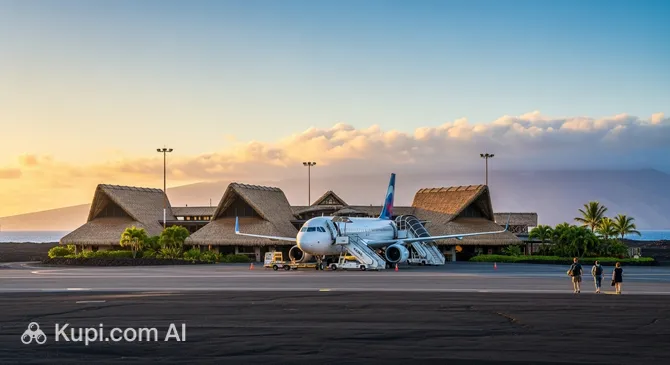
Kona International Airport at Keahole. Source: Kupi.com Binoculars

Kona International Airport at Keahole is not merely a transport hub, but a true gateway to a tropical paradise that immediately immerses you in the "Aloha" atmosphere. The airport is unique in its location: it is built directly upon a solidified flow of black lava from the Hualalai volcano, creating a stunning contrast with the turquoise waters of the ocean. There are no typical enclosed terminals with air conditioning here — instead, passengers are welcomed by cosy open-air pavilions, allowing you to enjoy the warm Hawaiian breeze right from the aircraft steps.

IATA Code KOA
ICAO Code PHKO
City Kailua-Kona
Distance to Centre 12 km
Status International
Annual Passengers Approx. 4 million

Airport Features and Highlights:

Kona Airport is renowned for its Polynesian-style architecture, where waiting areas consist of groups of open-walled bungalows. It is the only major airport in the USA with such a concept, making it a landmark in itself. The complex is named in honour of astronaut Ellison Onizuka, a native of this island, and there is a memorial centre dedicated to him on the premises. Other advantages include its compactness, lack of long queues, and proximity to the main resorts on the western coast of the Island of Hawaii (Big Island).

Contact Information

For your convenience, we have compiled the main contact information for Kona International Airport (KOA).

  • Official Website: You can always find up-to-date information on flights, services, and airport regulations on the official website.
  • Information Desk Phone: For general enquiries, you may call (808) 327-9520.
  • Airport Address: 73-200 Kupipi St, Kailua-Kona, HI 96740, USA.
  • Email: The airport does not have a publicly available email address. It is recommended to use the contact form on the official website for communication.
  • Social Media: The airport does not maintain separate official pages on social networks.
  • Lost and Found: If your belongings were lost within the terminal building, please contact the airport's Lost and Found service at (808) 327-9520. If luggage or personal items were lost on board the aircraft, you must contact your airline's representative directly.
  • Passenger Support Contacts: For questions related to airport services, you may contact the main information number at (808) 327-9520.

How to Get to the Airport

Reaching Kona International Airport (KOA), located just a 15-20 minute drive north of the city centre of Kailua-Kona, can be done in several ways. The choice depends on your budget, amount of luggage, and comfort preferences.

Taxis, Shuttles, and Ride-sharing. The fastest and most convenient method is to use taxi services or apps like Uber and Lyft. A trip from the tourist zone will take about 15-20 minutes and cost approximately $30-40. Pre-booked transfer shuttles are also popular and can be slightly cheaper than a taxi, especially for one or two travellers. This is an excellent option if you prefer not to worry about finding transport upon arrival.

Public Transport. The most budget-friendly option is the `Hele-On Bus` system. The route passing along the highway makes a stop at the airport. However, it is worth noting that buses run with long intervals, and this method may be inconvenient if you have a lot of luggage or are in a hurry. The fare is minimal, but be sure to check the current schedule in advance.

Car Rental. Most tourists on the Big Island rent a car to explore its beauty, so the most common way to get to the airport is to return a rented car before departure. All major rental companies have offices directly at the airport or nearby. The car return process is usually quick and well-organised. Access to the airport from the main Queen Ka'ahumanu Highway is well marked with signs.

Airport Parking. If you are travelling in a private or long-term rented vehicle, Kona Airport has public parking. There are zones for short-term and long-term parking with corresponding pricing. This is convenient if you are flying to neighbouring islands for a couple of days.

Terminals and Map

Kona International Airport at Keahole (KOA) boasts a unique and memorable structure that instantly immerses travellers in the atmosphere of the Hawaiian Islands. Instead of the usual monolithic building, the airport is a complex of open-air pavilions connected by covered walkways. This feature makes it one of the most unusual airports in the USA.

In fact, the airport consists of two main terminals located in close proximity to each other. No transport is needed to move between them — a short walk through the picturesque grounds is sufficient. The terminals are designated as follows:

  • Terminal 1 is used mainly for inter-island flights operated by airlines such as Hawaiian Airlines.
  • Terminal 2 receives most flights from the US mainland, as well as international destinations.

All infrastructure, including check-in counters, security checkpoints, and boarding gates, is housed in separate structures styled like traditional Hawaiian huts. Arrival and departure zones are clearly demarcated. Flight check-in and baggage drop-off take place in the central part of the complex, after which passengers proceed to security checkpoints and then to their boarding gates, grouped into several blocks.

Navigation in the airport is intuitive thanks to clear signage, but be prepared for a bit of walking in the fresh air. Waiting areas at the gates are also under canopies, allowing you to enjoy the warm climate almost until the moment of boarding the plane. Despite the apparent simplicity, do not underestimate the time required to complete all procedures. It is recommended to arrive at the airport at least 2 hours before departure for a domestic flight and 3 hours for an international one. During peak seasons, queues can be significant.

Airport History

The history of Kona International Airport began on 1 July 1970, when it was opened to replace an older, more modest airfield. The need for a new airport was driven by the rapid growth of tourism on the Kona coast and the requirement to accommodate large jet aircraft that could not land on the old runway. Located on a solidified lava field from the 1801 Hualalai eruption, the airport was unique from the start, harmoniously blended into the exotic landscape of the Big Island.

A key moment in the airport's development was the massive reconstruction in 1993, during which the runway was extended almost twofold — to 3,353 metres (11,000 feet). This allowed for the reception of long-haul wide-body aircraft without stopovers, opening direct flights from Japan and the mainland USA. To highlight its new status, in 1997 the airport was officially renamed Kona International Airport at Keahole. This event became a symbol of the transformation of Kailua-Kona into an international tourism hub.

Among the interesting facts in the airport's history is its unique architecture. Passenger terminals consist of a complex of open-air pavilions, allowing travellers to feel the warm tropical climate of Hawaii immediately upon arrival. In 2006, the airport suffered minor damage from the Kiholo Bay earthquake, which prompted further modernisation and strengthening of structures. Another notable fact: the lava fields surrounding the airport were used by NASA in the 1960s to train astronauts for the Apollo missions — here they prepared for the moon landing by practising movement on similar terrain.

Services and Amenities

Kona International Airport at Keahole (KOA) offers passengers a set of essential amenities, taking into account its unique open-air concept. Most terminal buildings do not have walls, creating a relaxed island atmosphere, but this also influences the list of available services.

Restaurants, Cafes, and Shops: At the airport, you will find several establishments where you can have a snack or coffee before your flight. The assortment includes fast-food outlets as well as bars offering local cuisine and tropical beverages. Duty-free shops and souvenir stalls offer Hawaiian delicacies, jewellery, clothing, and other memorable items. The selection is not as extensive as in major hubs, but quite sufficient for purchasing last-minute gifts.

Waiting Halls and VIP Lounges: Some airlines, such as Hawaiian Airlines, provide access to their lounges for premium class passengers or loyalty programme members. These lounges offer refreshments, snacks, and more comfortable conditions for relaxation.

Wi-Fi and Charging Stations: Paid Wi-Fi is available within the airport territory. There are also stations for charging electronic devices located in waiting areas near the boarding gates. Their number may be limited, so it is recommended to carry a portable charger.

Banking Services: ATMs are installed in the terminal where you can withdraw cash. There are no currency exchange points at the airport, so it is better to arrange money exchange in advance at banks in the city of Kailua-Kona.

Passenger Services: For passengers with reduced mobility, accessible restrooms, ramps, and special assistance are provided upon prior request to the airline. Families with small children can use baby care rooms. Medical assistance is limited to essential first aid services.

Hotels and Business Services: There are no hotels directly within the airport; however, many accommodation options are located a few minutes' drive away, in the Kailua-Kona area. Specialised conference rooms or business centres are absent at the airport, which corresponds to its tourism focus.

Where to Eat

Kona International Airport at Keahole (KOA), despite its compact size and unique open layout, offers travellers several excellent options for a snack or a full meal. Most establishments are located airside, meaning after passing security control, in the departure zones near the gates, allowing you to relax while waiting for your flight.

The main star of the airport food court is undoubtedly Kona Brewing Co. This is a great opportunity to enjoy a meal, such as pizza, sandwiches, or salads, in a lively atmosphere. The menu is suitable for those who want a substantial meal before their flight. Smaller cafes and bars also operate in the terminals, for example, Laniakea Cafe, where you can find traditional Hawaiian "plate lunches," fresh pastries, and, of course, the famous Kona coffee.

For those looking for a quick bite, there are several kiosks and snack bars at the airport. Here you can buy sandwiches, fruit, snacks, and beverages. This is an ideal option if you are short on time. Regarding special dietary needs, vegetarian dishes such as salads or vegetable sandwiches are easy to find. Options for vegan or gluten-free diets may be more challenging to locate, so it is recommended to clarify the ingredients directly with the staff at the establishment.

The price range in KOA airport establishments, as in most airports worldwide, is higher than the city average. The operating hours of cafes and restaurants are usually tied to the flight schedule: they open in the morning and close after the departure of the last evening flights. If you are travelling late at night, it is better to check in advance if the places of interest will be open.

Travel Tips

Travelling through Kona International Airport at Keahole can be a pleasant beginning or end to your Hawaiian adventure, especially thanks to its unique open-air design. To ensure everything goes smoothly, use these tips.

Arrival Time and Check-in: Kona Airport is not as large as many international hubs, but it can get crowded during peak seasons. It is recommended to arrive 2 hours before domestic flights (including flights to other islands) and 3 hours before international ones. Most check-in counters and waiting areas are outdoors, creating a relaxed atmosphere, but do not forget a hat and sunscreen if you have to wait in the sun.

Passing Security Control: Screening procedures are standard for the USA and are conducted by the TSA. Be prepared to remove shoes, and take out laptops and liquids from your carry-on luggage. A specific feature of Hawaii is the mandatory agricultural inspection of luggage before flying to the US mainland. Your checked luggage must pass through a special scanner before you hand it over at the airline counter. Look for the corresponding signs.

Choosing a Seat on the Plane: To enjoy farewell views of the island's coast, try to choose a window seat. When departing from Kailua-Kona, views of the volcanic landscapes and the ocean can be breathtaking, especially on a clear day. The side of the plane for the best views depends on the flight direction and takeoff pattern.

Carry-on Luggage: Remember the TSA rule for liquids: 3-1-1 (containers up to 100 ml or 3.4 oz, packed in one transparent bag up to 1 litre). It is strictly forbidden to export most fresh fruits, plants, and seeds from Hawaii without a special certificate to prevent the spread of invasive species. Do not put raw coral or sand from beaches in your carry-on luggage.

Passengers with Connections: If you have a connection to another Hawaiian island, ensure you have enough time. Terminals for inter-island and mainland flights are located close to each other, and moving between them usually does not take much time. However, always allow an extra buffer in case of unforeseen delays.

Economy and Convenience: Prices for food and drinks at the airport can be high. Bring an empty reusable water bottle with you — it can be filled after passing security control. You can also bring light snacks. If you rented a car, clarify the return procedure in advance to avoid rushing.

In Case of Flight Delay: The main thing is to remain calm. Contact your airline representative for up-to-date information and to clarify your rights (for example, regarding vouchers for food or accommodation during long delays). The unique architecture of Kona Airport allows you to spend waiting time in the fresh air, which is much more pleasant than in the enclosed space of a traditional terminal. Take a walk through its open courtyards and enjoy the warm Hawaiian breeze.
Reached the end of the page?

That means the route is fully explored