Support

Kamuela

About the Airport

Kamuela. Source: Kupi.com Binoculars

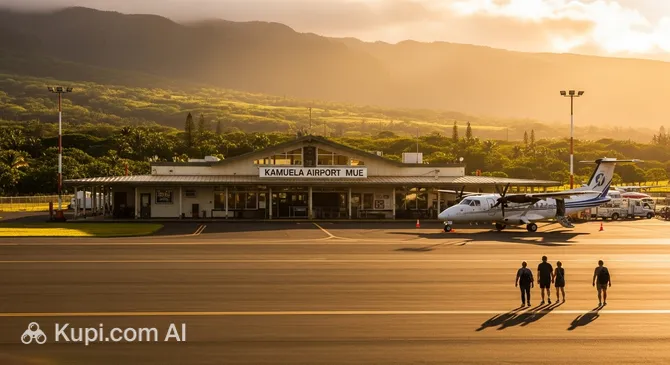
Waimea-Kohala Airport, also known as Kamuela, is not merely a transport hub, but a true gateway to the world of Hawaiian paniolo cowboys and the breathtaking landscapes of the Big Island. Located at an altitude of over 800 metres above sea level, it offers travellers a unique opportunity to land amidst cool mists and emerald hills, so unlike the typical tropical beaches. This intimate airport provides a sense of cosiness and tranquillity, allowing you to begin your acquaintance with North Kohala without the hustle and bustle of large terminals.

IATA Code MUE
ICAO Code PHMU
City Waimea (Kamuela), Hawaii, USA
Distance to Centre ~3 km
Status Domestic (Regional)
Annual Passengers About 5,000
Schedule Check the official website

Kamuela Airport possesses a special charm appreciated by lovers of non-standard routes. Among its key features and advantages are:

  • Scenic Location: The runway is located in the highlands, offering stunning views of the extinct Kohala volcano and the majestic Mauna Kea mountain.
  • No Crowds: Thanks to low passenger traffic, a relaxed atmosphere reigns here. Check-in and baggage claim procedures take mere minutes.
  • Proximity to Attractions: The airport is located just a few minutes' drive from the famous Parker Ranch and the centre of Waimea town with its colourful shops and restaurants.
  • Unique Design: On the grounds, you can see an unusual sculpture with 26 faces, which has become a local landmark and a popular object for photos.

Contact Information

  • Official Airport Website: airports.hawaii.gov/mue
  • Inquiry Service Phone: +1 (808) 327-9520 (Airport Administration)
  • Airport Address: Waimea-Kohala Airport Rd, Waimea, HI 96743, USA
  • Email: dot.air-h-manager@hawaii.gov (Hawaii District Airports Manager)
  • Social Media: News and updates are published on the official accounts of the Hawaii Department of Transportation (HDOT) on Facebook and X (Twitter).
  • Lost and Found Information: Due to the small size of the terminal, for questions regarding forgotten items, you should contact the airline office (Mokulele Airlines) directly or call the administration.
  • Passenger Support Contacts: Hotline for suggestions and complaints: +1 (888) 697-7813

How to Get to the Airport

Waimea-Kohala Airport (MUE) is distinguished by its convenient location. It is situated just a few kilometres from the centre of Waimea (Kamuela) town, making the trip there quick and tireless. However, given the rural nature of the area and the small size of the terminal, transport choices here have their own specifics, different from major hubs.

Here are the main ways to get to or from the airport:

  • Car Rental. This is the most popular and recommended way to move around the Big Island. Counters for several rental companies (e.g., Avis, Hertz) are present in the airport building, but due to low passenger flow, they may not operate 24/7 or might require advance booking. A car gives you the freedom to travel to remote beaches and volcanoes.
  • Taxi and Ridesharing. Services like Uber and Lyft operate in this area, but waiting times may be longer than in major tourist zones. Local taxi services are also available. A trip to the centre of Waimea will take just 5–7 minutes and will cost approximately 15–25 US dollars. It is recommended to order a car in advance, especially if you are arriving on an early morning or evening flight.
  • Public Transport. A budget option is the Hawaii County bus network, known as the Hele-On Bus. Routes pass through Waimea, but direct connection to the terminal may be irregular. This option is suitable only for travellers without heavy luggage and with plenty of time. The fare is inexpensive (sometimes free during county promotions), but the schedule must be checked on the official website in advance.
  • Hotel Transfers. Some large resorts on the Kohala Coast may provide shuttles for their guests. Be sure to clarify this possibility when booking your accommodation.

For those arriving in their own vehicle, the airport offers an undeniable advantage — free parking. The parking zone is located right in front of the terminal, and finding a free space is usually not difficult. This makes the airport a convenient departure point for residents and tourists taking short flights to neighbouring islands.

If for some reason flights to Kamuela do not suit you, travellers often choose to fly into larger island airports and then reach Waimea by rental car:

  • Ellison Onizuka Kona International Airport at Keāhole (KOA) — the island's main tourist hub. The road from here to Waimea is scenic and takes about 45–60 minutes (approximately 49 km).
  • Hilo International Airport (ITO) — located on the eastern side of the island. The journey from Hilo to Waimea via the Saddle Road or along the Hamakua Coast will take about 1 hour 15 minutes (approximately 71 km).

For inter-island flights, Kahului Airport on Maui or Kapalua Airport are also used, however, you can only reach Waimea from there by air, as there is no car ferry service between these islands.

Terminals and Map

Kamuela Airport (MUE) is the complete opposite of giant modern aviation hubs. Here you will not find confusing labyrinths of corridors, trains between terminals, or multi-storey car parks. The entire airport infrastructure is concentrated in one compact building, which serves both departing and arriving passengers. This creates a unique atmosphere of home-like comfort, where every stage of the journey passes quickly and without stress.

The terminal structure is extremely simple and intuitive even for those here for the first time:

  • Check-in Zone: Located immediately at the entrance to the building. Here are the airline counters (mainly Mokulele Airlines). Due to the specifics of flying on small aircraft, the check-in process often involves weighing not only luggage but also passengers to properly balance the aircraft.
  • Security Screening (TSA): Located in immediate proximity to the check-in counters. Although procedures here are standard for the USA, due to the small flow of people, queues rarely form.
  • Waiting Area: A small space with seats located after the security zone. There are restrooms and vending machines with drinks and light snacks here. There are no full-service cafes or Duty-Free shops in the terminal.

Navigation and Boarding Features

Kamuela Airport lacks jet bridges. Boarding the flight is as simple as possible: after the announcement, you simply exit through the single "gate" (a door leading to the airfield) and walk to the plane. This gives an excellent opportunity to see the aircraft up close and enjoy the fresh mountain air before takeoff. Staff always accompany passengers on the apron to ensure safety.

Arrival Zone

Arrival at Waimea-Kohala is also devoid of formalities. Passengers descend the plane's stairs and walk to the terminal building or the baggage claim area. There are no baggage carousels here — suitcases and bags are unloaded manually and handed to passengers in a designated area, which is often located outdoors under a canopy or immediately at the building entrance.

Time and Recommendations

Thanks to the terminal's size, all procedures take minimal time. Nevertheless, it is recommended to adhere to the following rules:

  • Arrival at the airport: It is sufficient to arrive 45–60 minutes before departure. This time is more than enough to check in luggage and pass through security.
  • Documents: Keep your identification and boarding pass handy, as transitions between zones are very short.
  • Dining: Since food choices in the terminal are limited to vending machines, we recommend having a meal beforehand in Waimea town or bringing snacks with you, especially if you are travelling with children.

Airport History

The history of Kamuela Airport (Waimea-Kohala) is closely intertwined with the history of the famous Parker Ranch and the development of aviation in the Hawaiian Islands. Unlike many military airfields of that time, this facility was created primarily for civilian needs, to connect the high-altitude areas of the Big Island with Honolulu and the outside world.

The official start date of the airport's operation is considered to be 1953, when a runway capable of receiving the Douglas DC-3 aircraft, popular at the time, was put into operation. Land for construction was allocated from the vast holdings of Parker Ranch, highlighting the importance of air connections for the local agricultural industry. The grand opening and the start of regular flights by Hawaiian Airlines marked a new era for the residents of North Kohala, who no longer had to spend hours travelling to remote airports in Hilo or Kona.

Stages of Development and Modernisation

Over the decades of its existence, the airport has gone through several significant transformations reflecting changes in the aviation industry:

  • 1972: A new, more spacious passenger terminal was built. This building, designed in a style that harmonises with the surrounding nature, functions to this day, preserving the atmosphere of the 70s.
  • Era of Turboprop Giants: In the 1980s and 1990s, the airport received larger aircraft, such as the 50-seat de Havilland Dash 7. This was a period of peak passenger traffic when locals actively flew to neighbouring islands for shopping or business.
  • Change of Format: With the departure of large Hawaiian Airlines aircraft in the early 2000s, the airport reoriented towards serving small commercial flights (commuter flights) operated by airlines like Mokulele Airlines and Pacific Wings (ceased operations).
  • Modern Improvements: In recent years, work has been carried out to renew the runway surface and modernise security systems to meet strict federal requirements, despite the airport's small size.

Records and Interesting Facts

Despite its modest size, Kamuela Airport holds a special place in the region's aviation geography:

  • Altitude Record: MUE is the highest commercial airport in the state of Hawaii. It is located at an altitude of 2,671 feet (about 814 metres) above sea level. Pilots often note that weather conditions here can change instantly — from bright sunshine to dense fog and cool wind.
  • The Name Mystery: Why does the airport of Waimea town have the code MUE and is often called Kamuela? Historically, the US Postal Service required a unique name for each post office. Since a town called Waimea already existed on the island of Kauai, the post office on the Big Island was named Kamuela (the Hawaiian version of the name Samuel) in honour of Samuel Parker, the grandson of the ranch founder. This dual name stuck to the airport as well.
  • Military Echo: Although the airport itself was built after the war, the Waimea area served as the location for the "Camp Tarawa" Marine Corps camp during World War II. The infrastructure laid by the military in the district indirectly contributed to the future development of civil aviation in this region.

Services and Amenities

Kamuela Airport (MUE) is a classic example of a small regional aviation hub where functionality prevails over commercial components. Passengers accustomed to huge terminals with boutiques and food courts should adjust their expectations in advance. You will not find a wide range of entertainment services here, but it is precisely this minimalism that ensures quick completion of all formalities and a calm atmosphere before departure.

Below is a detailed overview of what is available to travellers in the terminal and its vicinity.

Restaurants, Cafes, and Shops

Due to the modest size of the terminal, full-service catering establishments and retail shops are absent on the airport territory. There are no restaurants, coffee shops, or Duty-Free stores here.

  • Dining: Vending machines are installed for passengers, where you can purchase soft drinks, water, and light snacks (crisps, chocolate, crackers).
  • Recommendation: It is strongly recommended to have lunch or buy food for the journey in advance in Waimea town. The town centre with excellent restaurants and supermarkets is just a 5–10 minute drive from the airport.
  • Souvenirs: If you wish to buy Hawaiian souvenirs or leis, do so before arriving at the airport, as there are no gift kiosks inside.

Lounges and VIP Services

There are no separate Business Lounges or airline VIP rooms at Kamuela Airport. However, thanks to low passenger traffic, the general waiting hall is rarely overcrowded. It is equipped with standard seating and provides a sufficiently comfortable and quiet space for all passengers.

Communication and Technology

  • Wi-Fi: Free wireless internet is usually available within the terminal, provided by the State of Hawaii airport network. However, connection speed may vary, so it is better to download heavy files in advance.
  • Charging Devices: Specialised stands with a large number of sockets and USB ports (charging stations), typical of major hubs, may not be present here. It is recommended to have fully charged gadgets or a portable battery (power bank) with you, although a few standard wall sockets can be found in the waiting area.

Financial and Medical Services

  • ATMs and Currency Exchange: There are no ATMs or currency exchange points in the airport building. Ensure you have cash in advance by using banks in Waimea town.
  • Medical: There is no first aid post or pharmacy in the terminal. In case of an emergency, airport staff call emergency services (911). The nearest medical facility — North Hawaii Community Hospital — is located in the town, approximately 3 km from the airport.

Services for Special Categories of Passengers

Despite its compactness, the airport meets basic accessibility requirements:

  • Passengers with Disabilities: The terminal is single-storey, which maximises ease of movement for wheelchairs — there are no stairs, escalators, or lifts. Restrooms are equipped accordingly. When boarding the aircraft, where there are no jet bridges, airline staff use special ramps or devices to lift passengers on board. It is recommended to notify the airline of the need for assistance 48 hours before departure.
  • Passengers with Children: There are no mother and child rooms or play areas in the airport. However, thanks to quick security checks, children do not have to wait long in a confined space. Watching planes through the windows or the fence outside often becomes entertainment for little travellers, as the machinery is very close.

Hotels Near the Airport

There are no hotels on the airport territory itself, but thanks to its location, accommodation options are very close:

  • Kamuela Inn: A charming historic inn in the centre of Waimea, just a 5–7 minute drive from the terminal. An excellent option for immersing yourself in the atmosphere of "cowboy Hawaii".
  • Kohala Coast Resorts: Luxury hotels such as Mauna Kea Beach Hotel, The Westin Hapuna Beach Resort, or Fairmont Orchid are located 20–30 minutes' drive down towards the ocean. This is an ideal choice for those who want to combine a beach holiday with a convenient departure.

Business Services

Conference rooms or business centres with fax and printer are absent at the airport. If you need to hold a meeting or work with documents, it is better to use the infrastructure of hotels in Waimea or co-working spaces in the town.

Where to Eat

When it comes to dining at Kamuela Airport (MUE), travellers need to consider the specifics of this small regional hub. Unlike major international hubs, there are no full-service restaurants, cafes, bars, or food courts directly in the terminal building. The entire airport consists of one compact building, and the gastronomic infrastructure inside is reduced to the necessary minimum.

Nevertheless, passengers will not go hungry if they plan their time correctly by taking advantage of the proximity to Waimea town.

Options Inside the Terminal

The only way to get a snack directly at the airport is via vending machines. They are located in the waiting hall (departure zone, after passing security), as well as in the public zone (landside).

  • Assortment: Bottled water, soda, juices, as well as classic American snacks — crisps, chocolate bars, biscuits, crackers, and nuts. Hot meals, sandwiches, or fresh coffee are not sold here.
  • Prices: Budget segment. Drinks and snacks cost on average from $2 to $5.
  • Opening Hours: Machines are available whenever the terminal is open (usually from early morning until the last flight).
  • Payment: Cash (small denomination notes) and, typically, bank cards are accepted.

Dining Recommendations Before Departure (in Waimea Town)

Since the airport is only a 5–10 minute drive from the centre of Waimea (Kamuela), it is strongly recommended to eat before heading to your flight. Waimea is considered one of the gastronomic centres of the Big Island, known for its "farm-to-table" concept.

Here are a few options where you can have a snack or a full lunch on the way to the airport:

  • For a Quick Snack and Coffee: Waimea Coffee Company. An ideal place for morning flights. They brew excellent Hawaiian coffee and offer fresh pastries, bagels, and light sandwiches.
    Average bill: $10–15.
  • Local Cuisine (Must Try): Village Burger. Since Waimea is cowboy (paniolo) and ranch country, leaving here without trying the local beef would be an omission. Burgers here are made from the freshest meat from local pastures (Parker Ranch).
    Average bill: $15–20. (Travellers requiring Halal options are advised to check with the restaurant or opt for vegetarian alternatives).
  • Hawaiian Classic (Poke): Supermarkets Foodland or KTA Super Stores. If you are in a hurry, visit the deli section of any of these stores for fresh poke (cubes of raw marinated fish with rice). It is quick, delicious, inexpensive, and very Hawaiian. This meal is convenient to take with you (but remember that liquids and semi-liquid products cannot be taken through security; you must eat it before the control zone or choose a dry option).
    Average bill: $8–15.

Special Diets (Vegetarian, Vegan, Gluten-Free)

Inside the airport, the choice for people with special dietary needs is extremely limited (only if nuts or certain types of crisps are found in the machines). However, establishments in Waimea town are well-adapted to such requests:

  • Vegans and Vegetarians: Local cafes (for example, at Isaacs Art Center or specialised bistros) always have salads made from fresh local vegetables and dishes with tofu.
  • Gluten-Free: Many burger joints offer a "gluten-free bun" option or serve the burger in lettuce leaves, and stores have a wide selection of organic products.

Summary: Do not count on lunch at Kamuela Airport. Treat it as a point of rapid transit. The best strategy is to enjoy local cuisine in town an hour before departure, and buy only water in the terminal after passing control.
Tips for Travellers

Travelling through Kamuela Airport (MUE) is a unique experience that differs greatly from flying through major international hubs. To ensure your trip goes as smoothly as possible and leaves only pleasant impressions of the "real Hawaii", we have prepared a number of practical tips.

Optimal Arrival Time

The main advantage of this small airport is the lack of hustle. You do not need to arrive 2–3 hours before departure.

  • Recommended Time: Arrive 45–60 minutes before the departure time indicated on your ticket. This is sufficient to calmly complete check-in and security.
  • Do Not Arrive Too Early: Since there is practically no entertainment or cafes in the terminal, waiting for more than an hour can become tiresome.

Check-in and "Weighing"

Be prepared for the specifics of small aviation. Flights from Waimea are operated on small aircraft (most often the 9-seat Cessna Grand Caravan), where weight balance is critically important.

  • Personal Weight: At the check-in counter, airline staff may ask you to step on the scales together with your hand luggage. Do not be embarrassed — this is a standard safety procedure for distributing the load in the aircraft.
  • Documents: Despite the relaxed atmosphere, TSA requirements are standard. You must have valid identification (passport) with you.

Seat Selection on the Plane

Unlike large liners, here you cannot always choose a specific seat during online check-in.

  • Pilot Allocation: Often, seats are allocated by the pilot before departure, based on passenger weight to centre the aircraft.
  • Best Views: If a choice is provided, any seat will be successful. The "1+1" seat configuration means that every passenger gets access to both a window and an aisle. On one side, views of the Kohala coast open up, on the other — volcanoes and pastures.

Hand Luggage: Do's and Don'ts

This is the most important point for passengers accustomed to standard cabin-size suitcases.

  • Size Matters: A standard wheeled suitcase (carry-on) that fits in the overhead bin of a Boeing or Airbus will not fit in the cabin of a Cessna. Such bags will be taken from you free of charge at the ramp and placed in the luggage compartment.
  • What to Take in the Cabin: Only small soft bags, backpacks, or handbags that can be held on your lap or placed under the seat are allowed.
  • Valuables: Keep cameras, laptops, medicines, and documents in a small bag with you. Do not check fragile electronics into the luggage compartment ("valet check"), as it is unheated and subject to vibrations.
  • Prohibited Items: TSA rules on liquids (containers up to 100 ml) and the ban on sharp objects apply here in full force, despite the small size of the airport.

Tips for Transit Passengers

If Waimea is just the starting point of your grand journey, consider the following nuances:

  • Change of Terminals: Arriving in Honolulu (HNL) or Maui (OGG) on a local airline flight, you often end up in a separate "commuter terminal". To transfer to a flight of a major airline (United, Delta, Hawaiian Airlines), you will likely have to exit the "sterile zone", get to the main terminal, and go through security again. Allow at least 2–2.5 hours for the transfer.
  • Luggage: Through baggage check-in (interline) from Mokulele Airlines to international flights of other alliances may not be available. Clarify this in advance. You may have to collect your suitcases at the intermediate airport and check them in again.

Customs and Agricultural Control

Since the airport serves only domestic flights, there is no customs here. However, Hawaii has strict phytosanitary rules.

  • Export of Fruit: Do not attempt to take fresh fruit, vegetables, or flowers in your hand luggage when flying to another island or the mainland if they do not have an inspection certificate.
  • USDA Check: You will undergo the main agricultural control at the airport of departure to the mainland (for example, in Honolulu), but staff in Waimea may also ask to inspect bags for prohibited agricultural products.

Saving Time and Money

  • Food: As mentioned earlier, buy sandwiches and coffee in Waimea town. Prices in vending machines are inflated, and the choice is meagre.
  • Transfer: If you are renting a car, return it slightly in advance, but remember that rental counters may close early. If you are arriving late in the evening, arrange how to collect the keys in advance.
  • Clothing: It can be cool and windy in Waimea and on the airfield (temperatures are often 5–10 degrees lower than on the beach). Keep a light jacket or hoodie handy so as not to freeze when boarding the plane.

What to Do in Case of Flight Delay?

Weather in the mountains is changeable: fog or strong crosswinds can cause flight delays or cancellations, as visual approach requires good visibility.

  • Plan "B": If your flight from Waimea is cancelled due to weather, and you urgently need to fly, ask the airline about the possibility of rebooking a departure from Kona Airport (KOA). It is only a 45–60 minute drive by taxi or rental car, and the weather there is usually much more stable.
  • Entertainment: There is Wi-Fi in the terminal, but it is better to download a movie or book to your phone in advance. In case of a delay, there will be absolutely nothing to do in the small waiting hall.

Reached the end of the page?

That means the route is fully explored