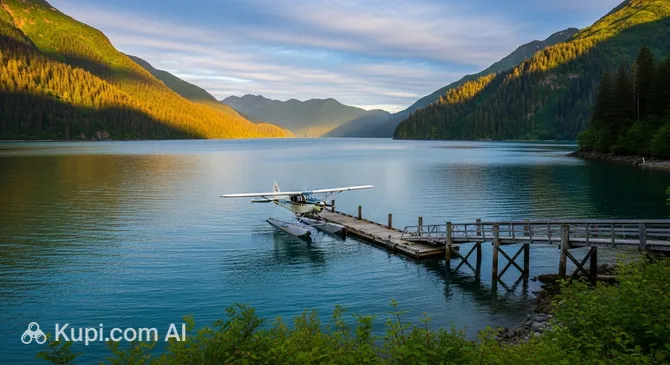
Source: Kupi.com AI
| Characteristic | Value |
|---|---|
| IATA code | KKB |
| City | Kitoi Bay |
| Country | United States |
| Time zone | America/Anchorage |
| Schedule | Online timetable |
| Characteristic | Value |
|---|---|
| IATA code | KKB |
| City | Kitoi Bay |
| Country | United States |
| Time zone | America/Anchorage |
| Schedule | Online timetable |
As Kitoi Bay Seaplane Base (KKB) is a small specialised facility primarily serving the local fish hatchery, it does not possess the standard passenger infrastructure of major international hubs. It is managed by the Kodiak Regional Aquaculture Association (KRAA). To resolve queries related to flights or visits, it is recommended to use the following contacts:
When planning a route to Kitoi Bay Seaplane Base, it is important to understand its geographical uniqueness. The facility is located in a remote bay on Afognak Island, where there is no road connection to the mainland or major cities. It is impossible to reach here by ordinary bus or car — the journey lies exclusively through the air or by water.
The main transit hub for travellers is the city and Kodiak Benny Benson State Airport, from where the final stage of the journey to Kitoi Bay begins.
Public Transport
Standard public transport (scheduled buses, trains, or metro) is completely absent in this wild area. There are no railway tracks on Afognak Island, and the road network is limited to logging roads not connected to the airport.
Taxis, Transfers and Air Taxis
The only way to quickly reach Kitoi Bay is to use the services of an air taxi (seaplanes). These are small floatplanes that perform charter and semi-regular flights.
The transfer organisation usually looks like this:
It is also possible to order a water taxi (boat) if the weather does not allow flying, however, this takes significantly more time and depends on storm conditions in the bay.
Car Rental and Parking
It is impossible to rent a car for a trip directly to Kitoi Bay, as no roads lead there. Car rental services are available in the city of Kodiak, but you will only be able to use the car within the road network of that island. You can leave the car at long-term parking at Kodiak Airport before departing on the seaplane.
In Kitoi Bay itself, there is no parking in the classical sense — there is only a dock for boats and pontoons for mooring planes.
Travel Time and Cost
Logistics in this region of Alaska depend heavily on the weather and the chosen type of transport:
Alternative Transport Hubs Nearby
If weather conditions in Kitoi Bay do not allow for landing, pilots may use neighbouring airfields or return to the point of departure. Within a radius of several hundred kilometres, there are other airports that can serve as alternate points or destinations for travel around the region:
Features and Recommendations
A trip to Kitoi Bay requires careful preparation. Always budget time for possible delays due to fog or wind. It is recommended to bring a minimal set of belongings in soft bags, as strict weight and size limits apply in small seaplanes.
The structure of Kitoi Bay Seaplane Base (KKB) differs radically from familiar international aviation hubs. Here you will not find multi-storey buildings, jet bridges, or confusing corridors. The entire "terminal" infrastructure represents a compact complex of hydraulic structures, harmoniously blended into the coastline of Afognak Island.
Terminal Organisation and Service Zones
In fact, the airport consists of one functional zone, located predominantly in the open air. The role of the passenger terminal is performed by:
Navigation Scheme and Transfers
Navigation in Kitoi Bay is extremely simple and intuitive. It is impossible to get lost here, as there is only one logical route: from the side of the plane along the dock decking to the shore. The distance from the drop-off point to the main buildings is only a few dozen metres. Signs are absent due to lack of necessity, and the meeting staff or pilot will always indicate the right direction.
Check-in and Screening Procedures
Check-in processes here are devoid of strict formalities and queues typical of large airports, but have their specific safety rules:
Features and Recommendations for Passengers
The main feature of the KKB "terminal" is its openness to the elements. The departure and arrival zone is located directly on the water, so passenger comfort depends directly on their equipment.
Tips on Navigation and Safety:
The history of Kitoi Bay Seaplane Base (KKB) is inextricably linked with the development of Alaska's biological resources and the creation of one of the oldest fish hatcheries in the state. Unlike civil airports that arose for passenger transport, this air harbour appeared out of purely practical necessity — to ensure the supply of a remote scientific station that is impossible to reach by land.
Foundation and Early Years (1950s)
The starting point in the history of the facility can be considered 1954. It was then, even before Alaska officially received US statehood status, that the Alaska Territory Department of Fisheries began the construction of an experimental station in Kitoi Bay. Along with the first buildings for personnel, a zone for receiving seaplanes was also organised. In those years, the "airport" represented only a primitive wooden deck for mooring "flying boats" delivering builders and biologists.
The 1964 Disaster and Rebirth
The most important and dramatic event in the chronicle of Kitoi Bay was the Great Alaskan Earthquake of 1964. Powerful tremors and the subsequent tsunami almost completely destroyed the infrastructure of the plant and the seaplane base. The docks were washed away, and equipment was destroyed. However, given the importance of the facility for the region, restoration work began almost immediately. In 1965, the seaplane base was rebuilt, receiving more reliable coastline fortifications.
Change of Management and Modernisation
A new era in the development of Kitoi Bay began in 1991, when the management of the facility passed from state structures to the non-profit organisation Kodiak Regional Aquaculture Association (KRAA). This event transformed the station from a research point into a full-fledged production hatchery.
With the increase in staff and production volumes, modernisation of the transport hub was required. In the 1990s and 2000s, work was carried out to expand the berthing zone, update the decking, and install modern navigation equipment, allowing pilots to orient themselves more safely in the complex coastline of Afognak Island.
Chronology and Interesting Facts
Today, KKB remains a living monument to the perseverance of people working in harmony with the harsh nature of the north, and continues to serve as the only thread connecting this secluded corner with the outside world.
The infrastructure and service of Kitoi Bay Seaplane Base (KKB) are entirely dictated by its location and purpose. Since this is a remote landing site in the wilderness, serving primarily a fish hatchery, passengers should not expect the usual set of urban amenities here. There is no Duty Free, food courts, or business lounges. All services are reduced to basic safety and functionality.
Dining and Shopping
In the area of the seaplane base and the adjacent territory of the factory, there are absolutely no shops, cafes, restaurants, or kiosks. It is impossible to buy food, water, or basic necessities upon arrival.
Communications, Wi-Fi and Electricity
Kitoi Bay is an ideal place for a "digital detox," often an involuntary one.
Financial Services
ATMs, currency exchange points, and bank branches are absent in Kitoi Bay. There is nowhere to pay by card here. If your journey involves paying for guide services or accommodation in private cabins nearby, you must have cash US Dollars with you, withdrawn in advance on the "mainland".
Medical Aid and Safety
There is no specialised medical centre for passengers at the airport.
Services for Passengers with Children and Limited Mobility
The infrastructure of KKB is challenging for vulnerable categories of passengers due to its "wild" nature.
Accommodation: Hotels and Lodges
There are no hotels for tourists directly in the "terminal" or on the factory territory. Sleeping in a waiting hall is impossible, as one does not exist. However, Afognak Island is famous for its secluded places for recreation, which can be reached from the landing site (by prior arrangement with the host party by boat):
Business Services
Conference rooms and business centres are absent in Kitoi Bay. The only meetings held here are meetings of biologists and fish farmers. If you need to conduct negotiations, it is better to plan them in the city of Kodiak before or after visiting the bay.
When it comes to dining at Kitoi Bay Seaplane Base (KKB), travellers should immediately adjust to the specifics of this place. As the airport represents a dock in the wilderness serving a fish hatchery, there are absolutely no restaurants, cafes, dining establishments, vending machines, or even coffee points here.
Your gastronomic experience at this point of the route depends entirely on your preliminary preparation. The "dining zone" here is any free corner on the dock or on board your seaplane, and the menu is whatever you brought with you.
Where to Eat: The Reality of Wild Alaska
Since there are no terminals with a division into "clean" and "public" zones here, the concept of public catering is replaced by the principle of complete autonomy. Here are the main dining scenarios for passengers:
Local Cuisine and Specialities
Although you cannot buy ready-made meals at the airport itself, the region is famous for its delicacies, which you will likely try if you stay in local lodges or catch them yourself (with a licence):
Recommendations for Organising Meals
To avoid going hungry during travel through Kitoi Bay, follow these rules:
1. Shop in Kodiak
This is critically important. The last chance to buy food is the supermarkets in the city of Kodiak before boarding the seaplane. It is recommended to purchase:
2. Dietary Preferences (Vegetarian, Halal, Gluten-free)
Since you form your diet yourself, control over the composition of products is entirely in your hands. If you are heading to an organised tour or lodge, be sure to inform them about your dietary restrictions in advance (at least 2–3 weeks). Food deliveries to the island are infrequent, and the chef needs time to order special ingredients from the mainland. Fresh seafood is widely available and typically suitable for Halal diets.
3. Waste Disposal
Strict rules of conduct in the wild apply in Kitoi Bay. Any food leftovers and packaging must be taken with you or thrown into strictly designated bear-proof bins, if available on the factory territory. Never leave food in the open air.
A flight through Kitoi Bay Seaplane Base (KKB) is a unique experience that has little in common with usual air travel. There are no departure boards, security queues, or Duty Free zones here. To ensure your journey to this wild corner of Alaska goes smoothly and safely, use the following recommendations, compiled taking into account the specifics of small aviation.
Optimal Arrival Time
Unlike major hubs, you do not need to arrive 2–3 hours early here. Seaplanes fly according to actual weather and often in "air taxi" mode.
Check-in and Safety: Informal Approach
The check-in procedure here is extremely simplified. You will not find check-in counters or body scanners.
Luggage and Hand Luggage: Rules of "Wild" Aviation
Small seaplanes (Cessna, Beaver, Otter) have limited space and carrying capacity.
Choosing a Seat on the Plane
Online seat selection does not work here. Seating is directed exclusively by the Pilot in Command, based on proper weight distribution.
Transfers and Connecting Flights
Since Kitoi Bay is connected by an air bridge only with the city of Kodiak (less often with other settlements), planning transfers requires special attention.
Customs Control
Flights to Kitoi Bay are domestic and do not pass through customs control. However, if you are carrying fish or game obtained on the island, ensure you have all necessary licences and permits (Tagging and Permit), as checks may occur at the transfer airport (Kodiak).
Saving Time and Money
What to Do in Case of Flight Delay?
Delays due to weather (fog, strong wind, rough seas) are common for Alaska. Your flight may be rescheduled for several hours or even a day.
Have you reached the end of the page?
So the route has been studied inside and out