Support

Geology Museum

About

An exciting journey through billions of years of Earth's history begins in the heart of Madison. This site—the UW–Madison Geology Museum—is a unique scientific venue at the University of Wisconsin where visitors can uncover the mysteries of paleontology and geology in the USA.
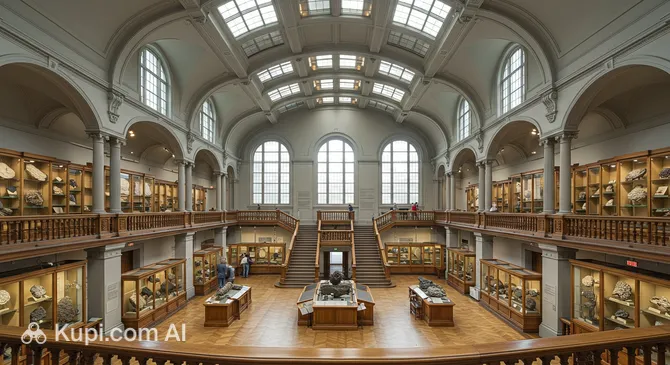
Geology Museum. Source: Kupi.com AI

The museum is famous for its impressive dinosaur skeletons, most notably the Tyrannosaurus and Stegosaurus. It also houses one of the oldest crystals on the planet, as well as an extensive collection of fossils and minerals that clearly illustrate the foundation upon which our planet is built. The exhibits tell the detailed story of how Wisconsin's landscape was shaped by the powerful influence of ancient glaciers.

With high ratings and free admission, the museum has become a favorite destination for families and all natural history enthusiasts. It is not just a display of rocks, but a true chronicle of the planet brought to life by the discoveries of university researchers.

Contacts

To plan your visit to this scientific center, we recommend checking the official contact information in advance. Below are the key details to help you easily find the museum and contact its staff for questions about your visit or educational programs.

Address 1215 W Dayton St, Madison, WI 53706, USA
Phone +1 608-262-1412
Official Website https://museum.geoscience.wisc.edu/

What to Do

The main draw for visitors is, undoubtedly, the majestic dinosaur skeletons. You can see the mighty Tyrannosaurus rex and the spiked Stegosaurus, seemingly frozen in time. In addition to these giants of the past, there are exhibits dedicated to climate change: you can trace how melting glaciers shaped the local lakes and the state's topography.

Special attention should be paid to unique artifacts, such as the oldest crystal on Earth, which is kept under strict protection. Science buffs will appreciate the opportunity to see the fossils of Ahvaytum bahndooiveche—the oldest dinosaur in North America, discovered by University of Wisconsin paleontologists. This find allows you to literally look back 230 million years and understand how life evolved in the Northern Hemisphere.

For those who prefer an interactive approach, the museum offers educational displays about "sun stones" and rare minerals. You can explore the geological diversity of the region and see traces of glaciers found right in the Madison area, making a walk through the museum informative for guests of all ages.

Getting There

Finding the museum is quite easy, as it is located on the University of Wisconsin campus at 1215 W Dayton St. Thanks to the university's well-developed infrastructure, it can be easily reached by car or public transport. City buses run regularly through the university district, and the nearest stops are just a few minutes' walk from the entrance.

If you prefer more comfort, you can use a taxi or popular ride-sharing services from the city center. For those who enjoy walking, the route from downtown Madison takes about 20–30 minutes. The path crosses the scenic isthmus between the lakes, allowing you to combine your journey to the museum with a pleasant view of the city landscape.

History & Facts

The history of the collection is inextricably linked to the region's geological past. Approximately 23,000 years ago, a massive glacier reached the area of modern-day Madison, creating a unique landscape of conical hills and lakes. The melting of the ice sheet left behind a wealth of research material, which is now featured in exhibits dedicated to Glacial Lake Wisconsin.

The University of Wisconsin itself, founded in 1848, has been a hub for major paleontological discoveries for decades. A significant milestone in the museum's history was 2013, when a team of scientists led by Dave Lovelace discovered the fossils of Ahvaytum bahndooiveche. This discovery confirmed the existence of early dinosaurs in North America approximately 230 million years ago.

Another notable fact dates back to 2005, when the museum displayed the oldest crystal on the planet, highlighting the institution's status in studying Earth's geochronology. Furthermore, the museum's exhibits reflect the history of Paleo-Indians settling the region around 10,000 BCE, telling the story of cultures that used copper and ceramics long before modern settlements appeared.

Time Needed

To fully explore the main exhibits, most visitors are recommended to set aside about 1–2 hours. This is plenty of time to leisurely view the dinosaur skeletons and the mineral collection, and to study the informational displays about the Ice Age.

If you are visiting with children or have a professional interest in geology, your visit may last longer. Although the museum is compact, it is filled with unique details that encourage a thoughtful study of the history of life on our planet.

Working Hours

The museum is open to the public on weekdays from 08:30 to 16:30. On Saturdays, there are reduced hours from 09:00 to 13:00, and it is closed on Sundays.

Please note that hours of operation may be adjusted based on the university's academic calendar or holidays. It is recommended to check the current schedule on the museum's official website before your visit.

Nearby

Exploring the campus surroundings can significantly enrich your trip. After diving into the world of ancient fossils, it’s worth spending time at the architectural landmarks and recreation areas located nearby.

Below are some of the most interesting nearby sites to help you plan a complete city itinerary:

Name Type Distance (km)
Wisconsin Field House - 0.6
Mansion Hill Inn - 1.8
Wisconsin Masonic Center - 1.8
Wisconsin State Capitol - 1.9
The Livingston Inn - 2.6
Sky Zone Madison - 3.8
Garver Feed Mill - 6.4
Urban Air Trampoline and Adventure Park - 8.5
Reindahl Park Splash Pad - 9.4
Crawdaddy Cove Indoor Water Park - 9.6

Reached the end of the page?

That means the route is fully explored