Support

Colonial Fort Condé

About

In the heart of the historic district of Mobile, it is impossible to miss the majestic brick walls that seem to transport visitors three centuries back in time. Colonial Fort Condé is a unique reconstruction of an 18th-century French fortress that once served as the primary outpost and administrative center of eastern French Louisiana in the USA.

The original structure, built in 1723, covered a vast area and served as a reliable defense for the strategically important Mobile Bay. The modern complex, opened in 1976, replicates approximately one-third of the original fort, preserving the scale and authentic appearance of the defensive structure.
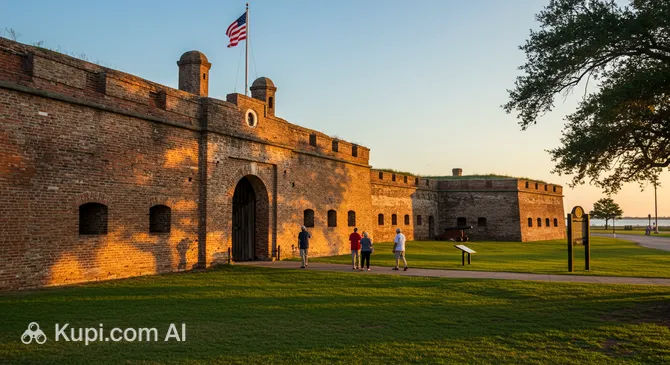
Colonial Fort Condé. Source: Kupi.com AI

Today, the fort functions as a living museum and the city's official hospitality center. Here, history stops being dry textbook facts and becomes a tangible experience, allowing guests to see how life was built and defended on the southern frontiers of the North American continent during the colonial period.

Contacts

When planning your visit to Colonial Fort Condé, it's helpful to have up-to-date contact information. The site is managed by the History Museum of Mobile and is always ready to welcome curious travelers.

Address 150 S Royal St, Mobile, AL 36602, USA
Phone +1 251-544-5480
Official Website historymuseumofmobile.com/colonial-fort-conde/

What to Do

A visit to Colonial Fort Condé offers guests many interesting activities. One of the main highlights is the tours led by guides in period costumes. They don't just recount facts; they literally bring the past to life, sharing stories of daily life for soldiers and townspeople during the French, British, and Spanish periods.

While on the fort grounds, be sure to stop by the gift shop, where you can find not only standard souvenirs but also high-quality historical literature. For archaeology buffs, the original fragments of the 18th-century fort foundation are of particular interest. These artifacts were discovered during tunnel construction in the 1960s and are now carefully displayed in Mardi Gras Park, right across from the fortress.

The fort is ideal for family outings and educational trips. Here, you can climb the ramparts to appreciate their strength and strategic importance or simply enjoy the atmosphere of the old city. This site provides a clear understanding of how Mobile developed as a key port hub and the role it played in shaping the culture of the American South.

Getting There

Reaching one of Alabama's premier historical locations is quite simple, as Colonial Fort Condé is situated in the heart of downtown at 150 South Royal Street. A great landmark is the popular Mardi Gras Park, located in the immediate vicinity of the fortress walls.

For those traveling by car, the route to the fort is convenient thanks to its proximity to major city thoroughfares. Parking areas are available around the attraction. If you are staying in the central part of Mobile, the best option is a pleasant walk, which also allows you to admire the architecture of the historic district along the way.

The city also has a well-developed public transportation network, with many bus routes passing through the center. Additionally, you can always use taxis or popular rideshare services to quickly reach the fort from any point in the city or the waterfront.

History & Facts

The history of this site began in 1723 when the French built a powerful fortification according to the principles of the famous military engineer Sébastien de Vauban. Originally named Fort Louis, it was later renamed Fort Condé in honor of the Prince of Condé, the brother of King Louis XIV. Notably, the brunt of the construction work was carried out by enslaved people brought from West Africa.

Over the centuries, the fort changed hands and names multiple times, reflecting the region's turbulent history. In 1763, it passed to the British and was renamed Fort Charlotte. However, in 1780, Spanish troops under the command of Bernardo de Gálvez captured the citadel after a two-week siege, renaming it Fuerte Carlota. It wasn't until 1813, during the presidency of James Madison, that American troops occupied the fort, finally securing it for the USA.

By 1823, the original structure was almost entirely dismantled, and its remains were used as fill for swampy areas along the shoreline. The fort's modern life began only in the 1970s, when a large-scale reconstruction returned this historical symbol to the city. The grand opening of the restored fort took place on July 11, 1976, coinciding with the bicentennial of United States independence.

Time Needed

To fully experience the exhibits and soak in the colonial atmosphere, most travelers need about 1–2 hours. This is plenty of time to leisurely explore all the reconstructed rooms, study the information displays, and take commemorative photos against the backdrop of the massive walls.

If you plan to join a guided tour or wish to carefully study the details of 18th-century daily life, we recommend allowing a bit more time. A visit to the fort is an excellent addition to a walk through the city center, and it won't overwhelm even the youngest tourists.

Working Hours

You can visit the historic fortress throughout the week, though the schedule varies slightly depending on the day. From Monday to Saturday, Colonial Fort Condé is open to guests from 09:00 AM to 4:30 PM. On Sunday, visiting hours are shorter—the museum doors open at 1:00 PM and remain open until 4:30 PM.

Before your visit, we recommend checking the official website or calling to confirm, as the schedule may change on holidays or during special events.

Nearby

Exploring the area around Colonial Fort Condé allows for a deeper immersion into the atmosphere of the old American South. The district surrounding the fortress is steeped in history, with unique architectural monuments and museums around every corner.

Thanks to its convenient downtown location, you can easily plan a rich walking tour, combining a visit to the fort with tours of historic mansions and quarters. Below is a list of nearby points of interest:

Attraction Name Distance (km)
Condé-Charlotte Museum 0.1
Kennedy-Cox House 0.9
Boyington Oak Tree 1.1
Aimwell Missionary Baptist Church 1.7
Oakleigh Historic District 2
Duffie Oak 2.1
The Pillars Mobile 4.1
Midtown Historic District 4.7
Hank Aaron Childhood Home and Museum 4.9
Africatown Historic District 5.1

Reached the end of the page?

That means the route is fully explored