Support

Allegheny County Airport

About the Airport

Allegheny County Airport
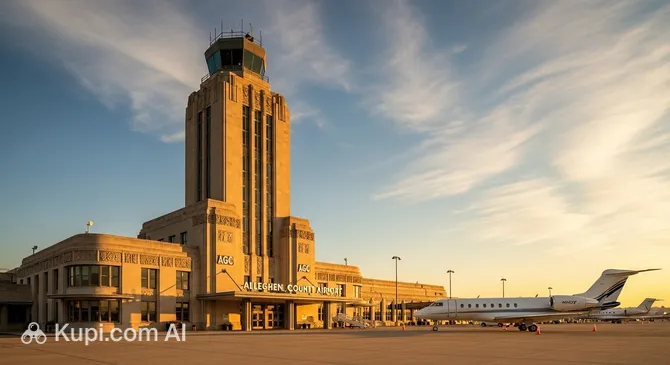
Allegheny County Airport. Source: Kupi.com AI
Allegheny County Airport (AGC) is not merely a transport hub, but a true architectural monument located in the suburbs of Pittsburgh. Unlike bustling international hubs, an atmosphere of exclusivity and tranquillity reigns here, characteristic of business aviation centres. Its terminal, designed in an elegant Art Deco style, transports travellers back to the golden age of flight in the 1930s, reminiscent of Hollywood movie sets. Today, the airport serves as the main aerial gateway for private jets, corporate flights, and medical aviation, offering fast and comfortable access to the city centre.
IATA CodeAGC
ICAO Code KAGC
City Pittsburgh (West Mifflin)
Distance to Centre ~12 km
Status General Aviation (business jets, private flights)
Annual Passengers Approximately 60,000 take-offs/landings per year
ScheduleOnline board
### Features and Advantages of the Airport Allegheny County Airport represents a unique combination of history and modern VIP service. Here is what makes it remarkable: * Unique Architecture: The airport terminal is a historical landmark. Its white façade with black and green elements, along with exquisite Art Deco interiors, make it one of the most beautiful small airports in the USA. The building is so picturesque that it is often used for filming movies. * Proximity to the City: The airport is located just 12 kilometres from the business centre of Pittsburgh, which is significantly closer than the main international airport. This makes it the ideal choice for business travellers who value their time. * No Queues: Since the airport does not serve regular commercial airlines, there are no crowds of tourists or lengthy security checks here. The arrival and departure process is maximally fast and confidential. * Historical Significance: Opened in 1931, it was one of the largest and most advanced airports of its time. Many aviation pioneers landed right here.

Contact Information

  • Official Airport Website: flypittsburgh.com/agc
  • Administration and Information Phone: +1 412-466-1275 (Administration and passes), +1 412-466-3026 (Management Office)
  • Airport Address: 12 Allegheny County Airport, West Mifflin, PA 15122, USA
  • Email: agcinfo@flypittsburgh.com
  • Social Media: Airport news can be found on the FlyPittsburgh management company accounts on Facebook, Instagram, and X (Twitter)
  • Lost and Found Information: Since the airport serves private and business aviation, there is no centralised lost and found bureau. For forgotten items, it is recommended to contact your Fixed Base Operator (FBO), for example, Atlantic Aviation (+1 412-267-8000) or Corporate Air (+1 412-469-6800), or the airport administration.
  • Support Service Contacts: For general enquiries, you can use the feedback form on the FlyPittsburgh website or write to the general email info@flypittsburgh.com.

How to Get to the Airport

Getting to Allegheny County Airport (AGC) is significantly easier and faster than reaching major international hubs, thanks to its location just 12 kilometres south of downtown Pittsburgh and the absence of heavy traffic characteristic of large passenger terminals. Since the airport primarily serves private and business aviation, the transport infrastructure here is oriented towards comfort and an individual approach.

When planning your route, consider that the airport is located in the West Mifflin area. Travel time from Downtown usually takes 20–30 minutes, however, during peak hours, it may increase to 45 minutes.

Taxi and Transfer

This is the most popular and convenient way to get to the airport for business aviation clients. A car can be summoned via popular mobile apps (Uber, Lyft) or by ordering a classic taxi.

  • Cost: A trip from downtown Pittsburgh to AGC usually costs in the range of $25–$40 for standard class and up to $60–$80 for premium vehicles.
  • Pick-up/Drop-off Point: Taxis and personal drivers can drive directly up to the main terminal or to the offices of Fixed Base Operators (FBO), such as Atlantic Aviation, which eliminates the need to walk long distances with luggage.

Personal Car and Rental

If you prefer to drive yourself, you can reach the airport via highway PA-51 South (Saw Mill Run Boulevard) or via PA-885 South. The road is intuitive, and navigation systems accurately lead to the main entrance at Lebanon Church Road.

Car Rental:
There are no giant rental counters in the airport itself, as in international terminals, but rental can be organised in advance. Major companies (Hertz, Enterprise) cooperate with local FBOs and can deliver the ordered car directly to the steps of your aircraft. It is recommended to book a car at least 24 hours before arrival.

Airport Parking

One of the main advantages of Allegheny County Airport is parking. Unlike large aviation hubs with expensive and confusing car parks, everything here is arranged for the convenience of visitors.

  • Accessibility: Parking is located in the immediate vicinity of the historic terminal building.
  • Cost: As a rule, short-term and even long-term parking here is complimentary for airport clients, although it is better to clarify the rules with your flight operator or FBO before departure.

Public Transport

Although the airport is oriented towards business aviation, it can be reached by public transport if you are travelling light. The area is served by Pittsburgh Regional Transit (PRT).

The most suitable route is bus 51 (Carrick), which travels from downtown Pittsburgh along Route 51. You will need to get off at the stop near Lebanon Church Road and walk about 10–15 minutes to the terminal. The fare is approximately $2.75. This option is rarely used by private flight passengers but may be useful for aviation enthusiasts wishing to inspect the historic building.

Nearest Alternative Airports

If your flight does not arrive at AGC, or you are planning a complex route with transfers, it is useful to know about other air harbours in the region. The main commercial hub is Pittsburgh International Airport (PIT), located approximately 32 km from AGC. It receives the majority of scheduled flights from major airlines.

For travel to neighbouring regions, the following may also be convenient:

Terminals and Map

The structure of Allegheny County Airport (AGC) differs radically from the familiar giant passenger hubs. Here you will not find endless corridors, a confusing system of gates, or trains between terminals. It is a compact, intuitively understandable complex created for the maximum efficiency and comfort of private aviation. All infrastructure is concentrated around the historic building and the service operators' hangars.

Terminals and Their Purpose

In fact, the airport consists of one main historic building and several specialised service centres (FBO — Fixed Base Operators), which perform the functions of "personal terminals" for private flight passengers.

  • Main Terminal: This is the heart of the airport, the very building in Art Deco style. Currently, it serves as an administrative centre, housing county police offices and some management services. Although passengers can enter here to admire the architecture, direct boarding for most private flights does not take place through the central entrance of this building.
  • FBO Centres (Atlantic Aviation and Corporate Air): These specific buildings are the "terminals" for 99% of passengers arriving at or departing from AGC. They are standalone complexes with their own lounges, car parks, and exits to the apron.

Layout and Navigation

Navigation around the airport territory is extremely simple. The complex is located along Lebanon Church Road. All key facilities are within one zone and are clearly visible from the road.

  • Departure and Arrival Zones: At AGC, there is no strict separation into departure and arrival floors. In FBO centres, this is usually a single space on the ground floor. You simply pass through the lobby directly to the exit onto the airfield.
  • Transfers: Transferring between buildings is usually not required. If your aircraft is serviced by Atlantic Aviation, you head straight to their building. The distance between facilities is small, but it is customary to move between them by car.

Service Features and Interiors

The atmosphere inside the "terminals" (FBOs) resembles the lobby of a fine hotel, not a train station. There is no noise or bustle here.

  • Lounge Zones: Instead of hard seats at gates, soft sofas, complimentary coffee, press, and Wi-Fi await you.
  • Conference Rooms: Both main operators offer meeting rooms so you can hold a meeting immediately after landing.
  • Amenities for Pilots: Separate rest areas for crews with showers and "quiet rooms" for sleep.

Check-in and Screening: Saving Time

The main advantage of Allegheny County Airport is speed. Procedures here differ strikingly from commercial flights.

Procedure Time:
You do not need to arrive 2–3 hours in advance. Usually, it is sufficient to arrive 15–20 minutes before the scheduled departure time. If you are flying by private jet, the pilots will be waiting specifically for you.

Check-in and Security:
There are no long queues for TSA (Transportation Security Administration) screening here, characteristic of scheduled flights (although random checks are possible). "Check-in" often consists of greeting the staff member at the reception desk and meeting your pilot. In many cases, a car can drive right up to the aircraft steps to load luggage (tarmac access) if this has been agreed in advance.

Navigation Recommendations for Passengers

To ensure your visit goes perfectly smoothly, follow these simple tips:

  • Clarify the Operator (FBO): Before leaving, be sure to check with your broker or pilot which FBO is handling your flight — Atlantic Aviation or Corporate Air. They have different entrances and car parks, although they are located next door.
  • Use the Correct Address for GPS: Do not simply enter "Allegheny County Airport". It is better to specify the exact address of the required FBO (for example, 15 Allegheny County Airport for Corporate Air) so that the navigator leads you directly to the door of the correct terminal.
  • Parking: Leave your car in the designated car park at the chosen FBO. Staff often offer valet parking services.

History of the Airport

Opening and the Golden Era

The history of Allegheny County Airport (AGC) begins in the era of romance and the rise of civil aviation. The official opening took place on 11 September 1931. It was a grand event for the entire region: more than 100,000 spectators gathered for the solemn opening ceremony to see air races and parachute shows, marking the beginning of a new transport era for Pittsburgh.

At the time of construction, AGC was the third-largest airport in the USA and was considered a true engineering marvel. Its construction cost approximately 3.5 million dollars — a colossal sum for the Great Depression era. It was one of the first airfields in the country with paved runways, which allowed it to receive aircraft in almost any weather, distinguishing it favourably from the majority of dirt fields of that time.

Changing Roles: From Main Hub to Business Aviation

For two decades, AGC served as the main aerial gateway of Pittsburgh and one of the key hubs for the entire country. The largest airlines of that era, such as TWA and Capital Airlines, were based here. However, after World War II, aviation began to develop rapidly: liners became larger, heavier, and required significantly longer runways for take-off.

The geographical position of the airport on a plateau limited opportunities for large-scale expansion. Therefore, in 1952, a new, more spacious Greater Pittsburgh Airport (now Pittsburgh International Airport, PIT) was opened. From that moment, scheduled passenger airlines left AGC, and it began its new chapter as an elite centre for general aviation, serving private, corporate, and government flights.

Renovations and Preserving Heritage

The terminal remains the airport's main pride. Unlike many historic airport terminals in America that were demolished for the sake of functionality, the AGC building survived. In the 1990s, a large-scale restoration costing several million dollars was carried out, aimed at returning the interiors and façade to their original Art Deco brilliance while maintaining functionality.

Modern upgrades mainly concern the technical side: updating navigation equipment, improving runway surfaces, and building new, modern hangars for business jets, while the historic architectural appearance of the complex is carefully protected as a historical monument.

Interesting Facts and Historical Events

  • Star Guests: In the 1930s and 40s, many legendary personalities passed through the terminal. Aviation pioneers Charles Lindbergh and Amelia Earhart landed here, as well as sitting US Presidents, including Franklin D. Roosevelt and Harry Truman.
  • Cinematic Venue: Thanks to its authentic and elegant look, the airport often becomes a set for Hollywood. Scenes for the films "Gung Ho", "The Mothman Prophecies", and other pictures requiring the atmosphere of a classic mid-20th-century airport were filmed here.
  • Unique Design: Architect Stanley L. Roush designed the main building so that from a bird's eye view, it resembles an aeroplane with spread wings. The façade is decorated with unique black and green glazed tiles and steel friezes.
  • First Lady of Aviation: In the early years of the airport's existence, Helen Richey often visited and worked here — the first female pilot hired by a commercial airline in the USA. She was a native of this region and often flew specifically from AGC.

Services and Amenities

Since Allegheny County Airport (AGC) specialises in serving private and business aviation, the range of services provided here differs substantially from customary commercial airports. There are no huge duty-free shops or noisy food courts here. Instead, service is focused on exclusivity, speed, and an individual approach provided by the Fixed Base Operators (FBO) — Atlantic Aviation and Corporate Air.

Restaurants, Cafés, and Shops

In the FBO terminals, you will not find fast-food chains or coffee shops like Starbucks. Service is built on an "all-inclusive" principle within the framework of business aviation service.

  • Dining in Lounges: In waiting areas, passengers are offered freshly brewed coffee, tea, soft drinks, fresh pastries, snacks, and fruit free of charge.
  • Catering: For a full meal on board or before departure, you can order food delivery from the best restaurants in Pittsburgh via your operator's concierge service. It is better to place an order in advance.
  • Shopping: There are no retail shops at the airport. However, in the lobby, you can find small display cases with aviation-themed souvenirs or essential items for pilots.

Lounges and Business Services

At AGC, the concept of a "waiting hall" is synonymous with the concept of a "terminal". All passenger stay zones in FBO buildings correspond to the standards of VIP lounges in major airports.

  • Comfort: Spacious lobbies are equipped with soft leather furniture, televisions, and press. The atmosphere here is quiet and conducive to relaxation.
  • Wi-Fi and Connectivity: Free high-speed Wi-Fi works throughout the FBO complexes. Rest zones are provided with a sufficient number of sockets and charging stations for gadgets.
  • Conference Rooms: Specially equipped meeting rooms are available for business travellers. You can hold a meeting with partners immediately after landing without travelling into the city. It is recommended to book the conference room rental service in advance.

Financial and Medical Services

The airport infrastructure is oriented towards short-term stays, so the set of additional services is limited.

  • Banks and ATMs: ATMs for withdrawing cash (USD) may be located inside FBO buildings, however, there are no full-service bank branches or currency exchange points here. It is recommended to arrange cash in advance or use banks in the West Mifflin area (5 minutes by car).
  • Medical: There is no pharmacy or medical point for passengers at the airport. However, staff are trained in first aid, and defibrillators (AED) are available at the facilities. Given that AGC is a base for medical aviation, in emergencies, help will arrive immediately.

Services for Passengers with Children and Special Needs

Although there are no specialised playrooms here, travelling with children via AGC is much easier thanks to the absence of queues and crowds.

  • For Children: FBO staff are usually very welcoming to young travellers and can offer colouring books or treats. Quick access to the aircraft saves parents from the stress associated with long waits.
  • Accessible Environment: All FBO buildings are single-storey or equipped with ramps, making them fully accessible for passengers in wheelchairs. Staff are always ready to assist with boarding and disembarking, and a car can drive right up to the aircraft steps for the most comfortable transfer of passengers with limited mobility.

Hotels Near the Airport

There are no hotels on the airport territory itself, but thanks to its location in the developed West Mifflin area, finding accommodation is not difficult. Staff at the FBO reception desk can help you book a room with a discount for airport clients.

Nearest Options (within a 3–5 km radius):

  • SpringHill Suites by Marriott West Mifflin: A modern hotel popular among crews and business tourists.
  • Hampton Inn Pittsburgh/West Mifflin: A reliable option with complimentary breakfast, located literally a few minutes' drive along Lebanon Church Road.
  • Extended Stay America: Suitable for those planning to stay in the region for a longer period.

Where to Eat

The gastronomic experience at Allegheny County Airport (AGC) differs radically from what scheduled airline passengers are used to. Since the airport is not a commercial hub, you will not find noisy food courts, chain cafés like Starbucks or McDonald's inside the terminals themselves. The catering system here is adapted to the specifics of private aviation: speed, individual approach, and exclusive catering.

Dining Inside the "Terminals" (FBO)

For passengers departing via the Atlantic Aviation or Corporate Air service centres, the dining concept is built around comfortable waiting in the lounge zone. There are no menus with prices here, as basic refreshments are provided free of charge as part of the premium service.

  • Assortment: Freshly brewed coffee (usually premium blends), tea, bottled water, juices, and carbonated drinks are always available in the lobbies of both operators. Food offerings include light snacks: fresh pastries (muffins, croissants), biscuits, fruit, nuts, and individually wrapped snacks.
  • For Whom: Available to all passengers and crews awaiting departure.
  • Cost: Included in the service cost (complimentary for the passenger).
  • Opening Hours: Self-service zones are available around the clock or during FBO opening hours (usually 24/7 upon prior flight request).

In-Flight Dining and Catering

If you have a flight ahead and wish to have a full lunch or dinner on board, catering is organised via your FBO's concierge service. This is the main way to access restaurant dishes immediately before departure.

  • How It Works: An order must be placed in advance (at least 24 hours). Food is delivered from the best restaurants in Pittsburgh or specialised catering companies.
  • Menu and Diet: There are practically no limitations. You can order vegan, gluten-free, Halal, or Kosher dishes. Both light salads and sandwiches, as well as complex hot dishes, are popular.
  • Price Range: High-end. The cost depends on the chosen restaurant and the complexity of the order.

Restaurants in the Immediate Vicinity (Landside)

Since procedures at AGC are very fast, many passengers and greeters prefer to eat before arriving at the airport. The airport is located in the West Mifflin area, next to the busy Route 51 (Clairton Blvd) and Lebanon Church Road. A huge number of establishments are concentrated here, reachable within 2–5 minutes by car.

For a Quick Bite (Fast Food & Casual):
Within a 1–2 km radius, there are popular American chains operating from early morning until late evening:

  • Panera Bread — an excellent option for a healthy breakfast, soups, and sandwiches (many vegetarian options).
  • Chick-fil-A, Wendy's, Arby's — for those in a rush.
  • Dunkin' — if you need a coffee to go before heading to the airfield.

For a Full Lunch or Dinner:
If you have about an hour to spare, we recommend visiting full-service restaurants located literally at the entrance to the airport zone or a little further along the highway:

  • Eat'n Park: A legendary local family restaurant chain that is a hallmark of the region.
    What to try: Be sure to order their famous Smiley Cookie — a symbol of Pittsburgh. They also serve excellent breakfasts all day and classic burgers.
    Average bill: $15–$25. Kids' menu available.
  • Olive Garden Italian Restaurant: A popular Italian-American cuisine restaurant located a couple of minutes' drive away on Route 51.
    What to try: Unlimited salads and breadsticks, classic pasta, and soups. Suitable for vegetarians.
    Average bill: $20–$35.
  • LongHorn Steakhouse: An excellent choice for meat lovers. The restaurant offers quality steaks in a casual atmosphere.
    What to try: Signature Flo's Filet or Outlaw Ribeye steaks. A gluten-free menu is available.
    Average bill: $25–$50.

Time Recommendations:
Considering the absence of full-service cafés inside the FBO, we recommend having a substantial meal in the city or at establishments on Route 51 before entering the airport territory. If you prefer maximum privacy, ordering catering on board remains the best solution.

Tips for Travellers

Travelling via Allegheny County Airport (AGC) differs radically from the experience of flying via large commercial hubs. There is no stress, endless queues, or rigid restrictions characteristic of scheduled airlines here. To ensure your flight is as comfortable and efficient as possible, we have prepared a number of recommendations considering the specifics of private and business aviation.

Arrival Time Recommendations

Forget the rule of "arriving 2–3 hours in advance". Everything happens much faster at AGC.

  • Optimal Time: Arrive at the FBO terminal (Atlantic Aviation or Corporate Air) 15–20 minutes before the scheduled departure. This time is sufficient to meet the pilot, hand over luggage, and proceed to the aircraft.
  • Do Not Be Late: Although a private jet usually waits for its passenger, pilots have strict limitations on duty time and booked take-off/landing slots at the destination. A significant delay can lead to flight cancellation for technical reasons.

Check-in and Security

Procedures at AGC take place in a relaxed and private atmosphere.

  • Documents: Keep your identification (ID or passport) to hand. It will be checked by a staff member at the FBO reception or personally by the aircraft captain.
  • No Queues: There are no metal detector frames or body scanners here, as in TSA (except for large charter programmes). You do not need to remove shoes or belts. Screening is conducted visually and quickly by the crew.
  • Direct Access: If your car and driver have passed preliminary vetting, in many cases it is possible to drive directly to the aircraft steps (ramp access), bypassing the terminal building.

Hand Luggage and Baggage

Rules for carrying items here are more flexible but depend on the aircraft type.

  • Liquids: The "100 ml rule" does not apply here. You can calmly bring your favourite drink, full-size perfume, or cosmetics on board.
  • Type of Bags: We strongly recommend using soft travel bags instead of rigid plastic suitcases. Luggage compartments of business jets (especially light classes) have non-standard shapes, and soft luggage is much easier to stow.
  • Prohibited Items: Dangerous goods (explosives, flammable liquids, etc.) are still prohibited by FAA rules. If you plan to carry hunting weapons, be sure to warn the operator in advance — they must be unloaded and packed in a case.

Choosing a Seat on the Plane

In private aviation, there are no boarding passes with seat numbers, but there are nuances.

  • Cabin Configuration: Clarify the layout in advance. Seats are often arranged facing each other (club seating). If you are uncomfortable flying backwards, discuss this with fellow travellers or the crew before boarding.
  • "Owner's Seat": On some corporate jets, there is an unspoken "main seat" (usually on the starboard side with the best view and cabin controls). If you are a guest, clarify where it is best for you to sit.

Tips for Transfer Passengers

AGC is rarely used for transit, but if you are changing aircraft here:

  • Luggage: Unlike scheduled flights, luggage is not transferred automatically. Ensure that ground service staff (line service) have moved your items from one aircraft to the other.
  • Waiting: Use the time between flights to relax in the FBO lounge. It is quiet there, Wi-Fi is available, as are meeting rooms, allowing you to spend time productively.

Customs Control (For International Flights)

Allegheny County Airport is an international airport (port of entry), but customs here works on request.

  • Notification: If you are arriving from abroad, your operator must notify US Customs and Border Protection at least within the time specified in flight rules (usually several hours in advance).
  • Procedure: Officers will meet you directly at the aircraft or in a specially designated FBO zone. You do not stand in a general queue with hundreds of other passengers. The entire process usually takes 10–15 minutes.

How to Save Time and Money

  • Transfer to Steps: Order a rental car (e.g., via Hertz or Enterprise) delivered directly to the aircraft (Go Rentals specialises in this). This saves you 20–30 minutes upon arrival: you exit the plane, get into the car, and drive away.
  • Empty Legs: If you are flexible with dates, ask brokers about the possibility of flying via the "Empty Legs" system (return empty flight). Such departures from/to Pittsburgh can cost 50–70% less than a regular charter.
  • Dining: Catering on board is expensive. If the flight is short, have a snack in the city or take complimentary snacks and coffee in the FBO lobby before departure.

What to Do in Case of Flight Delay

Delays in business aviation are most often related to bad weather or (less frequently) technical maintenance.

  • Comfortable Waiting: Do not sit in the plane. Return to the FBO lounge. There are comfortable sofas, TV, and drinks there.
  • Direct Communication: The main advantage of private flights is the ability to speak directly with the crew commander. The pilot will personally explain the situation and give a realistic departure forecast, without intermediaries like gate agents.
  • Plan B: If departure is impossible, FBO staff will help to promptly book a hotel in the West Mifflin area or a transfer to the large Pittsburgh airport (PIT) if you decide to fly by scheduled flight.

Reached the end of the page?

That means the route is fully explored