Support

The Alamo

About

The Alamo, also known as the Mission San Antonio de Valero, is one of the most significant historical landmarks not only in Texas but in the entire USA. Located in the heart of San Antonio, this complex is a symbol of courage and an important part of the region's cultural heritage, attracting millions of visitors annually. Originally founded in the 18th century as a Catholic mission to convert the local Indigenous people to Christianity, the Alamo eventually transformed into a true fortress.

Today, the Alamo is primarily a museum and a revered historical monument. The complex of buildings includes the famous church and adjacent structures surrounded by walls that once served for defense. Walking through the grounds, you can see not only historical buildings but also a cozy courtyard with a garden, where it is pleasant to relax in the shade of sprawling trees. Inside the former chapel is a museum with artifacts telling the story of this place's rich and heroic past.
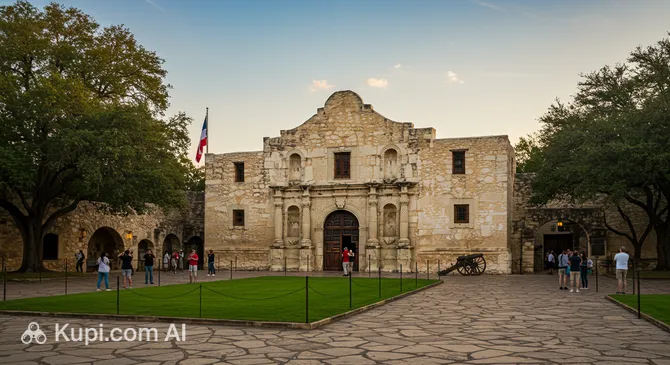
The Alamo. Illustration.
Source: Kupi.com AI

Traveler photos:

A visit to the Alamo is a unique opportunity to touch history. The complex is of great interest to anyone who wants to better understand the history of Texas and the formation of the American state. It is a place where the fates of Spanish missionaries, Indigenous tribes, and Texan settlers intertwined. Due to its cultural and historical significance, the Alamo, along with other San Antonio missions, was included in the UNESCO World Heritage list.

Contacts

To get the most up-to-date information on operating hours, special events, and ticket bookings, it is recommended to visit the official Alamo website or contact its representatives directly. Below are the primary contact details for this historic complex.

How to contactContact
Address300 Alamo Plaza, San Antonio, TX 78205, USA
Phone number+1 210-225-1391
Websitewww.thealamo.org

What to Do

A visit to the Alamo is a true immersion into history. Inside the complex, a museum awaits you with exhibits that detail the site's multifaceted past: from its origins as a religious mission to its transformation into a famous fortress. You will have the opportunity to explore well-preserved historical buildings, including the main mission building, and imagine how life unfolded within these walls centuries ago. This is a unique chance to get close to artifacts that tell the story of key events in Texas history.

Special attention is drawn to the defensive structures, which serve as a reminder of the heroic defense. You can see the remains of the fortress walls and the battery where cannons were once mounted, feeling the spirit of the time. To better understand the significance of the events that took place here, it is worth joining one of the tours. Experienced guides offer engaging stories about the history of the Alamo, its key role in the state's formation, and the legendary battle that made it a symbol of courage.

In addition to exploring the historic buildings, you can enjoy a pleasant time on the Alamo grounds by strolling through the well-maintained gardens. This is a great place to relax in the shade of trees after a busy tour, enjoy the peaceful atmosphere, and take beautiful photos. Thus, a visit to the Alamo offers a harmonious combination of educational experience and pleasant relaxation, leaving visitors with vivid and unforgettable impressions.

Getting There

Getting to the Alamo is quite simple thanks to its location in the very heart of San Antonio. If you are staying downtown, the best way to get there is a pleasant walk. Many hotels, as well as the famous River Walk, are within walking distance of this historic landmark. This route will allow you not only to reach your destination but also to get a better feel for the city's atmosphere.

For those who prefer public transport, San Antonio operates the VIA Metropolitan Transit bus network, with routes covering the entire city. Numerous buses, including numbers 21, 24, 30, 100, and others, stop just a few minutes' walk from the Alamo. Additionally, Hop-On-Hop-Off tourist buses circulate through the city and stop right at Alamo Plaza, which is a convenient way to combine your travel with a tour.

You can also use taxis or popular ridesharing services, which offer a fast and convenient option, especially if you are coming from more distant parts of the city. Driving is also possible; however, please note that the Alamo complex itself has no onsite parking. There are many paid parking lots located around the area, but finding a free spot downtown can be difficult, so public transport or taxis are often more practical choices.

Nearest city: San Antonio

History & Facts

The history of the Alamo, one of the most iconic sites in the USA, dates back to the early 18th century. Originally, it was the Catholic mission of San Antonio de Valero, founded by Spanish missionaries in 1718. Its main goal was the conversion and education of the local Indigenous population. The name "Alamo," which means "cottonwood" in Spanish, appeared later when the former mission housed a unit of Mexican soldiers from the town of Alamo de Parras. Even back then, the complex was built with a potential defense against raids in mind and was enclosed by a wall.

By the end of the 18th century, the mission lost its religious significance and was abandoned, after which its buildings began to be used for military purposes. Initially, it housed Spanish troops and a hospital, and during the Mexican War of Independence, the complex reportedly served as a prison. After Mexico gained independence, a small garrison was stationed at the Alamo, and the former mission was partially converted into a fort. However, the fortifications were not ideal: the fortress wall was not continuous and was interrupted by a palisade in some places.

The most famous and tragic event in the history of the Alamo was the Battle of the Alamo, which took place in 1836 during the Texas Revolution. For 13 days, from February 23 to March 6, a small band of Texan volunteers numbering about 200, including famous figures such as James Bowie and Davy Crockett, defended the fort against a Mexican army of several thousand under the command of General Antonio López de Santa Anna. The siege ended with an assault in which almost all the fort's defenders were killed. Despite the defeat, their heroic resistance inspired Texans, and the cry "Remember the Alamo!" became a symbol of the struggle for independence, which led to a decisive victory in the war and turned the Alamo into a shrine of Texas liberty.

Time Needed

When planning a visit to the Alamo, you should aim for a duration of 1 to 2 hours for a basic tour. This time is generally sufficient to walk leisurely through the entire grounds, see the famous church, view the main exhibits in the Long Barrack, and feel the atmosphere of this historic site. If you are short on time, you can manage in an hour, but for a more thoughtful introduction, it is better to set aside a little more time.

If you want to dive deeper into history and not miss a single detail, feel free to plan for 3–4 hours or even half a day. The length of your visit may increase if you decide to join a guided tour, which usually lasts about an hour and offers fascinating stories about the events and heroes of the Alamo. Additional time will also be required to visit the new exhibition center with its collection of artifacts or to watch "living history" demonstrations, which are held regularly on the complex grounds.

Working Hours

The Alamo complex is open to visitors year-round, except for Christmas. The main grounds and historical buildings are accessible for viewing daily, typically from 9:00 AM to 5:30 PM. It is worth noting that exhibition pavilions, such as the Ralston Family Collections Center, may close slightly earlier at 5:00 PM, and last entry to the grounds is usually permitted 30 minutes before closing. Visiting the Alamo grounds themselves is free, allowing everyone to touch this important symbol of Texas history.

Although entry to the grounds is free, mandatory advance reservation of a free timed-entry ticket is required to visit the complex's main shrine—the historic church. It is strongly recommended to reserve your free ticket in advance on the official Alamo website to ensure you can get inside, especially during peak tourist seasons. For those who wish to gain deeper knowledge, paid options are available, including audio guides and guided tours, which are also best booked in advance.

9:00 – 17:30

Nearby

Visiting the Alamo is undoubtedly a key part of the itinerary for any guest of San Antonio, but you shouldn't stop there. Thanks to the central location of this famous fortress, you are at the very epicenter of the city's cultural and entertainment life. Exploring the surroundings will significantly enrich your impressions and show you how multifaceted and interesting this Texan metropolis is.

Many iconic sites are within a few minutes' walk of the Alamo, making it an ideal starting point for a walking tour. Just around the corner, museums, parks, unique art spaces, and, of course, the famous River Walk await you. By planning a short route through the nearby attractions, you can easily combine historical education with vibrant modern entertainment.

NameDistance
SEA LIFE San Antonio0.2 km
San Antonio Fire Museum0.2 km
Hopscotch San Antonio0.4 km
River Walk San Antonio Hotel0.5 km
Tower of the Americas0.8 km
Elsewhere Garden Bar & Kitchen1.3 km
The DoSeum3.3 km

Have you reached the end of the page?

So the route has been studied inside and out