Support

Tuscaloosa Regional Airport

About the Airport

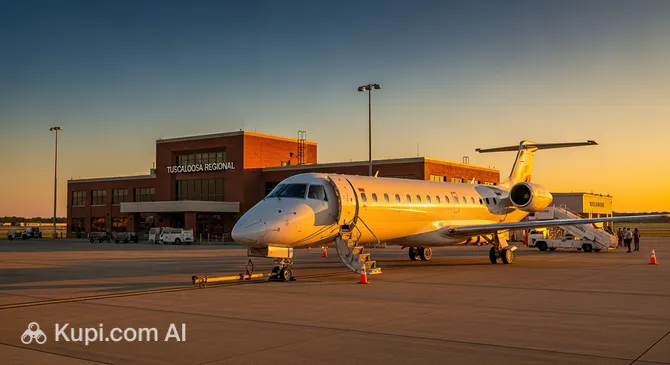
Tuscaloosa Regional Airport. Source: Kupi.com Binoculars

Tuscaloosa Regional Airport (TCL) serves as the air gateway to the city of the same name in the state of Alabama, playing an important role in the transportation system of the western part of the state. While many travelers heading to the region use the larger airport in Birmingham, Tuscaloosa Airport offers unmatched convenience for private, corporate, and general aviation. Thanks to its strategic location and compact size, it provides quick and seamless access to the city, which is famous for its university and rich cultural heritage.

IATA Code TCL
ICAO Code KTCL
City Tuscaloosa, USA
Distance to Center Approximately 6 km.
Status Domestic / General Aviation.
Annual Passengers Predominantly general aviation and charter flights; no scheduled passenger service.
Popular Airlines No scheduled commercial passenger flights.
Schedule online board "Tuscaloosa Regional Airport"

The main advantage of Tuscaloosa Airport is its exceptional accessibility and efficiency for specific categories of travelers. Located just a few minutes' drive from the city center and the University of Alabama campus, it is the ideal choice for private pilots, business jets, and charter flights, including those related to university sports events. The absence of queues and the hustle associated with major hubs allows all formalities to be completed as quickly as possible. The airport is equipped with two runways and provides a full range of services for general aviation, making it an important center for the local economy and educational institutions.

Contact Information

  • Official Website: The most up-to-date information on flights, services, and regulations of Tuscaloosa Regional Airport (TCL) can always be found on its official website. We recommend checking the site before your trip.
  • Information Desk Phone: For immediate information and answers to general questions, you can call the main airport administration number: +1 205-248-5300.
  • Airport Address: The airport is located at: 7601 Robert Cardinal Airport Rd, Tuscaloosa, AL 35401, USA.
  • Email: To contact the airport administration, it is recommended to use the contact form, which is usually available on the official website.
  • Social Media: Look for official airport pages on social networks (such as Facebook) to follow news and operational updates.
  • Lost Luggage Information: If your items were lost within the terminal building, contact the airport administration. If the issue concerns checked baggage, you should contact your airline's support service directly.
  • Passenger Support Service: For all questions related to booking, ticket changes, flight check-in, or special needs, it is necessary to contact the airline whose services you are using directly.

How to Get to the Airport

Getting to Tuscaloosa Regional Airport (TCL) from the city center of Tuscaloosa is quite simple thanks to its close proximity. The airport is located just a few kilometers from key areas of the city, and the trip usually takes no more than 10–15 minutes depending on traffic conditions. The main ways to get to the terminal are taxis, ridesharing services, and personal or rented cars.

Taxi and Transfer — the most popular and convenient option for travelers without their own transport. Both traditional taxi services and apps popular in the USA, such as Uber and Lyft, operate in the city. A trip from downtown Tuscaloosa to the airport will cost an average of 15–25 dollars. This is a fast and reliable way to get to the terminal, especially if you have a lot of luggage.

Car Rental and Private Transport — an excellent choice for those who value independence. If you have rented a car for trips around the city, you can easily return it at the company's representative office at the airport before departure. For those arriving in their own vehicle, convenient and affordable parking is provided on the airport grounds. Both short-term and long-term parking spaces are available, located in close proximity to the terminal building, making this option very comfortable.

Public Transport, unfortunately, is not a direct way to get to the airport. City bus routes do not enter the territory of Tuscaloosa Airport. Although theoretically, one could take a bus to the nearest stop and take a taxi from there, in practice, this is inconvenient and rarely used by tourists. Therefore, it is better to rely on other modes of transport when planning your trip.

If your route runs through larger regional air hubs, pay attention to Birmingham-Shuttlesworth International Airport, located approximately 90 km from Tuscaloosa. The transfer between cities will take over an hour, which is important to consider when planning connecting flights.

Terminals and Map

Tuscaloosa Regional Airport (TCL) is distinguished by its compactness and simplicity, making it very convenient for passengers. All airport infrastructure is concentrated in one passenger terminal, which serves both departing and arriving flights.

The structure of the terminal is extremely clear. Upon entering, you immediately find yourself in the general area, where airline check-in counters and the baggage claim area are located. Thanks to the small size of the building, navigation is intuitive, and all key zones are within walking distance of each other. It is impossible to get lost here, which is especially appreciated by travelers who prefer to avoid the hustle of major air hubs.

Departure and arrival zones are in the same building. After check-in, passengers pass through a single security checkpoint, which leads to a small and cozy waiting hall with a boarding gate. The process of check-in and passing control usually takes significantly less time than in large airports. In most cases, arriving at the airport 60-90 minutes before a domestic flight will be more than enough.

Since the airport has only one terminal, the question of transfers between them does not arise. All procedures — from check-in to boarding the plane — take place in one building, making travel through Tuscaloosa Regional Airport maximally fast and comfortable. This is the ideal choice for those who value their time and prefer a calm environment.

Airport History

The history of Tuscaloosa Regional Airport (TCL) is a vivid reflection of the development path of the city itself. The airport has come a long way from a small airstrip to a modern aviation hub playing an important role in the life of West Alabama.

Officially opened in 1939 as the Tuscaloosa Municipal Airport, it became an important facility for the region from the very beginning. However, a turning point in its early history was World War II. During this period, the airport was transferred to the Army Air Forces of the USA and was named Van de Graaff Field. It served as an important training base for thousands of pilots, contributing to the country's military efforts.

After the war, the airport returned to civilian use and hosted commercial flights for many years. However, the most dramatic event in its recent history was the massive tornado in April 2011. The natural disaster caused enormous damage to the infrastructure, destroying hangars and damaging many aircraft. This moment became a real test of resilience for the airport.

The tragedy served as a catalyst for large-scale reconstruction and modernization. The airport was not just restored but radically updated, turning into a modern and safe complex. Today, Tuscaloosa Regional Airport is an important center for private and corporate aviation. An interesting fact: it is actively used for flights by the sports teams of the famous University of Alabama, especially its football team, the "Crimson Tide," making it an integral part of the city's sports life.

Services and Amenities

Tuscaloosa Regional Airport (TCL) primarily serves private and corporate aviation. In this regard, most services for passengers and crews are provided through the ground handling operator (Fixed-Base Operator, FBO), which ensures personalized service and a comfortable stay at the airport, serving as an important air gateway to this region of the USA.

Instead of public terminals with shops and restaurants, passengers are offered premium services in the FBO building. Here, comfortable lounges and waiting rooms are equipped where you can relax in a quiet environment. Free Wi-Fi is provided throughout the territory, as well as convenient places for charging mobile devices, allowing you to stay connected or work.

For the convenience of travelers arriving in Tuscaloosa, one of the key services is car rental. Often, a car can be ordered in advance through the FBO, and it will be delivered right upon your arrival. ATMs and currency exchange points are generally absent at the airport, so it is recommended to settle financial matters in advance.

The airport is fully adapted to serve passengers with limited mobility — to receive assistance, it is necessary to notify the FBO operator in advance. There are no hotels or public conference rooms in the airport building, but FBO staff can assist in booking nearby hotels and meeting rooms located a few minutes' drive from the airport.

Where to Eat

When planning a departure from Tuscaloosa Regional Airport (TCL), travelers should take into account its specific nature. This is a small airport serving predominantly private and corporate flights, so the choice of dining establishments directly in the terminal is extremely limited.

Currently, there are no full-service restaurants, cafes, or dining lounges in the airport building. Passengers can only count on vending machines offering a standard set: soft drinks, water, and light snacks like chips, chocolate bars, or crackers. Accordingly, there is no possibility to find specific dishes for vegetarians, gluten-free, or halal options here, other than what might accidentally be found in a machine.

Given this, the best strategy is to eat beforehand, prior to arriving at the airport. The city of Tuscaloosa offers a wide selection of restaurants and cafes to suit every taste: from establishments serving classic Southern cuisine of the USA to famous fast-food chains. This is the most reliable way to have a proper lunch or dinner before your flight.

If you are short on time, several quick-service restaurants are located along the highway leading to the airport. You can stop there on the way for a quick bite. However, be sure to allow extra time so as not to be late for your flight. It is strongly recommended not to rely on buying food within the terminal itself.

Travel Tips

To ensure your journey through Tuscaloosa Regional Airport goes as smoothly as possible, follow our tips. This is a small and convenient airport, but proper preparation will help avoid unnecessary stress and save time.

Arrival Time and Check-in. For domestic flights within the USA, it is recommended to arrive at the airport 1.5–2 hours before departure. This time is usually sufficient to check in luggage and pass security control without rushing. To save time, use online check-in on your airline's website and save the boarding pass on your phone.

Passing Security and Seat Selection. The security checkpoint here operates according to standard TSA rules. Have your identification and boarding pass ready. When choosing a seat on the plane, consider your preferences: a window seat for beautiful views, an aisle seat for freedom of movement. If you want to disembark first, choose seats in the front of the cabin.

Hand Luggage. Remember the liquids rule: all containers must be no more than 100 ml and packed in one transparent bag. Laptops and other large electronics will likely need to be removed from your bag for separate scanning. Be sure to check with your airline regarding the allowable dimensions and weight of hand luggage.

Transfers and Customs. If you have a transfer in Tuscaloosa, you will not have to pass customs control if you are flying on a domestic flight. Simply find the gate number for your next flight on the board. Since this is a regional airport, navigation will not take much time. Customs and border control are only for passengers arriving on international flights, which is rare for this airport.

Saving Time and Money. To save money, book flight tickets in advance and watch for promotions. Bring an empty water bottle to fill after passing security, and light snacks — this is cheaper than buying them at the airport. To avoid wasting time, keep all documents close at hand and familiarize yourself with the airport map in advance.

Flight Delays. In case of a flight delay or cancellation, first contact your airline representative for up-to-date information and instructions. Clarify if you are entitled to compensation (for example, food vouchers). In small airports, the choice of entertainment is limited, so in case of a long wait, it is useful to have a book, headphones, or a charged power bank with you.

Reached the end of the page?

That means the route is fully explored