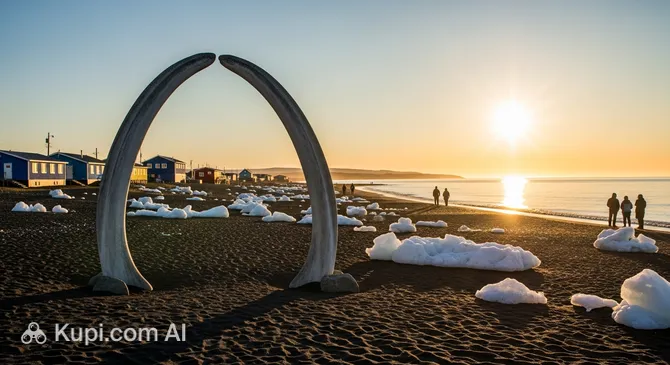
In Utqiagvik, the concept of parks and museums is defined not by manicured lawns or sprawling gallery complexes, but by the raw majesty of the Arctic landscape and the living history of its people. Here, the "green spaces" are the vast, open tundra and the icy coastline, while culture is preserved not just behind glass, but in the daily practices of the community. Exploring these areas offers an intimate look at how life thrives at the top of the world.
Parks and Natural Areas
While you will not find traditional botanical gardens here, the Arctic Coastline serves as the city's most significant natural recreational area. Stretching along the edge of town where the land meets the Chukchi Sea, the black sand beaches are a place of constant change and beauty. In summer, it is a spot for beachcombing and watching the midnight sun reflect off the water; in winter, it transforms into a rugged landscape of pressure ridges and sea ice. It is a powerful place to witness the connection between the Iñupiat people and the ocean.
Just outside the main town lies the expanse of the Arctic Tundra, a unique ecosystem that functions as a massive natural park. During the short summer, this treeless landscape bursts into life with wildflowers, mosses, and lichens, attracting thousands of migratory birds. Walking near the edge of town allows visitors to experience the spongy ground of the permafrost and spot wildlife such as lemmings, arctic foxes, and snowy owls in their natural habitat.
Museums and Cultural Centers
The crown jewel of the city's cultural institutions is the Iñupiat Heritage Center. As an affiliate of the National Park Service, this facility is dedicated to preserving the history, language, and traditions of the Iñupiat people. The center features impressive exhibits on the history of whaling, displaying traditional skin boats (umiaks) alongside modern tools. A highlight for many tourists is the "Traditional Room," where local elders and artisans often gather to teach and practice crafts like skin sewing, ivory carving, and baleen etching, allowing visitors to witness art in the making.
While not a traditional museum, the Barrow High School often serves as an unexpected gallery of local culture. The lobby and common areas frequently display student artwork, trophies, and cultural artifacts that reflect the community's pride. The school is a central hub for events, and its architecture and murals often depict scenes of subsistence living and Arctic wildlife, offering a glimpse into the modern life of the younger generation in this remote outpost.
Historical and Architectural Sites
For history enthusiasts, the Birnirk National Historic Landmark is a site of immense archaeological importance. Located about two miles northeast of the city center, this area contains a series of ancient sod house mounds from the Birnirk culture, which dates back to around 600 A.D. These mounds are considered the ancestral link between the prehistoric Thule people and the modern Iñupiat. While the site is subtle and looks like part of the landscape, it represents over a thousand years of continuous habitation.
Another significant structure is the Cape Smythe Whaling and Trading Station, built in 1893. Recognized as the oldest frame building in the Arctic, it was established by the legendary whaler and trader Charles Brower. The building played a crucial role in the commercial history of the region, serving as a trading post where furs and whalebone were exchanged for western goods. Its weathered white facade stands as a testament to the era of early Arctic commerce and exploration.
Insider Tips
For a truly authentic experience, take a drive or a long walk down Gaswell Road (locally known as Cake Eater Road). This gravel route leads away from the town and is one of the best places for birdwatching, particularly for spotting the majestic snowy owl or the rare Steller's eider. Additionally, keep an eye out for the traditional ice cellars (sigluaq) dug into the permafrost near family homes; while you cannot enter them, recognizing these mounds helps you appreciate how locals have traditionally stored whale meat and food without modern electricity.