Support

Tan Son Nhat International Airport

About the Airport

Tan Son Nhat International Airport (SGN) is not just an airport, but the main aerial gateway to the colourful world of southern Vietnam and the bustling Ho Chi Minh City. Founded in the 1930s, it has evolved from a small airfield into the country's busiest aviation hub. It is from here that millions of travellers annually begin their acquaintance with the rich history, busy streets, and incredible cuisine of this amazing region, as the airport connects the metropolis with dozens of countries and all popular Vietnamese resorts.
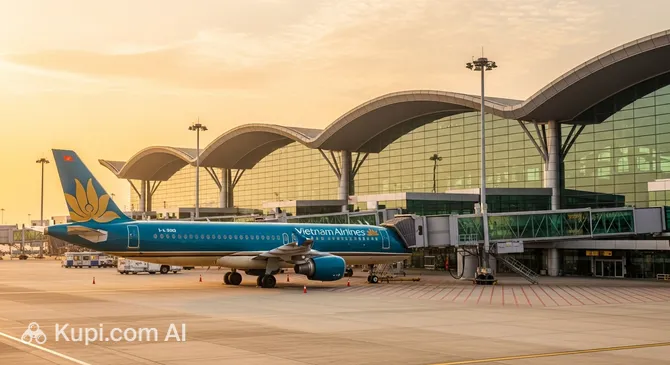
Tan Son Nhat International Airport. Source: Kupi.com Binoculars
IATA Code SGN
ICAO Code VVTS
City Ho Chi Minh City
Distance to centre approx. 6 km
Status International
Annual Passengers over 41 million (2023 data)
Popular Airlines Vietnam Airlines, Vietjet Air, Bamboo Airways
Schedule "Tan Son Nhat" Online Board

A key feature of Tan Son Nhat Airport is its convenient location right within the city limits, which significantly simplifies and reduces the cost of transfer to your hotel. The airport complex consists of two terminals. Terminal 2 (T2) serves all international flights, while Terminal 1 (T1) is used for domestic flights within the country. The distance between the terminals is about 400 metres, which can easily be covered on foot.

For the convenience of tourists, the airport provides everything necessary: counters for purchasing local SIM cards, currency exchange points, ATMs, cafes serving Vietnamese and European food, as well as Duty Free shops. You can get to the city centre in several ways: by city bus (the most popular routes are No. 109 and No. 152), which is the most budget-friendly option, or by taxi. A car can be ordered at the official counter in the airport or via the Grab mobile app. Depending on the traffic situation, a car ride to the tourist centre will take from 20 to 45 minutes.

Contact Information

Official Website: Up-to-date information on flights, services, and airport regulations can always be found on the official website: www.vietnamairport.vn. We recommend checking the site before your trip.

Information Service Phone: For information by phone, you can call: +84 28 3848 5383. Please note that the number may change, so it is worth verifying with the official website.

Address: The airport is located at: Trường Sơn, Phường 2, Quận Tân Bình, Thành phố Hồ Chí Minh, Việt Nam.

Email: For general inquiries, it is recommended to use the contact forms available on the airport's official website, as a public email address for general questions may not be available.

Social Media: For the latest news and updates, look for the official pages of Tan Son Nhat Airport on popular social networks.

Lost and Found: In case of lost luggage, you must first contact your airline's tracing service. Lost and Found counters are also available in the airport terminals.

Passenger Support Contacts: Information desks, where you can get help and advice, are located in the departure and arrival halls of both the domestic and international terminals.

How to Get to the Airport

Getting to Tan Son Nhat International Airport (SGN) from the city centre of Ho Chi Minh City is quite simple, and travellers have several convenient options. Depending on your budget, time, and amount of luggage, you can choose the most suitable method. Usually, the trip from the centre (for example, from District 1) takes from 30 to 60 minutes, but during peak hours, travel time can increase significantly due to the heavy traffic characteristic of this metropolis in Vietnam.

Public Transport is the most budget-friendly option. Several bus routes connect the airport with different parts of the city. The most popular among them are:

  • Bus No. 152: This is a standard green city bus. The cheapest way, the fare is only a few thousand dong. However, it can be crowded, and space for large luggage is limited.
  • Bus No. 109: A specialised yellow shuttle bus. It is more comfortable, equipped with air conditioning, and has more space for suitcases. The fare is higher than on the city bus, but still remains very affordable.
  • Bus No. 49: This premium shuttle bus takes passengers directly to hotels in the city centre, which is very convenient if you do not want to make transfers. The fare is the highest of the bus options, but justified by the comfort.

Taxis and Ride-hailing Services are the most popular and convenient method. Official taxis from companies Vinasun (white with green and red stripes) and Mai Linh (green) are considered reliable. Always insist on a trip by the meter. An even more convenient option is to use the Grab mobile app. In the app, you will immediately see the fixed cost of the trip, which eliminates disputes with the driver. A taxi or Grab ride from the city centre will cost approximately 100,000–180,000 VND (about 4–7 USD) depending on traffic and the departure point.

Car Rental is not the most common way to get to the airport for tourists, as driving in Ho Chi Minh City requires serious skills and getting used to the chaotic traffic. This option may be suitable for those planning to travel around the country by car and returning it at the airport before departure. Tan Son Nhat Airport has parking where you can leave a car for both short and long terms, but for most tourists, this is not relevant.

Recommendation: For most travellers, the best choice would be taxi or Grab for the ideal combination of price, speed, and comfort. If you are travelling light and want to save money, feel free to choose bus No. 109.

Terminals and Map

Tan Son Nhat Airport (SGN) consists of two main passenger terminals located in close proximity to each other: Terminal 1 (T1) for domestic flights and Terminal 2 (T2) for international flights.

The International Terminal (T2) is a modern four-story building. On the ground floor is the arrival area, where passengers go through passport control, collect luggage, and pass through customs. The second floor is the departure area with airline check-in counters. After check-in, passengers go up to the third floor for immigration control and security screening, after which they enter a spacious waiting area with boarding gates, Duty Free shops, restaurants, and business lounges.

The Domestic Terminal (T1) is an older and more compact building that is often crowded, especially during peak hours and national holidays. Its structure is simpler: check-in counters and the arrival area are located on the ground floor, while the security area and boarding gates are on the first floor. Despite its smaller size, there are also cafes and shops here for passenger convenience.

Moving between terminals is easy. They are just a few minutes' walk from each other (approximately 5-10 minutes). The path between them is a covered walkway, so you won't have to go out into the open street. Navigation in the airport is intuitive thanks to signs in Vietnamese and English.

To complete all formalities for international flights, it is recommended to arrive at the airport at least 3 hours before departure, as queues for check-in and passport control can be long. For domestic flights, 1.5-2 hours is usually sufficient, however, during periods of high load, it is better to allow extra time. To save time, keep your passport and boarding pass ready and carefully monitor information about your boarding gate on the screens.

Airport History

The history of Tan Son Nhat International Airport begins in the 1930s. It was then that the French colonial administration built a small airfield on this site, which initially had a dirt runway and was named Aérodrome de Tan Son Nhut. In the first decades of its existence, it served primarily small civil and military aircraft.

A key stage of development was the 1960s and early 1970s. During this period, the airport was significantly expanded and modernised by American engineers, turning into one of the most modern and busiest airbases in the world. New concrete runways, taxiways, and massive hangars were built, allowing it to receive heavy transport aircraft. At peak moments, it was considered one of the busiest airports on the planet in terms of take-offs and landings.

After 1975 and the end of the war, the airport came completely under civil management and became the main international gateway to the city of Ho Chi Minh City and all of southern Vietnam. It received its modern name and began a new chapter, symbolising the recovery and openness of the country to the global community. From this moment, its transformation into a major commercial hub began.

With the growth of Vietnam's economy and the increase in tourist flow, the old infrastructure could no longer cope with the load. This led to a large-scale reconstruction in the 2000s. The culmination was the opening in 2007 of the new International Terminal (T2), which allowed passenger flows to be separated and service levels to be significantly improved. The old terminal (T1) was refitted to serve domestic flights.

Today, Tan Son Nhat holds the status of Vietnam's busiest airport by passenger traffic. One of the interesting facts of its history is the preservation of its dual purpose: next to the modern civil terminals, a military airbase continues to function, which is a direct legacy of its turbulent past.

Services and Amenities

Tan Son Nhat Airport (SGN) offers passengers a full range of services and amenities to make waiting for a flight as comfortable as possible. The airport infrastructure is thought out to the smallest detail and meets the needs of both transit travellers and those starting or ending their journey in Ho Chi Minh City.

There are many cafes and restaurants in the airport terminals where you can taste Vietnamese cuisine or have a snack at international chain establishments. For shopping enthusiasts, Duty Free shops are open with a wide assortment of perfumes, cosmetics, confectionery, and souvenirs, as well as boutiques with clothes and accessories.

For a comfortable wait for their flight, passengers can use the services of several business lounges and VIP zones, access to which is provided for a separate fee or for premium class passengers. Free Wi-Fi is available throughout the airport, and numerous charging stations for mobile devices will allow you to always stay connected.

Financial matters can be resolved at bank branches, ATMs, and currency exchange points that operate in both terminals. In case of necessity, passengers can seek medical assistance at round-the-clock medical points located within the airport territory.

Families with children will appreciate the presence of mother and child rooms equipped with everything necessary for infant care. Special services are provided for passengers with reduced mobility, including escort, ramps, and equipped restrooms. It is recommended to notify the airline in advance about the need for assistance.

For those who need to rest between flights, several hotels are located in the immediate vicinity of the airport. Business travellers can make use of conference halls and business centres offering rental services for meeting rooms and necessary office equipment.

Where to Eat

Tan Son Nhat Airport in Ho Chi Minh City offers diverse dining options that will satisfy both connoisseurs of local cuisine and those who prefer familiar international dishes. Most establishments are located in the International Terminal (T2), but excellent places for a snack can also be found in the Domestic Terminal (T1).

If you want to enjoy the flavours of Vietnam one last time, be sure to try traditional dishes. The Pho 24 restaurant chain, present in both terminals, offers aromatic Pho soup — an ideal option for a hearty lunch. For a quick and tasty snack, look for kiosks with Banh Mi (a Vietnamese sandwich in a crispy baguette). And the famous Vietnamese iced coffee with condensed milk (cà phê sữa đá), prepared in local coffee shops such as Highlands Coffee, will help cheer you up before your flight.

For those missing global standards, well-known fast-food chains, such as Burger King, as well as international coffee shops, operate in the international terminal (mainly in the departure area after passport control). There is also a food court here with a large selection of Asian and European cuisine, where everyone will find something to their taste.

Most restaurants and cafes in the departure area of the international terminal operate around the clock or have extended opening hours to serve passengers of night flights. In the domestic terminal, establishments usually close earlier. As for prices, they are, as in any airport in the world, higher than in the city, but remain quite acceptable. A full lunch will cost on average 10-15 USD, and a quick snack — 5-7 USD.

Passengers with special dietary needs should pay attention to Vietnamese dishes — many of them are easily adaptable. For example, you can ask for a vegetarian Pho with tofu and vegetable broth. The menus of many restaurants have rice and vegetable dishes that are suitable for vegetarians. Specialised Halal or gluten-free establishments are limited, so it is best to clarify the ingredients of dishes directly with the staff.

Tips for Travellers

To ensure your journey through the main airport of Ho Chi Minh City goes smoothly, use our tips. Tan Son Nhat Airport is the busiest in Vietnam, so preparation will help save time and nerves.

Arrival time at the airport. For international flights, arrive 3–3.5 hours before departure, for domestic ones — at least 2 hours prior. During peak seasons, especially during the Tet celebrations (Vietnamese New Year), queues can be very long, so it is better to have a buffer of time.

Check-in and Security. If possible, complete online check-in for your flight — this will save you time. However, be prepared for queues for baggage drop-off and pre-flight screening. Rules for carrying liquids in hand luggage are standard: containers no more than 100 ml, packed in one transparent bag.

Seat Selection. If you want to enjoy views of the city during take-off or landing, choose a window seat. If comfort and the ability to stand up easily without disturbing neighbours are more important to you, your choice is an aisle seat.

Hand Luggage. Besides standard restrictions, remember local rules. It is forbidden to bring fruits with a strong smell, primarily durian, into the aircraft cabin (and often in checked luggage). Check with the airline regarding rules for carrying external batteries (power banks) — as a rule, they are allowed only in hand luggage and have capacity limits.

Transfer Passengers. The International (T2) and Domestic (T1) terminals are in different buildings, but within walking distance (about 10 minutes). If you have a transfer from an international flight to a domestic one, clarify in advance whether you need to collect and re-check your luggage.

Customs Control. The control procedure is standard. When leaving the country, it is necessary to declare cash if the amount exceeds the established limit (usually equivalent to 5,000 USD). Upon entry, if you are obtaining a visa on arrival, look for the Visa on Arrival counter before passing passport control. However, it is most convenient to apply for an electronic visa in advance.

Saving Time and Money. To avoid overpaying for a taxi, use the counters of official carriers in the arrival hall or order a car via a mobile app, for example, Grab. The currency exchange rate at the airport is not the most favourable, so change only a small amount for initial expenses. Prices for food and drinks in the departure area are high, so it is better to have a snack before passing through control.

In Case of Flight Delay. If your flight is delayed, contact the airline representative for information. The airport has cafes, shops, and paid business lounges where you can spend time comfortably. Good travel insurance will help cover unforeseen expenses for food or a hotel.

Reached the end of the page?

That means the route is fully explored