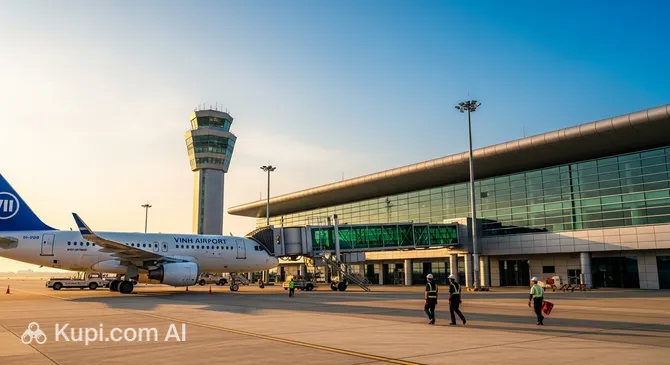
Source: Kupi.com AI
| Characteristic | Value |
|---|---|
| IATA code | VII |
| ICAO code | VVVH |
| City | Vinh |
| Country | Vietnam |
| Time zone | Asia/Bangkok |
| Popular airlines | VietJet Air, Vietnam Airlines |
| Schedule | Online timetable |
| Characteristic | Value |
|---|---|
| IATA code | VII |
| ICAO code | VVVH |
| City | Vinh |
| Country | Vietnam |
| Time zone | Asia/Bangkok |
| Popular airlines | VietJet Air, Vietnam Airlines |
| Schedule | Online timetable |
Below is contact information for passengers departing from or arriving at Vinh Airport. It is recommended to verify the data on official resources before traveling.
Vinh International Airport (VII) is located just 7-8 kilometers north of the city center of Vinh, making the journey quick and convenient. Travelers can choose from several transport options to get to their flight or, conversely, into the city upon arrival. Regardless of your budget and preferences, you will easily find a suitable mode of transport at this important transport hub of central Vietnam.
Taxis and Transfers are the most popular and convenient way to get to the airport. The trip from the city center takes an average of 15-20 minutes depending on traffic conditions. You can use the services of official taxi companies (look for cars with logos of well-known brands) or book a car through the popular Asian app Grab. The cost of a taxi ride is usually fixed or metered and is quite affordable. For maximum comfort, especially if you have a lot of luggage or are traveling with family, you can book a private transfer in advance.
Public Transport is represented by city buses. This is the most budget-friendly option, but it may not be as convenient, especially if you are traveling with heavy suitcases. Routes and schedules may change, so we recommend checking current information locally, for example, at your hotel. There are no specialized trains or metro lines connecting the airport to the city in Vinh.
Car Rental is a good option for those who plan to actively explore not only the city but also its picturesque surroundings. It is worth noting that in Vietnam, renting a car with a driver is more common among tourists, which eliminates the need to navigate local traffic peculiarities. Rental points can be found both in the city and can be arranged for delivery directly to the airport.
For those arriving at the airport in their own or rented vehicle, parking is provided. There are zones for both short-term and long-term parking, which is convenient if you are flying away for a few days.
If you are planning a route through the region, it is worth knowing that other airports are located a few hours' drive away. For example, you can consider flights through Dong Hoi Airport (VDH) or Bai Thuong in Thanh Hoa, and from there get to Vinh by bus or train.
Vinh Airport (VII) is a modern and compact aviation hub, making navigation simple and intuitive for passengers. All airport infrastructure is concentrated in one passenger terminal, which serves both domestic and international flights. Thanks to this, you do not have to worry about moving between different buildings.
The terminal layout is logical and standard for most modern airports. The building has two main levels:
Because there is only one terminal and its layout is well thought out, the time required to complete all formalities is usually short. For domestic flights, it is recommended to arrive at the airport 1.5-2 hours before departure. For international flights, it is better to allow a little more time — about 2.5-3 hours. This buffer will be more than enough for a calm check-in, baggage drop, and security screening.
For navigation, simply follow the signs in Vietnamese and English, which are clearly visible and logically placed throughout the terminal. The airport staff is friendly and always ready to help if you have any questions. Overall, Vinh Airport leaves an impression of an efficient and convenient transport hub that does not require unnecessary effort from travelers.
The history of Vinh Airport reflects the turbulent history of Vietnam itself in the 20th and 21st centuries. Its journey began in 1937, when the French colonial administration built a small airfield here. Initially, it consisted of a dirt runway and was used for both military and civil purposes to serve the region.
A key and most dramatic stage in the airport's history was the Vietnam War period. Due to its strategic location, the airfield was turned into an important airbase for the North Vietnamese Air Force. This made it one of the main targets for American aviation. As a result of massive bombardments, the airport infrastructure was practically completely destroyed by the end of the war in 1975.
After the unification of the country, a long process of restoration began. The airport was rebuilt but remained a modest regional hub with outdated infrastructure for a long time, serving mainly domestic flights on small aircraft. The real transformation began in the 21st century.
A significant event was the large-scale reconstruction completed in 2015. As part of the modernization, a new modern passenger terminal was built, and the runway was extended and strengthened to 2,400 meters. This allowed the airport to receive larger aircraft, such as the Airbus A320 and A321, and significantly increase passenger flow. After this reconstruction, Vinh Airport received international status, opening a new chapter in its history and turning it into an important transport hub for all of northern and central Vietnam.
Despite its compact size, Vinh Airport (VII) offers passengers all necessary services for a comfortable wait for their flight. Before departure, you can have a snack in one of the cafes or restaurants serving both local Vietnamese dishes and familiar snacks with beverages. There are also shops in the terminal where you can buy souvenirs, travel goods, and locally produced items to take a piece of Vietnam with you.
For those for whom staying connected is important, free Wi-Fi is available throughout the airport. If your device needs charging, you can find specially equipped stations with power outlets. Financial matters are also easily resolved on-site: ATMs are installed in the terminal building, and a currency exchange office operates, which is especially convenient for international tourists.
For a more comfortable wait, passengers can use the services of the Business Lounge (VIP-lounge), where you can relax or work in a quiet atmosphere. The airport cares for all categories of travelers. A mother and child room is equipped for passengers with children. Additionally, conditions have been created for people with disabilities: staff assistance is provided, and the terminal infrastructure is adapted to their needs.
In case of illness, a medical point operates at the airport to provide first aid. There are no hotels directly in the terminal building, however, many accommodation options can be found in the city of Vinh itself, which is easily accessible by taxi. For business travelers, opportunities for holding meetings directly at the airport may be limited, so it is better to plan business events in city hotels.
Vinh Airport (VII) offers passengers several options for a snack or a full meal, mainly focused on traditional Vietnamese cuisine. Although the selection here is not as wide as in major international hubs, you certainly won't go hungry. The main dining points are located both in the general area before security (landside) and in the departure area (airside).
In the general area accessible to all visitors on the ground floor, you will find several small restaurants and cafes. This is the best place for a leisurely lunch if you arrived at the airport early. Here you can order classics of Vietnamese cuisine: hearty Phở soup with beef or chicken, as well as the famous Vietnamese sandwich Bánh Mì. This is a great opportunity to enjoy the authentic flavors of Vietnam before departing from the city of Vinh.
After passing security, in the departure area, the choice becomes more limited. Mainly small cafes and kiosks operate here, offering quick and convenient options. You can buy freshly brewed Vietnamese coffee, pastries, sandwiches, light snacks, and beverages. This is an ideal option if you need a quick bite directly before boarding your flight. Remember that the selection here may be more modest, so for a full meal, it is better to eat before passing control.
Prices in airport establishments are expectedly higher than in the city but remain moderate by international standards. Most cafes and restaurants operate according to the flight schedule, opening early in the morning and closing after the departure of the last aircraft. Regarding special dietary needs, please note that finding certified Halal, vegan, or gluten-free dishes may be difficult. It is easier for vegetarians — you can order rice with vegetables or vegetable soup. Travelers with strict dietary restrictions are recommended to carry their own snacks.
When planning a trip through the airport of Vinh city, it is worth considering a few points that will make your trip more comfortable. This is a small and mostly domestic airport, so there are rarely large crowds, but preparation is always helpful.
Arrival Time: For domestic flights within Vietnam, it is recommended to arrive at the airport 1.5–2 hours before departure. If you have an international flight, it is better to allow at least 3 hours. This time will be enough to calmly go through all procedures without rushing.
Check-in and Security: To save time, use online check-in if your airline provides such an option. Check-in counters usually work quickly, but there may be queues during peak hours. The screening procedure is standard. Ensure that all liquids in your hand luggage are in containers up to 100 ml and packed in a transparent bag.
Seat Selection: If you are flying from Vinh to another city in Vietnam, for example, to Da Nang or Ho Chi Minh City, and want to enjoy the views, choose a window seat. For greater comfort and the ability to stand up freely during the flight, an aisle seat is better suited.
Hand Luggage: It is forbidden to take sharp objects (knives, scissors), flammable liquids, and other dangerous substances in hand luggage. Electronics, such as laptops and power banks, are allowed, but be prepared to take them out for separate scanning at security. Always check the current rules of your airline, as there may be restrictions on the weight and size of hand luggage.
Passengers with Connections: Vinh Airport is not a major transit hub. If you do have a connection planned, verify in advance whether you will need to collect and re-check your luggage. The infrastructure for long waits here is modest, so plan your time accordingly.
Customs Control: When departing or arriving on domestic flights, there is no need to go through customs control. For international flights, the procedure is standard: you must fill out a declaration if you are carrying goods subject to declaration or large sums of cash.
Saving Time and Money: Book a transfer from or to the airport in advance to avoid inflated prices from taxi drivers on site. Travel light to avoid paying for excess baggage. It is also useful to have a small amount of Vietnamese Dong (VND) for minor expenses, although there are ATMs in the airport.
In Case of Flight Delay: If your flight is delayed, first contact your airline representative at the information desk. Find out the reason for the delay and the estimated departure time. Depending on the duration of the wait, the airline may be obliged to provide you with beverages, meals, or even hotel accommodation. Remain calm and follow updates on the information screens.
Have you reached the end of the page?
So the route has been studied inside and out