Support

Budapest Ferenc Liszt International Airport

About the Airport

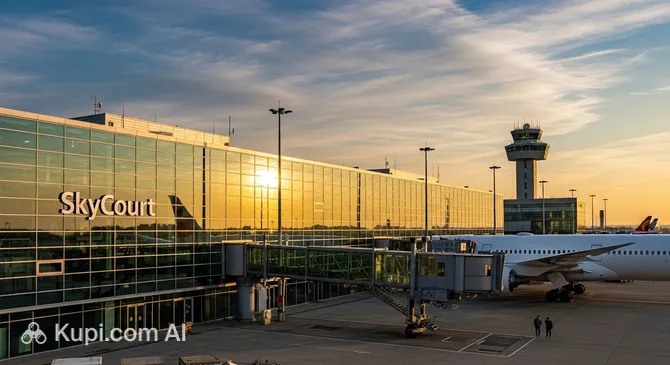
Budapest Ferenc Liszt International Airport. Illustration.
Source: Kupi.com AI

Budapest Ferenc Liszt International Airport is more than just a transportation hub; it is a true overture to your journey through the "Pearl of the Danube." Named after the great virtuoso composer, this modern hub harmoniously combines advanced technology with Hungarian hospitality. Spacious terminals and intuitive navigation allow travelers to feel perfectly comfortable from their very first minutes in Hungary. Whether it is a short layover or the start of a long vacation, the airport's atmosphere sets the stage for pleasant discoveries.

CharacteristicValue
IATA codeBUD
ICAO codeLHBP
CityBudapest
CountryHungary
Time zoneEurope/Budapest
Popular airlinesEurowings, LOT Polish Airlines, Lufthansa, Swiss, Turkish Airlines
ScheduleLive departures board

Features and Advantages

Budapest Airport is renowned for its well-thought-out infrastructure and passenger convenience. The centerpiece is the SkyCourt ("Sky Court") — a spacious hall connecting Terminals 2A and 2B, home to the best shops, cafes, and restaurants. One unique feature is the open-air Observation Terrace on the roof of Terminal 2A. It offers a breathtaking panoramic view of the runway, making the wait for a flight an exciting experience.

Transportation accessibility is another strong point: you can reach the city center quickly and affordably via the direct 100E express bus. The airport also offers excellent business lounges and high-speed Wi-Fi throughout the premises, allowing you to stay connected or work productively while waiting for your departure.

Contact Information

  • Official Website: www.bud.hu. On the website, you will find the most up-to-date information regarding flights, services, and airport regulations.
  • Information Desk Phone: +36 1 296 7000 (24/7).
  • Address: Budapest, 1185, Hungary.
  • Email for General Inquiries: info@bud.hu.
  • Social Media: The airport actively maintains pages on popular social media platforms such as Facebook and Instagram. Links can be found on the official website.
  • Lost Luggage Information: If you lost items in the terminal, contact the airport's lost property service. If items were lost on board an aircraft, you must contact your airline directly. Detailed contact information and a form to fill out are available in the "Lost property" section on the official website.
  • Passenger Support Service: For assistance or consultation, you can use the information desk phone or send an email.

How to Get to the Airport

There are several convenient ways to get from Budapest Ferenc Liszt International Airport (BUD) to the center of Budapest or vice versa. The transportation system of the capital of Hungary is well-developed and offers options suitable for any budget and preference, from economical buses to comfortable taxis.

Public transport is the most budget-friendly way to reach the city. Two main bus routes are available to passengers:

  • 100E Express Bus: This is the most direct and fastest option. The shuttle runs from the airport to the central Deák Ferenc tér square, making only a few stops at key points in the center. The trip takes approximately 35-45 minutes. It is important to remember that this route requires a special "Airport shuttle bus single ticket," which costs more than a regular ticket but provides a direct connection to the city center.
  • 200E Bus + Metro: A more economical but longer route. The 200E bus runs between Terminal 2 and the terminus of the M3 blue metro line (Kőbánya-Kispest). From there, you can easily reach any part of Budapest by metro. Standard city tickets and BKK passes are valid on this route. The total travel time is about 50-60 minutes.

There is also an alternative route via the railway. To use it, take the 200E bus to the Ferihegy railway station, from where trains depart for the Nyugati railway station. This option can be particularly convenient if your accommodation is located near this station.

Taxi and private transfer are choices for maximum comfort. Near the exit of the arrival terminals, there are desks for the airport's official partner, Főtaxi. A trip to the city center takes about 30-40 minutes, depending on traffic, and will cost approximately 9,800 forints (about $27–33), as the rates are fixed. Additionally, you can use mobile apps (such as Bolt) or pre-book a private transfer, which is especially convenient for those traveling with a family or heavy luggage.

For those planning to travel extensively around the country, renting a car is an excellent solution. Offices of all major international rental companies are located in the airport building. You can arrange a rental and pick up the car immediately upon arrival. For car owners driving to the airport, various types of parking are provided: from short-term Premium parking right at the terminal to more affordable long-term Holiday Parking. To get the best rate, it is recommended to book a parking space online in advance.

While Budapest Airport is the main transport hub of the region, other airports may be convenient for certain routes. For example, travelers heading to eastern Hungary might consider Debrecen Airport, and for trips to Slovakia — Bratislava Airport or Košice.

Terminals and Layout

Budapest Ferenc Liszt International Airport has a simple and logical structure, making navigation through it quite convenient for passengers. In fact, all passenger flights are serviced in a single complex — Terminal 2, which consists of several interconnected parts.

The main complex is divided into two wings: Terminal 2A and Terminal 2B. The key difference between them lies in the geography of the flights:

  • Terminal 2A serves flights to Schengen Area countries.
  • Terminal 2B is intended for flights to non-Schengen countries, as well as for all long-haul flights.

These two terminals are connected by a modern central building called SkyCourt. This is a spacious transit zone where most shops, restaurants, cafes, and business lounges are located. It is here that passengers go through centralized security screening before heading to their boarding gates in wing 2A or 2B. Moving between terminals is done on foot through SkyCourt and does not require the use of shuttles.

Arrival zones are located on the lower level of both terminals, while departure zones and check-in counters are on the upper level. Navigation is intuitive thanks to clear signage in Hungarian, English, and German, as well as pictograms. Recently, a new pier, Pier 1, was added to Terminal 2A, which primarily serves low-cost airlines and expands the capacity of the Schengen zone.

To go through check-in and security, it is recommended to arrive at the airport well in advance. For flights within the Schengen Area (Terminal 2A), it is advisable to be on-site 2 hours before departure. For international non-Schengen flights (Terminal 2B), where passport control is required, it is better to allow at least 2.5–3 hours. During peak seasons and holidays, waiting times can increase, so it's worth adding an extra buffer.

Airport History

The history of Budapest's main airport began before World War II. The decision to build it was made in 1938, and by 1943, the first runways were ready. However, military actions interrupted the development of civil aviation. The official opening of the airport, named Ferihegy, took place on May 7, 1950. Initially, it served both civil and military flights.

With the growth of passenger traffic in the 1980s, the need for expansion arose. In 1985, the new Terminal 2 (now known as Terminal 2A) was opened, which significantly increased the airport's capacity and became a symbol of Hungary's openness to international travel. Following the change in the political regime and an increase in flight numbers, Terminal 2B was completed in 1998, designed to handle flights outside the Schengen Area.

One of the key events in the airport's recent history occurred in 2011. First, it was renamed in honor of the great Hungarian composer and received its current name — Budapest Ferenc Liszt International Airport. Second, a large-scale renovation was completed that same year: the modern SkyCourt passenger complex was built between Terminals 2A and 2B, uniting them into a single space with shops, restaurants, and relaxation areas.

An interesting fact: the historical building of the first terminal, built in the modernist style, is now an architectural monument. Although it has not been used for passenger transport since 2012, after the bankruptcy of the national airline Malév, its unique design continues to command admiration. For aviation enthusiasts, the Aeropark museum is located near the airport, where you can see aircraft that were once the pride of Hungarian civil aviation.

Services and Facilities

Budapest Ferenc Liszt International Airport (BUD) offers passengers a full range of services to make their stay as comfortable and productive as possible. Regardless of your travel purpose, you will find everything necessary for a pleasant wait for your flight here.

For those who are hungry, the terminals feature numerous restaurants, cafes, and bars for every taste — from fast-food outlets to establishments serving Hungarian and international cuisine. A wide selection of shops, including a large Duty Free area, allows you to purchase souvenirs, gifts, perfumes, and local delicacies. Free Wi-Fi is available throughout the airport, and numerous charging stations for gadgets will help you stay connected.

Passengers who value enhanced comfort can take advantage of several business lounges and VIP lounges, offering a secluded atmosphere, snacks, drinks, and workspaces. For financial matters, there are bank branches, currency exchange points, and ATMs at the airport. In case of need, you can seek help at the 24-hour medical post.

The airport also looks after its youngest travelers: playgrounds and baby care rooms are equipped for them. Passengers with reduced mobility are provided with special assistance and escort, and the terminal infrastructure is fully adapted to their needs. For business people, conference rooms and business centers are available. If you have a long layover or an early flight, you can stay in one of the hotels located directly on the airport grounds or within a few minutes' drive.

Dining

At Budapest Ferenc Liszt International Airport (BUD), you will find many options for a snack or a full meal to suit any taste and budget. The main concentration of dining establishments is located in the departure area after security control, in the so-called SkyCourt — the central hall connecting terminals 2A and 2B.

Before security (in the public area), the choice is more limited but sufficient for those seeing off or meeting passengers. Several cafes serving coffee and pastries (such as Costa Coffee) are located here, as well as a SPAR supermarket, where it is convenient to buy drinks and snacks for the journey at more affordable prices.

After passing through security, a large food court and numerous restaurants in the SkyCourt await you. There are world-famous fast-food chains (Burger King, KFC) as well as table-service restaurants.

  • For a quick snack: The numerous cafes serving sandwiches, salads, and pastries, as well as pizza or burger outlets, are ideal.
  • For a full meal: Look for restaurants offering international and local cuisine, such as Leroy Bistro. Here you can comfortably spend time while waiting for your flight.
  • To try something local: Look for establishments with traditional Hungarian goulash soup, lángos, or the "Somlói Galuska" dessert on the menu. This is a great opportunity to get to know the national cuisine before your flight.

Most restaurants and cafes offer vegetarian dishes. Options for vegans or people with gluten intolerance are also available, but it is best to check on-site by reviewing the menu of a specific establishment. The operating hours of most dining outlets are tied to the flight schedule, covering morning and evening departures, and some establishments in the departure area operate 24/7. The price range, as in most airports worldwide, is above the city average, however, the variety of formats allows you to find an option for any budget.

Travel Tips

To ensure your journey from Budapest Airport goes smoothly, arrive well in advance: 2.5–3 hours before non-Schengen flights and 2 hours before flights within the Schengen zone. Use online check-in to save time. Regarding money, avoid currency exchange at the airport — the rate here is extremely unfavorable. Exchange only a small amount for immediate needs or use an ATM, and exchange the bulk of your money once you are in the city. The same applies to SIM cards: you will find better offers from local operators in the city.

Security screening at the airport is standard, but be prepared for queues during peak hours. Liquids up to 100 ml must be in a transparent bag, and large electronics must be removed from hand luggage. Life hack for the budget-conscious: bring an empty water bottle with you. After security, you can fill it for free at drinking fountains located in the transit zone. Saving on food is also possible: there is a Spar supermarket with regular prices in the arrivals hall (before the security zone) where you can buy snacks.

For transfer passengers, navigation is simple: terminals 2A (Schengen) and 2B (non-Schengen) are connected by the spacious SkyCourt building, where shops and restaurants are concentrated. Moving between them takes no more than 10 minutes. If you are transiting between Schengen and non-Schengen zones, you will need to pass through passport control. Customs regulations in Hungary comply with EU standards: goods for personal use are carried through the "green channel."

To get to the city affordably, use public transport. Tickets, including for the popular 100E shuttle to the center, are best purchased from the purple BKK (Budapest Transport Center) machines located in the arrivals hall. They have a menu in Russian and accept bank cards. Buying a ticket directly from the driver will cost more. If you prefer a taxi, order it only at the official Főtaxi stand in the arrivals area to avoid inflated prices.

In case of a flight delay or cancellation, first find your airline's counter or representative. Remember your EU passenger rights (Regulation 261/2004), which provides for assistance and possible compensation. While waiting for departure, you can use the free Wi-Fi throughout the airport, relax in a cafe, or visit one of the business lounges, for which access can be paid for on-site.

Reached the bottom of the page?

Looks like you know this route inside out

We use cookies for your convenience.