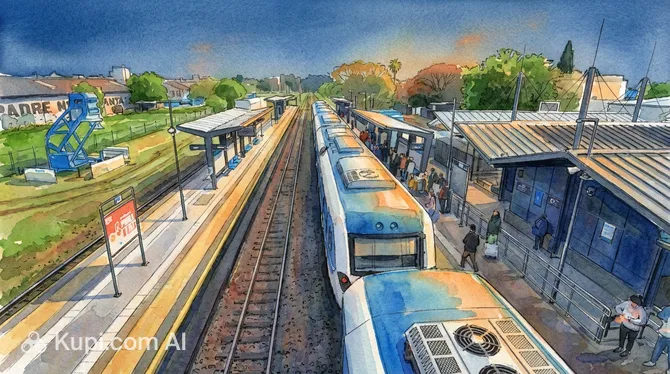
González Catán is a dynamic and densely populated city located in the Buenos Aires Province, in sunny Argentina. As part of the Greater Buenos Aires metropolitan area, it is a classic example of a South American suburb, where residential neighborhoods and industrial zones are closely intertwined. With a population of about 238,000 people, the city holds the distinguished second place in terms of size within the La Matanza Municipality, remaining an important economic hub for the region.
Gonzalez Catan. Illustration.
Source: Kupi.com AI
The rich history of this place began in the early 20th century when the opening of a railway station in 1908 gave a powerful boost to the settlement's development. The city was named in honor of Dr. Mauricio González Catán, who donated land for the founding of a college. Today, the area is known as an industrial center specializing in meat processing, attracting those who want to see the real, non-touristic life of the Argentine province.
Despite its utilitarian character, González Catán can surprise travelers with its authentic atmosphere and proximity to unique architectural sites, such as the eclectic Campanopolis park. It is a city of workers and football fans, steeped in the spirit of everyday Argentina, inviting you to look behind the facade of capital city glamour and get to know the lives of ordinary citizens.
Weather Overview
The weather in González Catán is determined by a humid subtropical climate, characteristic of the entire Greater Buenos Aires region. Summers here are long and quite hot: in January, the average maximum temperature reaches +29.8°C, and high humidity can intensify the feeling of heat. Winters, by contrast, are mild and short, with daytime temperatures around +10–15°C, although it can get colder at night.
Precipitation is distributed relatively evenly throughout the year, though March and April are often rainier. Expect a warm summer with occasional thunderstorms and dry, cool winter months. If you want more details, you can always check the current weather in the city before your trip.
The terrain of the Pampean plain means the city is open to winds, which sometimes bring sudden temperature changes. Overall, González Catán is comfortable to visit year-round, but the most pleasant times for walking are spring (September–November) and autumn (March–May), when the climate is most moderate and mild.
Average monthly temperature
Average monthly precipitation
Interesting Facts
The city was named after Dr. Mauricio González Catán, a prominent physician who donated his land in 1879 for the construction of the College of Saint Maurice.
González Catán is the birthplace of the famous footballer Gonzalo Montiel, who became a world champion in 2022 as part of the Argentina national team.
The official founding date of the city is considered to be April 3, 1910, although life here began buzzing even earlier thanks to the railway.
The nearby Autódromo Roberto Mouras features a 4.18 km track and is an important spot on the map of Argentine motorsport.
The main economic engine of the city for decades was the meatpacking plants (frigoríficos), which attracted thousands of migrants in search of work.
How to Get There
The city's transport accessibility is shaped by its role as an important suburb in the Greater Buenos Aires area. The main artery connecting González Catán to the capital is National Route 3 (Ruta Nacional 3). The distance to the city center is about 20 kilometers, and travel time by car can vary from 30 to 60 minutes depending on traffic. Detailed information on routes can be found in the how to get to the city section.
For those who prefer public transport, the railway remains the most reliable method. Trains on the Roca Line run regularly from Constitución station in central Buenos Aires to the local González Catán station. The trip takes about 40–50 minutes, making the city convenient for daily commutes, though the high volume of passengers during peak hours should be considered.
Station
Passenger traffic
Distance
Morón train station
4
14 km
Federico Lacroze train station
10
27 km
Once train station
13
28 km
Once train station
13
28 km
Constitución train station
13
29 km
For travelers arriving by air, it is most convenient to travel from Ezeiza International Airport, which is approximately 35–40 kilometers away. A trip by taxi or Uber will take between 45 and 90 minutes. There are also numerous bus lines (e.g., routes 88 and 96) connecting the city with various districts of the capital and other suburbs.
Although González Catán is primarily known as an industrial and residential area, there are several sites in its vicinity and within the city itself that deserve attention. The most unusual attraction is undoubtedly Campanopolis—a fantastic medieval-style village built from recycled materials. This place is striking for its eclectic architecture, which looks as if it came straight out of a fairy tale, and it can only be visited as part of a guided tour.
For fans of technical achievements and transport history, the González Catán railway station itself is of interest. Having served as the foundation for the city's development at the beginning of the last century, it remains an important transport hub today, preserving the spirit of old Argentina when trains were the main link between the capital and the agrarian regions.
Motorsport enthusiasts often visit the nearby Autódromo Roberto Mouras. This niche attraction allows you to immerse yourself in the atmosphere of local racing and feel the Argentine passion for speed. Otherwise, the city is interesting for its lively markets and central squares, which serve as the main landmarks in the daily lives of local residents.
Local Cuisine
The culinary scene in González Catán is an honest reflection of Argentine traditions, where meat and simplicity of preparation take center stage. Locals favor hearty dishes such as asado (traditional grilled meat) and milanesas (thin breaded cutlets). The city has many small family-run establishments where you can feel true home comfort and hospitality.
You should definitely try the local empanadas—crispy pastries with various fillings sold on almost every corner. A popular spot among residents is the Las Dos Palmeras restaurant, which serves classic Argentine dishes, including pasta and juicy steaks. Street food is also prevalent: it's impossible to pass by a stall selling choripán (a traditional sandwich with chorizo sausage).
As for drinks, mate reigns supreme and is enjoyed at any time of day. You can also find a wide selection of Argentine beer and wine in local bars. The dining culture here is devoid of pretension—food should be tasty, affordable, and bring people together at a shared table, whether it's lunch at a busy market or a quiet evening in a local restaurant.
Travel Tips
A trip to González Catán is a chance to see Argentina without its tourist polish, but such a visit requires some preparation and adherence to simple rules. These tips will help make your trip comfortable and safe.
Clothing and Essentials: Choose practical, everyday clothing. For the summer months (December–February), sunscreen and light fabrics are essential, and for winter, a windbreaker. Comfortable shoes are necessary for walking through busy streets and markets.
Transport: Use the Roca Line train to travel to central Buenos Aires—it's the fastest way. For moving around the city in the evening, it's better to call an Uber or an official taxi.
Finances: Always carry a supply of Argentine pesos in cash. Small shops and markets may not accept cards. It is best to exchange currency at official points in the capital's center.
Health and Safety: Try to visit the city during daylight hours. Avoid walking in poorly lit peripheral areas. It is recommended to filter tap water or buy bottled water.
Communication: The primary language is Spanish. Few people know English here, so learn basic phrases or use an offline translator. A SIM card from a local provider can be purchased at any "Kiosco."
Local Etiquette: Argentines are very sociable. A traditional greeting is a light kiss on the cheek, even when first meeting someone. Be polite and smile.
What to Avoid: Do not display valuables, expensive cameras, or large amounts of money in crowded places. This is a general rule for all metropolitan suburbs.
Pro-tip: If you plan to visit Campanopolis, be sure to book your visit in advance on the official website, as there is no walk-in entry to the park.
By following these simple recommendations, you can fully enjoy the authenticity of this place and gain only positive emotions from experiencing the true spirit of the Argentine province.
Entertainment & Nightlife
Nightlife in González Catán is quiet and local in character, as the city is predominantly a residential suburb. You won't find a huge number of nightclubs or noisy discos typical of the capital's center here. Evening activity is concentrated in small local bars and family restaurants where residents gather for dinner and to discuss the latest news.
For those looking for vibrant entertainment, theaters, or large-scale concert venues, the best solution is to head to the center of Buenos Aires, located just 20 kilometers away. Residents often travel to the capital's San Telmo or Palermo neighborhoods to enjoy music and dancing until dawn. On weekends, a popular pastime is shopping at the large malls within the La Matanza Municipality.
During the day, the main entertainment site remains Campanopolis park, which offers a unique immersive experience in an artificially created medieval atmosphere. It is also worth checking the event calendar for the Autódromo Roberto Mouras, where exciting local racing series are periodically held.
Parks & Museums
Given the dense urban development of González Catán, green zones and cultural institutions are minimally represented. The primary spots for outdoor walks are the small public squares near the railway station and in the center of residential blocks. Here, locals rest in the shade of trees, drink mate, and socialize.
While there are no classic museums within the city itself, their absence is compensated for by the proximity to the unique architectural ensemble of Campanopolis. This place is often called an open-air museum because of its amazing structures created from antique parts collected from across the country. It is a true treasure trove for photography lovers and fans of unusual design.
To visit full-fledged art galleries or history museums, residents and guests usually head to neighboring San Justo or the capital's center. Nevertheless, González Catán itself, with its industrial landscapes and authentic atmosphere of a working-class suburb, can be considered a kind of living museum of 20th-century Argentine social history.
Getting Around
The public transport system in González Catán is well-developed for suburban needs. The main link is the Roca Line railway, providing quick and regular connection to the capital's center. González Catán station is a busy place where life doesn't stop from early morning until late evening.
Bus service is represented by many routes, such as 88, 96, and 501. These "colectivos" connect the city not only with the capital but also with other parts of the La Matanza district. A single contactless card, SUBE, is used to pay for all types of public transport; it can be topped up at kiosks and stations. Keep in mind that transport can be very crowded during peak hours.
As an alternative, many residents use taxis or mobile apps like Uber and Cabify, which is especially convenient in the evening or for trips to areas not covered by bus routes. Cycling is not well-developed here due to high traffic density on the main roads, so trains and official taxis remain the most comfortable and safe ways for tourists to get around.
Accommodation
Accommodation options directly in González Catán are limited, as the city is rarely considered by tourists as a place for an extended stay. Most available properties are budget guesthouses or short-term apartments catering to those visiting for business or family. One of the better-known options in the district is Posada De Las Aguilas, which offers basic amenities.
If you plan to visit local attractions like Campanopolis, you might consider staying in neighboring areas of the La Matanza Municipality or closer to transport hubs. Renting accommodation here is significantly cheaper than in the capital's center, but you should carefully check for necessary infrastructure in your chosen apartment.
For a classic tourist holiday, experts recommend booking hotels in Buenos Aires itself, using González Catán as a destination for a day trip. If you must stay here, it is best to book in advance through popular international services, prioritizing properties with good reviews for safety and comfort.
Nearby Cities
Due to its location on the southwestern edge of the metropolis, González Catán serves as a convenient starting point for exploring other suburbs of Greater Buenos Aires. Each of the neighboring settlements has its own character, whether they are administrative centers or cozy residential areas with developed infrastructure.
Nearby are cities such as Rafael Castillo and Isidro Casanova, which are important parts of the La Matanza Municipality. It is also worth noting San Justo, the administrative capital of the district, where the region's main shopping centers and cultural institutions are concentrated. For those seeking a quieter atmosphere, a trip to Castelar or Libertad would be interesting.
City
Population
Distance
Rafael Castillo
147 965
7 km
Isidro Casanova
190 696
9 km
Libertad
100 324
9 km
San Justo
136 604
12 km
Castelar
107 786
13 km
Exploring these surroundings allows for a better understanding of the structure of the Argentine metropolitan area and a glimpse into how different social groups live. Traveling between these cities by bus or train is a great way to immerse yourself in the local flavor and discover Argentina beyond the popular guidebooks.
Shopping & Souvenirs
Shopping in González Catán is primarily oriented toward the daily needs of its residents, creating the atmosphere of a busy and authentic market. Main commercial activity is concentrated around the railway station and along the main streets, where numerous stalls, supermarkets, and small specialized shops are located. Here you can find everything from fresh produce to clothing and household goods.
The city has local shopping centers, such as Viviana, which offer a basic range of goods and services. If you are looking for typical Argentine souvenirs, look for leather goods or mate sets, which can be found at local markets for much better prices than in the tourist districts of Buenos Aires. However, for major shopping and brand-name boutiques, it is better to head to the large malls in neighboring districts.
Shops typically observe a siesta break, opening early in the morning and closing late in the evening. Payments are most often made in cash using Argentine pesos, especially at markets and small shops, though larger retail outlets accept credit cards. Visiting the local market stalls is an excellent opportunity to see the city's life from the inside and purchase quality local products.