Support

Ministro Pistarini Airport

Airports in the city

About the Airport

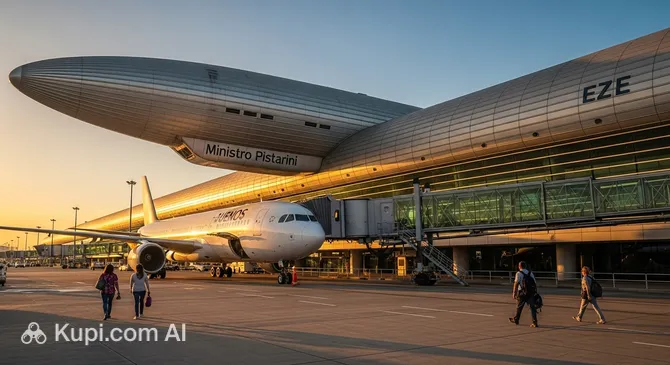
Ministro Pistarini Airport. Source: Kupi.com Binoculars

Welcome to Ministro Pistarini International Airport, better known as Ezeiza Airport (EZE)! This is the main aerial gateway to Argentina and the entry point for most international travelers seeking to discover the charm and beauty of Buenos Aires. As the country's largest and busiest aviation hub, Ezeiza serves as the starting point for unforgettable adventures across South America. The airport combines modern amenities with a lively atmosphere, reflecting the dynamic spirit of the Argentine capital.

IATA Code EZE
ICAO Code SAEZ
City Buenos Aires
Distance to centre 22 km
Status International
Annual Passengers Over 11 million (2018)
Popular Airlines Aerolineas Argentinas, Air France, Iberia
Schedule online flight board "Ezeiza Airport"

Ezeiza Airport is not just a transit point, but a well-organized complex designed for passenger convenience. It is a key hub for the national carrier Aerolineas Argentinas and other major airlines. The complex consists of several interconnected terminals: Terminal A handles most international flights, while Terminal C is used by the SkyTeam alliance. Thanks to recent renovations, navigating the airport has become even easier, and a wide range of services is available to passengers.

Among the airport's advantages are free Wi-Fi throughout the area, numerous Duty Free shops, cafes, and restaurants where you can experience Argentine cuisine. Travelers can use currency exchange offices, ATMs, and Tax Free refund services. Although there is no direct metro or train connection to the city, you can reach the centre of Buenos Aires via official taxis or special shuttle buses; the journey takes about 40–60 minutes depending on traffic.

Contact Information

Below you will find useful contact information for Ministro Pistarini International Airport (Ezeiza) to help you plan your trip and navigate upon arrival.

  • Official Website: You can always find the most up-to-date information on flights, services, and airport regulations on the official website: www.aeropuertosargentina.com/ezeiza.
  • Information Desk Phone: For inquiries by phone, you can call: (+54 11) 5480 6111.
  • Airport Address: Autopista Tte. Gral. Riccheri Km 33,5, B1802EZE Ezeiza, Provincia de Buenos Aires, Argentina.
  • Email: The airport does not provide a direct email address for general inquiries. It is recommended to use the dedicated contact form on the official website to communicate with the administration.
  • Social Media: Follow news and updates on the official pages of the airport operator Aeropuertos Argentina 2000 on Instagram and Facebook.
  • Lost Luggage Information: It is important to remember that for issues related to lost, delayed, or damaged checked baggage, you must contact your airline's representative office directly. If you have left personal items in the terminal building, please contact the airport's Lost and Found service.
  • Customer Support Contacts: For general questions, as well as to request special services (such as assistance for passengers with reduced mobility), please contact the information desk phone or visit the information counters in the terminals.

How to Get to the Airport

Ezeiza International Airport (EZE), the main international hub of Argentina, is located approximately 35 kilometres southwest of the centre of Buenos Aires. Depending on your chosen mode of transport, traffic conditions, and time of day, the journey to the city can take from 45 minutes to an hour and a half or even more. We recommend always allowing extra time, especially during peak hours.

Public Transport is the most economical option. The most budget-friendly method is the city bus (colectivo) route No. 8. The trip costs very little but can take up to two hours as the bus makes many stops. This option is not very convenient if you have a lot of luggage. To pay for the fare, you will need a SUBE transport card, which can be purchased and topped up at kiosks. A more comfortable alternative is shuttle buses, such as those from Manuel Tienda León. They offer a good balance of price and comfort, run on a schedule, and take passengers to their terminal in the city centre or distribute them to hotels.

Taxis and Transfers are the fastest and most convenient way to reach your destination. To ensure safety and a fixed price, it is best to book a car at official taxi or "remis" (licensed private car service) counters directly in the arrivals hall. This helps avoid unlicensed drivers. In Buenos Aires, ride-hailing apps like Cabify and Uber are also active, and their rates can be competitive.

Many travelers require a transfer to domestic flights, which mostly depart from Jorge Newbery Airfield (AEP). For transfers between airports, it is most convenient to use the mentioned shuttles or taxis. The direct route between Ezeiza and the Aeroparque allows you to make the journey in approximately 60-90 minutes, bypassing the busy city centre.

Car Rental and Parking. If you prefer complete freedom of movement, offices of all major international and local car rental companies are present at Ezeiza Airport. The airport is connected to the city by the modern Riccheri highway. For those arriving in their own vehicles, both covered and open parking lots for short-term and long-term parking are provided within the airport complex.

Terminals and Map

Ezeiza International Airport (EZE) consists of several terminals that are currently integrated into a single, modern complex. The main passenger areas are Terminal A and Terminal C, as well as a new, spacious departures hall (Partidas), which has centralized the check-in process for most airlines. All terminals are located in one building and are interconnected, which significantly simplifies navigation.

The airport structure is organized logically and intuitively. The departure process begins in the new central hall, where numerous check-in counters and self-service kiosks are located. After check-in and baggage drop, passengers pass through security and passport control, and then enter the general "airside" zone, from where there is access to gates in the wings corresponding to Terminal A and Terminal C. Arrival areas are located on the ground floor of the complex, where baggage claim belts and customs control are situated.

Movement between terminals is done on foot. Since they are part of one large building, there is no need to use shuttles or buses to move from one zone to another. A walk from one end of the complex to the other (for example, from the far gates of Terminal A to the gates of Terminal C) may take about 15-20 minutes, so please factor this time in when connecting flights or finding your boarding gate.

The time required to complete all procedures can vary greatly. For international flights, it is recommended to arrive at the airport at least 3-4 hours before departure. Although the new check-in hall has optimized processes, queues for check-in, security, and passport control can be significant during peak hours and the tourist season.

For easy navigation at Ezeiza Airport, follow these tips:

  • Immediately upon arrival, find the information board to check which counter is checking in your flight.
  • Pay close attention to signs — they are in Spanish and English and will help you find your way.
  • After passing security control, check your gate number again, as it may change.
  • Do not leave pre-flight formalities to the last minute, even if the airport does not seem too large to you.

Airport History

The history of the main international airport of Buenos Aires, officially named after Minister Juan Pistarini but better known as Ezeiza (EZE), began in the post-war years. The decision to build it was made in 1945, and on April 30, 1949, the airport received its first flights. At the time of its opening, it was considered the largest airport in the world and was a true symbol of Argentina's ambitions and technological progress.

The initial project was truly grandiose. It included three runways that intersected to form a giant letter "A" from the air, symbolizing Argentina. This interesting fact highlighted the national pride invested in the project. With the growth of international traffic volume, the airport constantly developed: new terminals (A, B, and C) were built, and infrastructure was modernized to serve an increasing number of passengers and airlines.

In the 21st century, Ezeiza Airport underwent several stages of massive reconstruction aimed at increasing comfort and capacity. One of the most notable innovations was the construction of a new departure terminal, which received the unofficial nickname "Zeppelin" for its futuristic architecture. This modernization allowed for the consolidation of operations from several terminals under one roof, optimizing logistics and offering passengers world-class service.

Over decades of operation, Ezeiza Airport has witnessed many important moments in the country's history, welcoming and seeing off millions of travelers, world leaders, and celebrities. Today, it is not just a key transport hub in South America but also an important part of history that continues to evolve, adapting to the demands of modern aviation while maintaining its status as Argentina's main aerial gateway.

Services and Amenities

Ezeiza International Airport offers all the conditions for a comfortable wait for your flight. Passengers have access to numerous cafes and dining venues where they can have a quick snack or a full meal, enjoying dishes of local and international cuisine. The terminals house many shops, including large Duty Free areas offering a wide range of perfumes, cosmetics, beverages, souvenirs, and other goods.

For those who value enhanced comfort, several VIP lounges and business lounges operate at the airport. Here you can rest in a quiet atmosphere, enjoy complimentary snacks and drinks, work, or simply relax in comfortable armchairs before departure. Access to lounges is available for business class passengers, airline loyalty card holders, or for a separate fee.

Free Wi-Fi is available throughout Ezeiza Airport, allowing you to stay connected and handle work matters. Numerous power outlets and special charging stations are provided for electronic devices. Financial services are represented by bank branches, 24-hour ATMs, and currency exchange offices where you can exchange money upon arrival or before departure.

The airport cares for all categories of passengers. Mother and child rooms are equipped for travelers with children. In case of necessity, you can contact the medical centre for first aid. Passengers with reduced mobility can book assistance services in advance and receive all necessary help to move around the terminal and board the aircraft.

For business travelers and those who need to rest between flights, hotels are located near the airport. Some of them offer transfer services. Additionally, the airport offers the possibility to rent conference rooms and use business centre services, making it a convenient place for meetings and events.

Where to Eat

At Ezeiza International Airport (EZE), travelers will find diverse dining options to suit any taste and budget. Whether you are looking for a quick snack before departure or want to enjoy a full dinner, a wide selection of cafes, restaurants, and dining spots is presented in the airport terminals.

Most establishments are concentrated in the main terminal, both in the public area (before security control) and in the departure area (after control). In the public area, you can find popular coffee shops where it is convenient to have coffee with those seeing you off. The main selection awaits passengers in the departure area. Here, establishments for every taste are located: from world-famous fast-food chains such as McDonald's and Burger King to cozy cafes and restaurants with à la carte service.

While in Buenos Aires, even at the airport, it is worth paying attention to local cuisine. Be sure to try traditional Argentine snacks. In many cafes, you can buy fresh `empanadas` — appetizing pastries with various fillings (meat, chicken, cheese, and vegetables). For breakfast or with coffee, `medialunas` — local sweet croissants — are perfect. Visit one of the `Havanna` chain cafes to enjoy famous alfajores (cookies filled with dulce de leche) and high-quality coffee.

For travelers with special dietary needs, choices may be limited, but options can be found. Vegetarians can easily find `empanadas` with cheese or vegetables, as well as various salads. Gluten-free and vegan options are less common, so it is worth studying the menu carefully or asking the staff. Please note that while beef is common, standard meat preparation in Argentina is not necessarily Halal; please inquire specifically if this is a requirement. The price range at the airport is generally higher than in the city. A quick snack at a fast-food outlet will cost less, while a full lunch at a restaurant will be more expensive.

Most restaurants and cafes in the international departures area operate around the clock or are adjusted to flight schedules, so you can have a snack even at night. For a quick bite, coffee shops and food courts are ideal. If you have time for a full lunch or dinner, look for restaurants with a broader menu where you can order pasta, steaks, or other hot dishes in a quiet atmosphere.

Travel Tips

When planning a departure from the main international airport of Buenos Aires — Ezeiza (EZE), it is worth considering several points for a calm and comfortable journey. Since this is a major hub for international flights, it is strongly recommended to arrive at the airport at least 3 hours before departure. This will give you a sufficient margin of time in case of queues at check-in, passport control, and security screening.

To save time, complete online check-in for your flight if your airline provides such a service. This will allow you to go straight to the baggage drop-off counter, bypassing the general queue. At security control, be prepared in advance: remove all metal objects and electronics from your pockets, and take off your outer clothing and belt. Liquids in hand luggage must be in containers of no more than 100 ml and packed in a transparent bag.

When choosing a seat on the plane for long-haul flights from Argentina, consider your preferences. A window seat will offer you beautiful views during takeoff and landing but makes it harder to exit. An aisle seat provides freedom of movement, which is especially valuable on flights lasting more than 10 hours.

In hand luggage, besides standard restrictions on liquids and sharp objects, you should not pack souvenirs that might be interpreted as weapons. If you are carrying a traditional mate set as a gift, ensure that the bombilla (metal straw) does not raise questions with security. Always keep documents, money, valuables, and fragile electronics in your hand luggage.

For passengers with connections at Ezeiza Airport, it is important to check in advance whether you need to collect and re-check your luggage. Information about this is usually indicated when purchasing the ticket. Pay close attention to signs and information boards to find the correct gate. If you have a short layover, do not linger in the shops, but head straight to the boarding gate.

Customs control when leaving the country is usually faster than when entering. However, be prepared to present receipts for expensive purchases if asked. There are restrictions on taking out cash currency and certain categories of goods, so it is better to familiarize yourself with current rules in advance, especially if you plan to carry many souvenirs or specific beverages.

To save time and money, order a taxi or transfer only at official counters in the arrivals hall or through verified apps. Prices for food and drinks at the airport are traditionally high, so you can bring an empty bottle and fill it with water at drinking fountains after passing security control. Free Wi-Fi is available throughout the terminal.

In case of a flight delay or cancellation, first contact your airline representative for information. Keep all boarding passes and receipts for necessary expenses (food, beverages). Depending on the length of the delay, the airline is obliged to provide meals, and for long waits — hotel accommodation. Having travel insurance will help compensate for unforeseen expenses.

Reached the end of the page?

That means the route is fully explored