Support

Northern Peninsula Airport

About the Airport

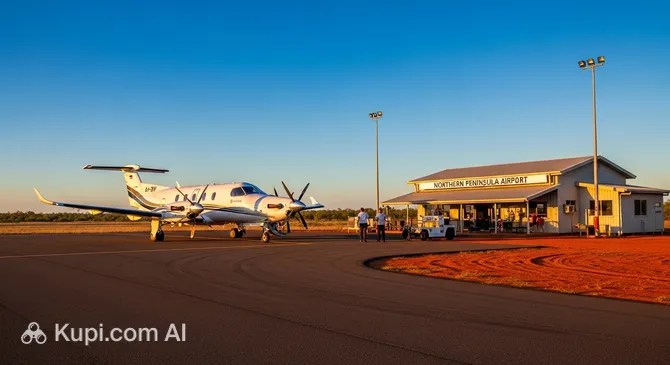
Northern Peninsula Airport is not just a runway, but the aerial gateway to the uttermost north of Australia. Located on the Cape York Peninsula, it serves as a vital artery connecting remote communities with the rest of the country. For travellers, it is the starting point for exploring wildlife, experiencing Indigenous culture, and journeying to the famous Cape York — the northernmost point of the Australian continent.

Northern Peninsula Airport. Source: Kupi.com Binoculars
IATA Code ABM
ICAO Code YNPE
City Bamaga
Distance to centre approx. 10 km
Status Domestic
Annual Passengers approx. 30,000
Popular Airlines Rex (Regional Express), Skytrans Airlines, QantasLink

The main feature of the airport is its strategic location. It serves not only the town of Bamaga but the entire Northern Peninsula Area (NPA), including several Indigenous Australian communities. The airport is a key hub for flights to the Torres Strait Islands, offering a unique opportunity to discover their distinct culture. Despite its modest size, Northern Peninsula Airport plays an invaluable role in ensuring connectivity, cargo delivery, and tourism development in one of Australia's most remote and breathtaking corners.

Contact Information

To ensure your journey through Northern Peninsula Airport goes smoothly, it is important to have up-to-date contacts at hand. Below is the essential contact information that you may find useful.

  • Official Website: Bamaga Airport (ABM) does not have its own separate website. The airport is managed by the Northern Peninsula Area Regional Council (NPARC), on whose official portal general information can be found.
  • Help Desk Phone: For information regarding flights, schedules, and services, it is recommended to contact your airline directly. For administrative questions concerning airport operations, you may contact NPARC.
  • Airport Address: Airport Rd, Bamaga QLD 4876, Australia. The airport is located a few kilometres from the town of Bamaga on the Cape York Peninsula.
  • Email: There is no specialised email address for passengers. To contact the administration, please use the general contact forms on the NPARC website.
  • Social Media: The airport does not maintain official pages on social networks. Up-to-date news should be checked on the websites of the air carriers.
  • Lost Luggage Information: If you encounter a problem with lost or damaged luggage, immediately contact the Lost and Found service of your airline at the airport of arrival.
  • Customer Support Contacts: For all questions related to tickets, flight check-in, special services, and carriage regulations, please contact the customer support service of the airline you are flying with.

How to Get to the Airport

Northern Peninsula Airport (ABM) is the main aerial gateway for the town of Bamaga and the entire northern Cape York Peninsula in Australia. Given the remote location, transport options here are specific but quite functional. Planning a trip to the airport, which is located just a few kilometres from the town, will not be difficult if local specifics are taken into account.

Taxis and Private Transfers. The most common way to get to the airport is to use a local taxi service or book a private transfer. The journey from the centre of Bamaga takes only 5–10 minutes. Several companies operate in the region, but their fleet is limited. It is highly recommended to book a car in advance, especially during the tourist season (from May to October), to avoid waiting. The cost of the trip may be higher than in major cities due to the remoteness of the region. Many hotels and guesthouses also offer transfer arrangements for their guests.

Car Rental. For travellers wishing to explore the Cape York region on their own, car rental is the best choice. Mostly four-wheel drive vehicles (4WD) are offered here, which are necessary for moving along many local roads leading to famous landmarks. Rental desks can be found both directly at the airport and in the town itself. As with taxis, a vehicle should be booked well before the trip, as demand often exceeds supply. The drive to the airport in a rental car will take no more than 10 minutes.

Airport Parking. Parking is available at Northern Peninsula Airport. Given the small size of the airport and traffic volume, parking is usually free and offers a sufficient number of spaces for both short-term and long-term stays. Difficulties with finding a free space generally do not arise.

Public Transport. It is worth noting that in Bamaga and its surroundings, there is no regular public transport system in the conventional sense (city buses, trains, or metro). The only alternative may be shuttles organised by some tour companies or hotels for their clients. Please verify the possibility of such a transfer when booking accommodation.

Terminals and Map

Northern Peninsula Airport (ABM), serving the town of Bamaga and its surroundings in northern Australia, is a typical example of a small regional aviation hub. Its main feature is simplicity and compactness, which makes staying here as comfortable as possible and eliminates the stress typical of large airports.

The airport operates one passenger terminal, which handles all flights — both arrivals and departures. The terminal building is small, and its layout is extremely simple. Immediately at the entrance are the check-in counters, followed by the security screening area and a small waiting room for departing passengers. The arrivals area with the baggage claim belt is also located in this same building. Thanks to this layout, you will not have to walk far from the check-in counter to the boarding gate.

Since there is only one terminal, the question of transfers between them is irrelevant. All pre-flight and post-flight formalities take place in one building. Flight check-in and security control procedures usually take a minimum amount of time due to the low passenger flow. Nevertheless, it is always worth following the airline's recommendations and arriving at the airport in good time.

Navigation at Northern Peninsula Airport is intuitively clear. It is practically impossible to get lost here. The signs are clear, and the short distances allow you to orient yourself quickly. For passengers, this means a calm and predictable start or end to their journey without unnecessary fuss.

Airport History

The history of Northern Peninsula Airport (ABM) is inextricably linked with the events of World War II. It was built in 1942 as a military airfield and originally bore the name Higgins Field or Jacky Jacky Airfield. In those years, it played a vital strategic role in the defence system of northern Australia, serving as a base for fighter and bomber squadrons protecting the continent.

After the end of the war, the military significance of the airfield decreased significantly, and it was repurposed for civil needs. For remote communities in the north of the Cape York Peninsula, including Bamaga, the airport became a true lifeline. It ensured the regular delivery of mail, food, medical evacuation, and, most importantly, connection with the rest of the country, helping to overcome the geographical isolation of the region.

Throughout its civil history, the airport has undergone several stages of modernisation to meet modern aviation standards. Works were carried out to improve the runway and terminal infrastructure, which allowed it to receive more modern types of aircraft. These updates were crucial to support not only the local population but also the growing flow of tourists seeking to explore the unique nature and culture of Queensland's northernmost region.

Perhaps the most interesting fact in the airport's history is its transformation from an object of military significance into a key civil hub. Its main achievement is not passenger traffic records, but decades of uninterrupted service as an indispensable bridge connecting the northern tip of Australia with the world. Today, landing in Bamaga, you step onto land with a rich historical past that continues to play a central role in the life of the modern community.

Services and Facilities

Northern Peninsula Airport (ABM) is a small regional airport serving the northern tip of the Cape York Peninsula in Australia. Given its size and remote location, the range of services here is focused on meeting the basic needs of passengers before departure. It is recommended to plan all important matters, such as dining or financial transactions, in town beforehand.

Dining and shopping opportunities at the airport are quite modest. Usually, there is a small kiosk or cafe operating here, where you can purchase light snacks, sandwiches, and beverages. There are no full-service restaurants or a wide variety of shops here. Specialised high-comfort lounges or VIP zones are absent at the airport; all passengers wait for departure in the general waiting hall.

For the convenience of travellers, charging points for electronic devices may be available in the terminal, however, their number is typically limited. Access to Wi-Fi may also be limited or provided on a paid basis. Regarding financial services, there are no bank branches or currency exchange points at the airport. It is recommended to withdraw cash and settle all financial matters in Bamaga before arriving at the airport.

The airport is equipped to serve passengers with reduced mobility. Accessible restrooms and ramps for convenient movement are available. Nevertheless, to receive special assistance, such as escorting or the provision of a wheelchair, it is necessary to notify your airline in advance. For passengers with small children, basic amenities such as changing tables in the restrooms are provided. There are no play areas for children.

There are no hotels directly on the airport territory. The nearest accommodation options are located in the town of Bamaga and its vicinity. Business travellers should note that Northern Peninsula Airport lacks conference rooms and business centres. Medical assistance on-site is limited to the provision of basic first aid by airport staff.

Where to Eat

Northern Peninsula Airport (ABM) is a small regional airport, and dining opportunities here correspond to its compact size. Options for passengers are focused on a quick and convenient snack before departure or immediately after arrival.

In the main terminal building, there is one small cafe operating, which serves as the central point for purchasing food and beverages. The assortment usually includes classic options for travellers: sandwiches, pies, pastries, crisps, and chocolate. Available drinks include hot coffee, tea, as well as bottled water and soft drinks. This establishment is ideal for those who want a quick bite but is not designed for a full lunch or dinner.

It is important to note that due to the limited menu, passengers with strict dietary requirements (vegan, gluten-free, Halal) will find it difficult to find suitable dishes. If you have specific dietary needs, it is strongly recommended to bring food with you. Prices in the cafe are moderate, as in most regional airports.

The cafe is located in the general terminal zone, accessible to both departing and meeting passengers. Its operating hours are directly linked to the flight schedule — it opens shortly before departures and closes after the last aircraft have left. For a more substantial meal, it is better to plan a visit to one of the establishments in the town of Bamaga before travelling to the airport.

Travel Tips

Travelling through Northern Peninsula Airport, serving the town of Bamaga and the Cape York region, requires some preparation. Given its status as a regional airport, processes here may differ from major international hubs. Here are a few tips to make your trip more comfortable.

Arrival Time and Check-in. For domestic flights within Australia, it is usually recommended to arrive at the airport 60-90 minutes before departure. Since this is a small airport, queues for check-in and security are generally shorter. Nevertheless, it is always better to check your airline's recommendations. Online check-in, if available, will help save time.

Security Control and Hand Luggage. Rules for carrying hand luggage are standard for Australian domestic flights. Liquids, aerosols, and gels must be in containers of no more than 100 ml and packed in a transparent bag. Sharp objects, weapons, and other dangerous substances are prohibited. The screening procedure usually proceeds quickly, but be prepared to present all necessary items.

Seat Selection and Transfers. If it is possible to choose a seat when booking, select a window seat to enjoy stunning views of the Cape York Peninsula during take-off and landing. If you have a connecting flight, study the plan of the transfer airport in advance. In Bamaga Airport itself, opportunities for long waits are limited, so plan your actions beforehand.

Special Quarantine Control. This is a critically important point for travellers to this region. The Cape York Peninsula has strict biosecurity rules to preserve its unique ecosystem. You may be asked to present luggage for inspection for the presence of prohibited food, plants, seeds, or soil. It is strictly prohibited to carry fresh fruits, vegetables, honey, and other products that may pose a biological threat. Be sure to declare all such items to avoid large fines.

Savings and Flight Delays. To save money, book tickets in advance and travel light to avoid surcharges for excess baggage. The airport may have a limited selection of food and drinks, so you can take a small water bottle (to fill after security) and light snacks. In case of a flight delay, immediately contact your airline representative. Have a phone charger and a book or another way to entertain yourself, as infrastructure for long waits at the airport is minimal.
Reached the end of the page?

That means the route is fully explored