Support

Bundaberg Airport

About the Airport

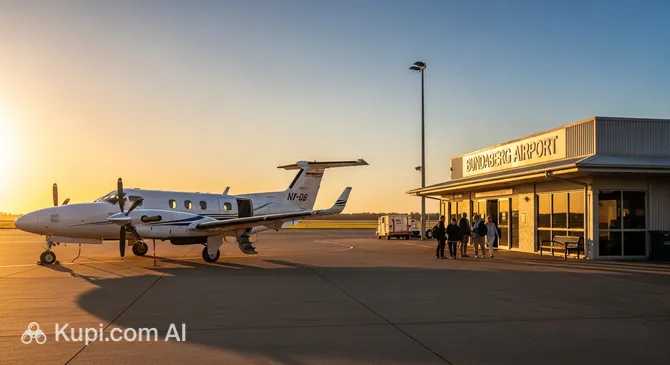
Bundaberg Airport. Source: Kupi.com Binoculars

Bundaberg Airport is not just a transit point, but a welcoming gateway to the Southern Great Barrier Reef and the famous Mon Repos sea turtle beaches. This cozy regional aviation hub instantly immerses arrivals in the relaxed atmosphere of Queensland, offering travellers comfort without the hustle and noise of megacities. Located just a few minutes' drive from the city centre of Bundaberg, it allows you to begin exploring local natural wonders and legendary beverage production facilities almost immediately after landing.

IATA Code BDB
ICAO Code YBUD
City Bundaberg
Distance to Centre 6 km
Status Regional
Annual Passengers ~115,000
Schedule Daily flights

Airport Features and Benefits

The main advantage of Bundaberg Airport is its exceptional accessibility. Thanks to its location within the city limits, the journey from the aircraft steps to central hotels or the business district takes less than 15 minutes by car. This makes it an ideal choice for both business travellers valuing every minute and tourists eager to reach the coast quickly.

The airport terminal has undergone modernization and, despite its compact size, offers a high level of service. Navigation here is intuitive: it is impossible to get lost, and check-in and baggage claim procedures are much faster than in capital city hubs. The atmosphere inside the building is calm and friendly, setting a positive tone for the entire journey through this picturesque region.

For tourists, the airport serves as a convenient starting point to one of Australia's main natural treasures — Lady Musgrave Island. Many travellers choose this specific aviation hub to avoid the crowds typical of more northern tourist centres and to enjoy the beauty of the Coral Sea in a more secluded setting.

Contact Information

  • Official Website: www.bundabergairport.com.au
  • Helpline Phone: +61 7 4130 4277
  • Address: Airport Drive, Kensington QLD 4670, Bundaberg, Australia
  • Email: airport@bundaberg.qld.gov.au
  • Social Media: The airport does not have its own official accounts. Important information and updates are published on the Bundaberg Regional Council resources.
  • Lost Luggage Information: For issues related to lost or damaged luggage, you must contact the airline directly that you flew with.
  • Passenger Support Contacts: For general information, you can use the helpline phone. If your question concerns booking, schedules, or flight check-in, please contact your airline.

How to Get to the Airport

Bundaberg Airport (BDB) is located just a few kilometres from the city centre of Bundaberg, making the journey to it fast and convenient. Travellers can choose from several transport options depending on their budget and preferences when planning a trip to this corner of Australia.

Taxis and Shuttles are the most popular and reliable way to get to the airport. A trip by taxi or via ridesharing services (such as Uber) from the city centre will take just 10–15 minutes. The cost of the trip is moderate, making this option optimal in terms of price and comfort. You can also pre-book a private transfer or shuttle, which is especially convenient for groups or travellers with a large amount of luggage.

Public Transport in Bundaberg is represented by bus routes; however, direct and regular services to the airport terminal itself may be limited. This option is the most budget-friendly but less predictable. It is recommended to check the schedule on local transport company websites in advance and account for possible waiting times. For most tourists, a taxi or car rental will be a more convenient choice.

Car Rental is an excellent choice for those planning to actively explore the Queensland region. Offices of several major rental companies operate at the airport and in the city. Having your own vehicle gives maximum freedom of movement. If you are driving to the airport in your own or a rented car, parking is available directly at the terminal. Both short-term and long-term parking spaces are available.

Terminals and Map

Bundaberg Airport (BDB) is a compact regional aviation hub where the structure is extremely simple and clear for passengers. There is only one terminal operating here, which serves both departing and arriving flights. Thanks to this, navigation through the airport is intuitive, and the risk of getting lost is reduced to zero.

The terminal layout is very logical. The building is single-level: upon entering, you immediately find yourself in the general area where airline check-in counters and car rental desks are located. Departure and arrival zones are in different parts of the same building. After passing check-in and pre-flight security screening, passengers enter a small waiting lounge. The arrival zone is located separately and includes a baggage claim belt. Since there is only one terminal, the issue of transfers between them is irrelevant — everything is within a few minutes' walk.

Processing of all formalities, including flight check-in and security screening, usually happens quickly and without queues at Bundaberg Airport, which is a great advantage for travellers. Nevertheless, it is recommended to arrive at the airport approximately 60 minutes before departure to check in luggage and go through all procedures without rushing. Orienting yourself in the building is easy thanks to clear signs, but its modest dimensions serve as the best navigator for any tourist visiting Australia for the first time.

Airport History

The history of Bundaberg Airport (BDB) begins in 1931, when the first licensed airfield was opened. It was originally known as Hinkler Airfield, named after the famous aviation pioneer Bert Hinkler, a native of this city. From its early days, the airport became an important link in the development of air travel in the Queensland region.

A key stage in the airport's history was the period of World War II. In 1941, it was requisitioned by the Royal Australian Air Force (RAAF) and transformed into a major training base. Service Flying Training School No. 8 was located here, where thousands of pilots underwent training before being sent to the front. This period left a significant mark on the airport's history, transforming it from a small civil airfield into a strategically important military facility.

After the war ended, the airport returned to civil use and began to actively develop as a passenger hub. In the post-war decades, leading Australian airlines such as Trans Australia Airlines and Ansett-ANA began operating flights here, which contributed to the growth of tourism and business activity in the region. Infrastructure was gradually improved to meet the growing passenger traffic.

The most significant modernization in the airport's recent history occurred in 2009-2010. As part of a large-scale reconstruction, a new modern terminal was built, the runway was strengthened and extended, and new lighting was installed. These improvements allowed the airport to accommodate larger jet aircraft, such as the Boeing 737. An important achievement was the commencement of regular flights by Virgin Australia in 2013, which significantly improved Bundaberg's connections with the country's major cities.

Today, Bundaberg Airport is a modern regional hub playing a vital role in the economy and tourist appeal of the region. Its history reflects the journey from a modest airfield named after a local hero to a gateway to one of the most fertile and picturesque corners of Australia.

Services and Facilities

Bundaberg Airport (BDB) is a modern and compact regional aviation hub that ensures a comfortable start or end to your journey. Despite its small size, the terminal offers all necessary services so that passengers can relax and prepare for their flight.

While waiting for your flight, you can have a snack or drink coffee in the cozy cafe located in the terminal building. It serves light meals, sandwiches, pastries, and beverages. Shopping opportunities are limited, but a small shop offers newspapers, books, and travel essentials.

For the convenience of passengers, free Wi-Fi is available throughout the terminal, allowing you to stay connected or work while waiting for departure. Charging stations for electronic devices are also provided. It is worth noting that there are no dedicated VIP halls or airline business lounges at Bundaberg Airport; a comfortable general waiting area is equipped for all travellers.

ATMs are installed in the terminal for cash withdrawals. However, currency exchange services are not provided at the airport. We recommend arranging currency exchange in advance at banks in the city of Bundaberg. In case of need, passengers can seek basic medical assistance at the first aid point.

The airport is fully equipped for the comfortable movement of passengers with reduced mobility: there are ramps and specially equipped restrooms. Travellers requiring additional assistance should notify their airline in advance. For families with small children, there are parents' rooms with changing tables.

There are no hotels on the airport territory itself, but in the immediate vicinity, in the city of Bundaberg, there are many accommodation options — from motels to comfortable hotels. Specialized conference rooms or business centres are also not provided at the airport, as it is primarily oriented towards serving passenger flights.

Where to Eat

Bundaberg Airport (BDB) is a compact regional aviation hub, so all catering establishments here are conveniently located in a single terminal. The selection is not as large as in megacities, but quite sufficient to have a comfortable snack before departure or after arrival.

The main place to eat is the cafe located in the general hall (before the security zone). Here, passengers and greeters are offered a classic assortment of Australian snacks: fresh sandwiches and rolls with various fillings, salads, meat pies, pastries, muffins, and cakes. This establishment is suitable for both a quick snack with a cup of coffee and a more substantial lunch.

While in Bundaberg, be sure to try local drinks! In the cafe, you will likely find the world-famous non-alcoholic Bundaberg Ginger Beer and other lemonades of this brand — this is a great opportunity to experience local flavour. As for dietary options, vegetarian sandwiches are usually available. However, the selection of gluten-free, vegan, or Halal dishes may be extremely limited, so with strict dietary requirements, it is better to check availability with staff or bring snacks with you.

The cafe's opening hours are directly linked to the flight schedule — it opens well in advance of the first departure and operates until the last one. Thus, you will always have time to drink coffee or have a snack. Prices correspond to the average level for airports in Australia: they are slightly higher than in city establishments but remain within reasonable limits.

Thus, for a quick snack, coffee with pastries or fruit is ideal, and if you have time for a full lunch, pay attention to hearty sandwiches or a classic Australian pie. All options are available in the main terminal hall, making the wait for the flight more pleasant.

Travel Tips

To ensure your journey through Bundaberg Airport goes smoothly and without unnecessary stress, take advantage of our useful tips. These recommendations will help you save time, money, and nerves, making the beginning or end of your adventure in Australia as comfortable as possible.

Arrival time at the airport. Bundaberg Airport is regional, so there are no queues like in major hubs. For domestic flights, it is recommended to arrive 1.5–2 hours before departure. This time will be enough to calmly check in, drop off luggage, and pass security control without rushing.

Check-in and Security. To speed up the process, complete online check-in if your airline provides such an option. At the airport, keep your passport (or other identification) and boarding pass ready. During screening, be prepared to remove laptops and other large electronic devices, as well as containers with liquids, from your hand luggage.

Seat Selection. If you want to enjoy views of the Queensland coast, choose a window seat. If comfort and the ability to stand up freely during the flight are more important to you, an aisle seat is better suited. Book tickets in advance to have a wider choice.

Hand Luggage. Australia has strict rules regarding the carriage of liquids, aerosols, and gels (LAGs) in hand luggage. All containers must be no more than 100 ml in volume and packed in a single transparent resealable bag. It is forbidden to carry sharp objects, weapons, and flammable substances. Be sure to check the current requirements of your airline before departure.

Connecting Passengers. If you have a connecting flight, check at registration whether your luggage will be checked through to the final destination automatically. Leave enough time between flights, especially if the transfer is in a major airport like Brisbane.

Customs Control. Australia's customs and biosecurity rules are among the strictest in the world. Make sure to declare all food products, plants, seeds, wooden items, and animal products. Failure to comply with this requirement may result in large fines. Even if you are flying on a domestic flight but arrived in the country from abroad, these rules apply to you.

Saving Time and Money. Book airport parking online — it is often cheaper. Check in for your flight via the internet to avoid standing in line. To avoid overpaying for drinks, bring an empty water bottle with you and fill it after passing security control.

Flight Delays. In case of a flight delay, first contact your airline representative for information. Depending on the length of the delay, you may be provided with food vouchers. Since the airport is small, entertainment options are limited, so it is useful to have a book, a charged power bank, or pre-downloaded movies with you.

Reached the end of the page?

That means the route is fully explored
