Support

Brisbane Airport

About the Airport

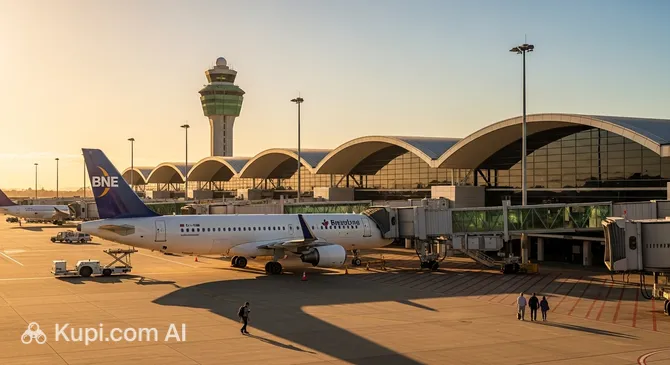
Brisbane Airport. Source: Kupi.com Binoculars

Brisbane Airport (BNE) is not just the aerial gateway to the Sunshine State of Queensland, but a modern and massive aviation hub, ranking first in Australia by land area. Located on the site of the historic Eagle Farm aerodrome, where legendary aviator Charles Kingsford Smith landed in 1928 after the first-ever trans-Pacific flight, today the airport is one of the fastest-growing in the country. It serves as a major hub for Virgin Australia and a key node for Qantas, offering travelers a high level of service and convenient connections to both Australia's major cities and international destinations.

IATA Code BNE
ICAO Code YBBN
City

Brisbane

Distance to center approx. 14 km
Status International
Passengers per year 22.6 million (FY 2024)
Popular Airlines Qantas, Virgin Australia, Jetstar
Schedule Brisbane Airport Online Flight Board

Brisbane Airport consists of two main terminals — International and Domestic — connected by a complimentary shuttle bus. Travelers can take advantage of a wide range of services: from free Wi-Fi and numerous shops to shower cabins and prayer and meditation rooms. One of its distinguishing features is its award-winning punctuality; the airport has repeatedly been ranked among the best in the world for on-time performance. Additionally, for passenger convenience, various parking options are provided, including the budget-friendly AIRPARK with free transfers to the terminals, as well as direct rail connections to the city center and the popular Gold Coast resort area via the Airtrain.

Contact Information

For your convenience, we have compiled the main contact information for Brisbane Airport. If you have any questions, you can contact airport representatives in one of the following ways:

  • Official Website: www.bne.com.au — here you will find the most up-to-date information on flights, services, and airport regulations.
  • Help Desk Phone: +61 7 3406 3000. Staff are ready to answer your questions 24/7.
  • Airport Address: Airport Drive, Brisbane, Queensland 4008, Australia.
  • Email: A direct email address for general inquiries is not published. It is recommended to use the dedicated contact forms on the airport's official website for communication.
  • Social Media: Brisbane Airport maintains active pages on Facebook, Instagram, and X (Twitter), where you can follow news and updates.
  • Lost Property Information: If your items were lost within the terminal, fill out a request in the "Lost Property" section on the official website. If luggage was lost during a flight, you must contact your airline directly.
  • Passenger Support Contacts: Information desks are located in the arrival and departure halls of both terminals. You can also always call the general help desk number.

How to Get to the Airport

Reaching Brisbane Airport (BNE), located approximately 12 kilometers northeast of the city center, can be done through several convenient methods. The choice of transport depends on your budget, amount of luggage, and time preferences. Whether you are looking for the fastest, most economical, or most comfortable option, Brisbane's transport system offers solutions for every need.

The Airtrain express train is arguably the fastest and most reliable way to get to the airport. Trains depart regularly and connect both the International and Domestic terminals with central city stations (Central, Roma Street) and continue on to the Gold Coast. The trip from Brisbane city center to the airport takes only about 20 minutes. While not the cheapest option, its predictability and avoidance of traffic jams make it very popular among travelers. Tickets can be purchased online in advance, often at a discount, or at the station.

A more budget-friendly alternative is the public bus. TransLink route 590 runs from Toombul Interchange to Skygate — a shopping center near the airport. From there, you can use the free TBus shuttle which runs between Skygate and the terminals. This option is significantly cheaper than the train but requires more time and a transfer, which may be inconvenient with a large amount of luggage.

For maximum comfort, you can use taxis or ridesharing services (such as Uber, DiDi, Ola). The ride from the city center will take 20-30 minutes depending on traffic conditions. This is an excellent choice for families, groups, or travelers with bulky luggage, as you will be delivered directly to the entrance of the required terminal. The cost will be higher than public transport and may vary during peak hours.

If you are traveling by private or rental car, Brisbane Airport provides diverse parking options. There are short-term lots for drop-offs and pick-ups, as well as several types of long-term parking, including covered and open-air areas. It is strongly recommended to book a parking space online in advance — this almost always allows for significant savings compared to paying on arrival.

Terminals and Map

Brisbane Airport (BNE) has a simple and clear structure consisting of two main passenger terminals: International (T1) and Domestic (T2). They are located at a significant distance from each other, on opposite sides of the runway, so walking between them is not possible. It is important to verify in advance which terminal your flight departs from to avoid confusion and rushing.

The International Terminal (T1) handles all flights outside of Australia. It is a modern multi-level building. On Level 4, you will find the Departures zone with check-in counters and security checkpoints. Level 3 is the Arrivals zone with passport control and baggage claim. Level 2 houses offices and travel agency counters. The terminal is well-equipped with shops, cafes, and rest zones, allowing for a comfortable wait before your flight.

The Domestic Terminal (T2) is designed for flights within the country. Its unique feature is that it is divided into three sections corresponding to major airlines: the northern part serves Qantas and QantasLink, the southern part serves Virgin Australia, and the central part serves Jetstar and other regional carriers. Navigation inside is simple: the upper level contains departure and security zones, while the lower level contains arrival and baggage claim zones.

There are two convenient ways to move between terminals. The Free Shuttle (T-Bus) runs every 10–15 minutes, with the trip taking about 10 minutes. This is an excellent option if you have enough time. A faster, but paid method is the Airtrain. It connects the terminals in just 2 minutes but is part of the suburban rail network, so a fare applies (transfers between terminals are usually offered at a reduced rate).

To complete all formalities, it is recommended to arrive at the airport well in advance. For international flights — at least 3 hours before departure, and for domestic flights — 1.5–2 hours. Navigation in both terminals is intuitive thanks to numerous signs in English. In case of difficulties, you can always approach the information desks located at key points in the terminals.

Airport History

The history of Brisbane Airport is a story of growth and transformation, closely linked to the development of the entire Queensland region. The first flights in this area began as early as **1922** from a small government airfield. The official starting point is considered to be **1925**, when the Eagle Farm airfield was founded on the site where the racecourse of the same name is now located. Initially, it served mail and a few passenger flights.

A key moment in the airport's history was the Second World War. Eagle Farm was transformed into a crucial military base for Allied forces in the Southwest Pacific. It was from here that air operations were commanded, and the airfield served as the main base for forces under the leadership of American General Douglas MacArthur. This period left a deep mark on the site's history, turning it from a modest airfield into a strategic hub.

After the war, with the growing popularity of air travel, it became obvious that the old airport could not cope with the load. In the **1970s**, a decision was made to build a completely new airport complex on an adjacent site, which required massive work to drain marshy terrain. This ambitious project concluded in **1988** with the opening of the new domestic terminal, marking the birth of the modern Brisbane Airport. The international terminal was commissioned in **1995**, finally cementing Brisbane's status as a major international aviation center.

In the 21st century, development did not stop. One of the most significant milestones was the realization of the project to build a new parallel runway. This multi-year and complex project was completed in **2020**, allowing the airport's capacity to double and preparing it for future passenger growth. Brisbane Airport has repeatedly received awards for service quality, confirming its commitment to excellence.

Among interesting facts, it can be noted that Brisbane Airport is one of the largest in Australia by land area (about 2700 hectares). A large part of this territory is reclaimed land won back from Moreton Bay. This makes it not only a transport facility but also an outstanding example of engineering.

Services and Facilities

Brisbane Airport offers passengers a wide range of services and amenities to make their stay as comfortable as possible. The terminals house numerous restaurants, cafes, and dining venues to suit every taste: from fast food establishments to full-service restaurants where you can try local and international cuisine. For shopping enthusiasts, there are numerous stores, including Duty Free, boutiques of famous brands, souvenir shops, and bookstores.

For those who prefer to wait for their flight in a quieter atmosphere, premium lounges are available. Business class passengers, as well as economy class travelers (for an additional fee), can use these services. The lounges offer snacks, beverages, comfortable seating, and work zones. Free Wi-Fi is available throughout the airport, and numerous gadget charging stations allow you to stay connected at all times.

Financial services are represented by bank branches, currency exchange points, and ATMs located in both terminals. In case of need, passengers can visit the medical center for first aid. For travelers with children, special mother and child rooms and play areas are equipped to help pass the time before departure.

The airport is fully adapted for passengers with reduced mobility: there are ramps, elevators, specially equipped restrooms, and assistance services provided. For those who need to rest between flights, several hotels are located directly on the airport grounds and in the immediate vicinity. Business travelers can utilize conference rooms and business centers equipped with everything necessary for meetings and negotiations.

Where to Eat

Brisbane Airport (BNE) offers diverse dining opportunities capable of satisfying any taste and budget. Whether you are looking for a quick snack before departure or a full dinner, you will find a suitable option in both terminals.

In the International Terminal, especially in the departure zone after passing security (airside), the majority of establishments are concentrated. Here you can find both chain cafes and fast-food restaurants, as well as bistros with local charm offering modern Australian cuisine. In the Domestic Terminal, the choice is no less extensive: from popular coffee shops where you can grab an excellent flat white to go, to grill bars and sushi restaurants. In the public zones (landside) of both terminals, there are also several cafes, ideal for those seeing someone off or those who have arrived at the airport early.

When traveling through Australia, be sure to try some of the local gastronomic offerings. Pay attention to fresh seafood dishes, Australian beef steaks, or modern cuisine with Asian influences. Of course, do not miss the chance to enjoy high-quality coffee — it is an integral part of the local culture.

Most establishments at Brisbane Airport take passengers' dietary preferences into account. In the menus of many cafes and restaurants, you will easily find vegetarian, vegan, and gluten-free options. Information regarding Halal dishes is best clarified directly with the staff of the specific restaurant.

The price range varies from budget options at fast-food outlets to mid and high-level prices in full-service restaurants. Opening hours are usually tied to flight schedules: coffee shops and fast food open early in the morning and work until late evening, while restaurants may have a more standard schedule. For the most up-to-date information, it is recommended to check the opening hours on the official airport website.

If you are short on time, a coffee with pastries from one of the numerous cafes or a quick order at the food court will be the ideal choice. For those who have time and want to relax before their flight, we recommend visiting one of the restaurants or lounges where you can have a leisurely lunch or dinner in a comfortable setting.

Travel Tips

To ensure your journey from Brisbane goes smoothly, arrive at the airport in advance. For international flights, it is recommended to arrive 3 hours before departure, and for domestic flights within Australia — 1.5–2 hours. Online check-in helps save time, but don't forget that baggage drop and security checks also require time.

Brisbane Airport has two main terminals: International and Domestic. Be sure to check which terminal your flight departs from. For convenience, use self-service kiosks for check-in and baggage drop. When passing through security, be prepared to remove laptops and other large electronic devices, as well as liquids, from your carry-on luggage. Remember that special rules apply to carrying powdered substances on international flights.

Rules for carrying liquids, aerosols, and gels are standard: containers no larger than 100 ml each, packed in a transparent bag. However, Australia has additional restrictions for international departures: inorganic powders (e.g., salt, talc, sand) in carry-on luggage are limited to a volume of 350 ml (350 g) per person. Organic powders, such as baby food or protein mixes, are usually permitted, but it is better to prepare them for separate inspection in advance. Always check the weight and size limits for carry-on luggage with your airline.

When entering the country, be especially careful when passing through customs and biosecurity controls. Australia has some of the strictest rules in the world regarding the import of food products, plants, and animal materials. You must declare all such items on the incoming passenger card. Fines for failing to declare can be very high. The golden rule is: if in doubt, declare it.

If you have a transfer in Brisbane between the international and domestic terminals, you can use the free T-Bus shuttle that runs between them. The terminals are also connected by the Airtrain, but this is a paid service. Verify with your airline in advance whether you need to collect and re-check your luggage during the transfer.

To save money, book airport parking online — it is usually cheaper. Getting to the city is possible via Airtrain or bus, which is often more economical than a taxi. Bring an empty reusable water bottle with you: after passing security, you can fill it at special water fountains. To avoid losing time, check in for your flight online if your airline provides this option.

In case of a flight delay, first contact your airline representative for information and possible compensation (food or hotel vouchers). Brisbane Airport has free Wi-Fi, many cafes, shops, and waiting lounges where you can spend time comfortably. Check your travel insurance conditions — it may cover expenses related to departure delays.

Finally, a small tip on choosing a seat on the plane. A window seat will offer you magnificent views during takeoff and landing, especially if you are flying over the coast. An aisle seat provides more legroom and freedom of movement around the cabin. If you want to disembark faster, choose seats in the front section. Have a safe flight!
Reached the end of the page?

That means the route is fully explored