Support

Parque Astronômico Albert Einstein E=mc²

Nearby attractions

About

Imagine a place where the boundaries between the Earth and the endless cosmos become almost imperceptible. The Albert Einstein Astronomy Park is an ultra-modern scientific and educational complex that opened in early 2023 in the city of Criciúma. Located at the top of Morro Cechinel hill, this park is a true gift for anyone in love with science and the mysteries of the Universe.
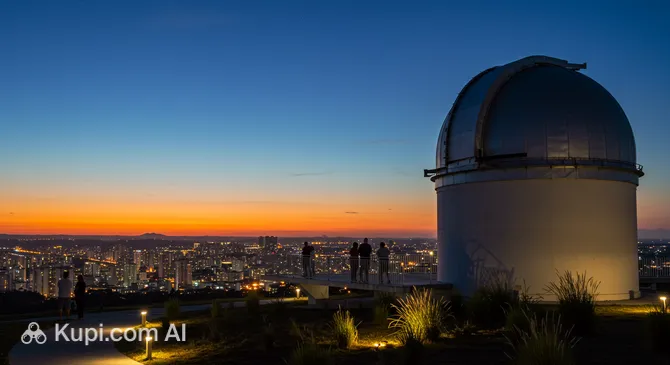
Albert Einstein Astronomical Park
Albert Einstein Astronomical Park. Иллюстрация. Источник: Kupi.com AI

In this amazing location brought to travelers by Brazil, guests are greeted not only by high-tech instruments but also by figures of those who changed our understanding of the world. Here you can see life-sized sculptures of Nicolaus Copernicus and Neil Armstrong, as well as learn about the legacy of Newton, Galileo, and Hawking. Spanning nearly a thousand square meters, the park serves as a unique platform for immersive learning.

The heart of the park is the digital planetarium with a unique dome whose shape mimics the surface of Mars. In addition, the complex includes laboratories, an open observatory for naked-eye observations, and powerful telescopes that allow you to peer into the farthest corners of our galaxy. This is not just a museum, but an interactive space where the theory of relativity takes shape through monuments and vivid exhibits.

Contacts

For information regarding special events or group tours, you can use the official communication channels. The park actively collaborates with educational institutions; therefore, separate communication channels for school groups are provided via the municipal website.

How to contactContact
AddressR. Aristides Bolan, 64 - Mina Brasil, Criciúma - SC, 88810-201, Brazil
Phone+55 48 3431-0400
Websiteviva.criciuma.sc.gov.br

What to Do

The highlight of any visit is a session at the digital planetarium. Under the dome shaped like the Red Planet, captivating shows take viewers on a virtual journey through the solar system, teaching them about the movement of constellations and the birth of stars. This is an immersive experience that is equally impressive for both children and adults.

For fans of practical observation, the park is equipped with professional telescopes. On clear evenings, you can see craters on the Moon, the rings of Saturn, and distant nebulae. If you visit during the day, be sure to join a guided tour. Specialists, including professional geologists and astronomers, share fascinating stories about armillary spheres, sundials, and monuments dedicated to great discoveries.

A walk through the grounds turns into a quest through the history of science: you can take a photo with a statue of Einstein, examine a collection of meteorites and fossils, or visit the makers space where scientific experiments are conducted. Don't forget to find the time capsule embedded in the Bicentennial monument—it is an important symbol of the connection between the current generation and future space explorers.

Getting There

Reaching the park is quite simple, as it is located on Morro Cechinel, which is one of the highest and most recognizable points in the city. If you are traveling by car, follow Aristides Bolan street straight up from the city center. The road is fully paved, and there is visitor parking available at the top.

For those who prefer public transport, bus routes heading to the Mina Brasil district are suitable. However, keep in mind that it is an uphill walk from the stop to the park entrance itself, so many tourists prefer to use taxis or ride-sharing apps like Uber. This is especially convenient if you are coming from more distant areas or airports such as Diomício Freitas (40 km) or Navegantes (200 km).

The park grounds are fully developed and accessible for people with limited mobility: special ramps have been installed and toilets are equipped, making the ascent to the observatory comfortable for all categories of travelers.

Ближайший город: Criciuma

History & Facts

The Albert Einstein Astronomy Park is a relatively young but already iconic landmark. It was officially opened on January 6, 2023, a date chosen deliberately as the city celebrated its 143rd anniversary. The project was the result of significant municipal investment totaling over 8 million reais, which created a modern scientific and educational hub on a site that was previously vacant.

The opening ceremony featured not only the city's mayor but also a guest of honor — Victor Hespanha, the second Brazilian in history to travel into space as part of a Blue Origin mission. His presence emphasized the project's ambitious goal: to inspire a new generation of researchers and make science accessible and engaging for every resident and visitor to the region.

The park's branding incorporates the famous E=mc² formula, paying tribute to the genius of Albert Einstein. The entire complex is designed as a tribute to the history of space exploration. For example, important dates such as the anniversary of the Moon landing are regularly celebrated here, and among the exhibits, you can find a detailed replica of Neil Armstrong's spacesuit.

Interestingly, the park serves not only as entertainment but also as a serious venue for the scientific community. Within its first year of operation, it was slated to host the Santa Catarina Symposium on Astronomy, confirming the park's status as a major educational center in the state.

Time Needed

To leisurely view all the open-air exhibits, take photos with the statues of great scientists, and enjoy the panoramic view of the city, you will need about 1–1.5 hours. However, if you plan to attend a session in the digital planetarium or participate in nighttime telescope observations, you should budget 2–3 hours for your visit.

Families with children and student groups are recommended to set aside up to 4 hours, as the interactive zones and laboratories often captivate young researchers, and a walk through the well-maintained park grounds encourages a slow and thoughtful study of the planet and constellation models on display.

Working Hours

The park operates on a very convenient schedule that allows visitors to enjoy both daytime educational programs and evening stargazing. The doors of the complex are open daily from 9:00 AM to 9:00 PM.

Since the park is open seven days a week, you can plan your visit for any day. Evening hours (after sunset) are particularly recommended for those who want to use the telescopes and see celestial bodies in their true brilliance.

9:00 – 21:00

Nearby

A visit to the astronomy center can easily be combined with a stroll to other interesting spots in the city. The area around Morro Cechinel offers both cultural monuments and family recreation zones, allowing you to plan a full day's itinerary.

Exploring nearby sites will help you better feel the city's atmosphere and learn about its history, which is closely linked to the mining industry and ethnic diversity.

NameDistance
Octávio Fontana Mine Tour0.8 km
Congress Square1.6 km
Ana Terra Coffee1.7 km
Trattoria San Paolo1.8 km
Shopping Della2 km
Pimenta Pastéis2.2 km
Queen's House Pub2.9 km

Reached the end of the page?

That means the route is fully explored