Support

Fernando De Noronha Airport

About the Airport

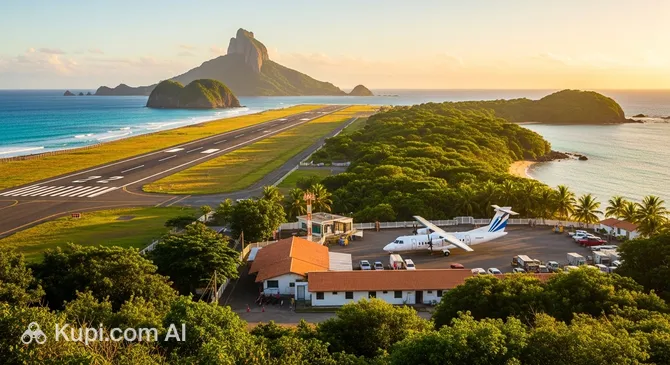
Fernando De Noronha Airport. Source: Kupi.com Binoculars

Fernando de Noronha Airport, known as Gov. Carlos Wilson Airport, is the sole aerial gateway to the eponymous archipelago, recognized as a UNESCO World Heritage Site. Being the easternmost airport in Brazil, it serves as a crucial link between the mainland and this remote paradise. Landing here is a spectacular start to the adventure in itself, as the runway stretches across a significant part of the narrow island, offering passengers breathtaking views of the Atlantic Ocean.

IATA Code FEN
ICAO Code SBFN
City Fernando de Noronha
Distance to Centre 4 km to Vila dos Remédios
Status Domestic
Annual Passengers approx. 350,000 (based on 2022 data)
Popular Airlines Azul Brazilian Airlines, Gol Transportes Aéreos, LATAM Airlines.
Schedule Online board

Despite its modest size, the airport fully succeeds in its main task — ensuring controlled tourist access to the island's fragile ecosystem. It is a small but functional terminal offering basic amenities required by travellers before immersing themselves in the world of wild nature. There is no hustle and bustle of large aviation hubs here, which perfectly matches the relaxed atmosphere of the archipelago. Major flights connect the island with large cities on the Brazilian mainland, such as Recife and Natal. Three major Brazilian airlines operate at the airport: Azul, Gol, and LATAM, ensuring regular connections to this unique destination.

Contact Information

For your convenience, we have gathered the essential contact information for Fernando de Noronha Airport (FEN). We recommend always checking the validity of the data on official resources before your trip.

  • Official Website: You can find all the latest information about flights, services, and airport regulations on the official website of the operator Aena Brasil: www.aenabrasil.com.br.
  • Inquiry Service Phone: For consultations on general questions, you can use the phone numbers listed on the airport's official website in the contacts section.
  • Address: BR-363, Vila do Trinta, Fernando de Noronha - PE, CEP 53990-000, Brasil.
  • Email: A direct email for passenger communication is not published. It is recommended to use the contact form on the official website for inquiries.
  • Lost Luggage Information: If your belongings were lost within the terminal building, please contact the "Achados e Perdidos" (Lost & Found) service. In case of lost checked baggage, you should immediately contact your airline representative.
  • Passenger Support Service: Assistance with general questions can be obtained at the information desk directly inside the airport building.

How to Get to the Airport

Getting to the airport on the island of Fernando de Noronha, the gem of Brazil, is a simple task thanks to its compact size. The island's main transport arteries are concentrated along the single main road, BR-363, making navigation intuitively easy. Regardless of where you are staying, the trip to the airport will take very little time, usually between 5 to 20 minutes. The choice of transport depends on your budget, comfort preferences, and amount of luggage.

Public Transport

The most budget-friendly way to reach the airport is to use the local bus. It runs along the main highway BR-363, connecting the port, major beaches, and the central part of the island, Vila dos Remédios, with the airport. Buses run on a schedule, but it is worth noting that it may not always be precise. This is an excellent option for travellers with light luggage looking to save money. The fare is low and is paid in cash to the driver.

Taxi and Transfer

A taxi is the most popular and convenient way to get to the airport. A car can be found at designated stands or called by phone. The cost of the trip is fixed depending on the district, but it is significantly higher than the bus. Many hotels and guest houses (pousadas) offer a transfer service to their guests, which can be booked in advance. This is particularly convenient if you have an early flight or a lot of luggage. It is recommended to arrange a transfer or taxi in advance, especially during the high season.

Car or Buggy Rental

If you have rented a buggy (the most popular transport on the island) or a car to get around Fernando de Noronha, you can drive it to the airport yourself. Most rental companies allow you to leave the vehicle in the airport parking lot before departure, provided this is agreed upon beforehand. This is the most flexible, but also the most expensive option if considered solely as a way to get to the airport. However, for exploring the island, renting a buggy is almost a mandatory part of the programme.

Parking and Recommendations

The small Fernando de Noronha Airport has a parking area where you can leave a rented car or buggy. Given the size of the island, problems with arriving on time rarely arise, but always allow extra time. When choosing a buggy as a transfer, remember that it is open — your luggage might get wet in case of sudden tropical rain. Regardless of the chosen method, the island's atmosphere promotes tranquillity, so your trip to the airport will likely be a pleasant conclusion to your journey.

Terminals and Map

Fernando de Noronha Airport (FEN) is the gateway to one of the most unique corners of Brazil, and its structure fully corresponds to the relaxed and simple atmosphere of the island. The airport consists of just one small terminal that handles both arriving and departing flights. Thanks to its compact dimensions, it is impossible to get lost here, making it very convenient for travellers.

The terminal layout is extremely simple. All main zones — check-in counters, baggage claim area, boarding gate, and a small waiting hall — are located in one building on a single level. There are no transfers between terminals as they are unnecessary. Navigation is intuitive: upon entering the building, you will immediately see the airline counters for flight check-in (Embarque) and the arrival area (Desembarque) for those meeting passengers.

Departure and arrival zones are located nearby but are clearly separated. Upon arrival in Fernando de Noronha, passengers enter a small baggage claim area. The departure zone includes several check-in counters and one security screening point. After passing control, passengers enter a cosy waiting hall with basic amenities, but do not expect a large selection of shops or restaurants — everything is very simple and functional.

Completing all formalities at the airport usually takes little time. Check-in and security screening rarely take more than 20-30 minutes. However, since the airport serves only a few flights a day, queues can form before a plane departs. It is recommended to arrive at the airport 1.5–2 hours before flight departure to go through all procedures and check in luggage without haste.

The main advice for navigation is simply to follow the signs. The scale of the terminal is such that you will see everything you need as soon as you step inside. The atmosphere here is generally calm and unhurried, serving as an excellent start or finish to your journey to this paradisiacal archipelago.

Airport History

The history of Fernando de Noronha Airport (FEN) is inextricably linked to the strategic importance of the archipelago in the 20th century. It was built in 1942 during World War II by the United States Air Force. The airfield served as an important transit point on the air route between South America and West Africa, facilitating the transfer of troops, cargo, and aircraft to the European theatre of operations. It was one of many airfields constructed under American-Brazilian cooperation.

After the war ended, the facility was transferred to the control of the authorities of Brazil. With the development of tourism on the archipelago, the airport gradually transformed from a military facility into a key civil transport hub. It became the sole "aerial gateway" to Fernando de Noronha, ensuring connection with the mainland for both local residents and the growing stream of travellers eager to see the unique nature of this place.

Throughout its history, the airport has been modernized multiple times to meet modern requirements. In 1975, the first passenger terminal was built. Between 2000 and 2001, a complete reconstruction of the runway was carried out, allowing it to accommodate more modern types of aircraft. And in 2011, a new, more spacious terminal building was opened to serve passengers.

An interesting fact: Fernando de Noronha Airport is one of the most environmentally regulated in the world. Since the archipelago is a national marine park and a UNESCO World Heritage Site, the airport's activities are subject to strict environmental regulations. All expansion and modernization projects undergo thorough assessment regarding their impact on the island's fragile ecosystem, making its history an example of balance between infrastructure development and nature conservation.

Services and Amenities

The airport of Fernando de Noronha (FEN) is a small regional airport serving one of the most beautiful and secluded places in Brazil. Its infrastructure matches its status as a gateway to a nature reserve, so the range of services here is basic but sufficient for comfortable waiting before a flight.

For passengers, there are several small cafes and snack bars where you can have coffee, refreshments, and a light bite before flying. The selection of dishes is limited but quite suitable for a light lunch. There are also several souvenir stalls selling local crafts, beachwear, and memorable gifts with the archipelago's symbols. There is no full-fledged Duty-Free or a wide variety of shops at the airport.

The waiting area in the airport is common for all passengers; there are no separate VIP or business lounges. Access to Wi-Fi may be limited and not always stable, which is typical for remote islands. The number of power outlets for charging electronic devices is also small, so it is recommended to carry a portable charger (power bank).

There are no bank branches or currency exchange points within the terminal. An ATM may occasionally be operational, but it is better to withdraw a sufficient amount of cash in advance, while still on the mainland. A medical point is provided at the airport for first aid.

Special play areas for passengers with children are not equipped, but restrooms may have changing tables. The airport provides basic amenities for passengers with reduced mobility, including ramps and accessible toilets. Nevertheless, the need for special assistance, for example, for boarding the aircraft, should be communicated to the airline in advance.

There are no hotels on the airport territory itself. However, the island is small, and most hotels and guest houses (pousadas) are within a few minutes' drive by taxi. Conference rooms and business centres are not provided at Fernando de Noronha Airport.

Where to Eat

When planning your departure from the paradise island, it is important to understand that Fernando de Noronha Airport (FEN) is a small regional airport with a basic set of services. Dining options here are limited, so do not count on the variety found in major aviation hubs. Nevertheless, having a snack before the flight is possible.

The main dining spot at the airport is usually a small cafe or snack bar (lanchonete) located in the public hall before the security check (landside). Sometimes a small kiosk with beverages and snacks may operate in the sterile departure zone. There are no full-service restaurants with hot meals and waiters at the airport. Therefore, if you wish to try famous local seafood dishes, it is better to do so at one of the restaurants on the island before travelling to the airport.

In the local cafe menu, you will most likely find:

  • Quick snacks: Sandwiches, pastries, and traditional Brazilian snacks such as cheese buns pão de queijo or croquettes coxinhas.
  • Beverages: Coffee, fresh juices, carbonated drinks, and bottled water.
  • Sweets: Chocolate, biscuits, and other packaged desserts.

Regarding prices, be prepared that they will be significantly higher than on the mainland of Brazil. This is a general feature of the entire island due to complex logistics. The opening hours of catering establishments are directly tied to the flight schedule — they open a few hours before departures and close after the last plane leaves.

Passengers with specific dietary requirements (vegetarians, vegans, or those with gluten intolerance) will find it extremely difficult to find suitable options. It is recommended to bring food with you. In general, the airport of Fernando de Noronha offers opportunities for a simple and quick snack, but for a full lunch or dinner, it is better to choose establishments outside of it.

Traveller Tips

Travelling to the Fernando de Noronha archipelago is a unique experience, and knowing the specifics of the local airport will help make your trip as comfortable as possible. The airport here is small and mainly serves domestic flights, so navigating it is simple. Here are a few tips that will be useful for every traveller.

Arrival Time and Check-in. Despite the modest size of the terminal, we recommend arriving at the airport at least 1.5–2 hours before departure. This will give you enough time to go through all procedures without haste. Be sure to pay the environmental preservation tax (TPA) required for staying on the island online in advance, and keep the receipt handy. To save time, check in for your flight online and, if travelling light, head straight to the boarding gate.

Seat Selection and Hand Luggage. If possible, choose a window seat. The bird's-eye views of the archipelago during takeoff and landing are simply mesmerizing! As everywhere, liquids over 100 ml and sharp objects are prohibited in hand luggage. But there is a local peculiarity: it is strictly forbidden to take sand, shells, stones, and corals from the strictly protected territory of Fernando de Noronha. This is closely monitored.

Connections and Customs. Most flights to the archipelago are operated with connections in major cities of Brazil, such as Recife or Natal. If you are flying from another country, you will pass customs and passport control at the first airport of arrival in the country. There is no customs control for domestic flights at Fernando de Noronha Airport, but security services may check your luggage.

Economy and Comfort. Prices for food and drinks at the airport can be quite high. Bring a light snack and an empty water bottle, which can be filled after the security check. The main way to save money is to book flight tickets and accommodation well in advance, as the destination is very popular.

In Case of Flight Delay. The airport infrastructure is quite basic. There is a small cafe and a waiting area. If your flight is delayed, be prepared to pass the time with a book or a pre-downloaded movie. Do not forget to bring a portable charger, as the number of power outlets is limited. Airline representatives are usually located in the common area and can provide up-to-date information on the status of your flight.

Reached the end of the page?

That means the route is fully explored