Support

Jundiaí (Comandante Rolim Adolfo Amaro)

About the Airport

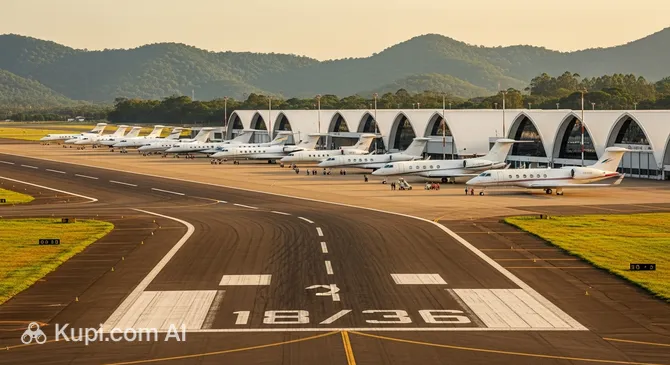
Jundiaí (Comandante Rolim Adolfo Amaro). Source: Kupi.com Binoculars

Jundiaí Airport, bearing the name Comandante Rolim Adolfo Amaro, is not merely an air gateway but a key center for business aviation in the state of São Paulo. Named in honor of the founder of TAM Airlines, this airport has specialized in serving private and corporate flights since its opening in 1942. Thanks to its strategic location and high level of service, it has previously ranked among the top ten busiest airports in Brazil in terms of take-offs and landings, underscoring its importance to the country's business community.

IATA Code QDV
ICAO Code SBJD
City Jundiaí
Distance to Center 7 km
Status Business and General Aviation
Annual Passengers approx. 11,600 (2015)
Popular Airlines The airport does not serve scheduled passenger flights and specializes in private and business aviation.
Schedule Online Board "Jundiaí (Comandante Rolim Adolfo Amaro)"

The main advantage of Comandante Rolim Adolfo Amaro Airport is its specialization in business aviation. It serves as a vital alternative to the large and congested airports of São Paulo for corporate and private flights. Major aircraft maintenance centers are located here, including the Azul Conecta base and the TAM Aviação Executiva service center, which is one of the largest in Latin America. This makes the airport not only a convenient arrival point but also an important technical hub for private jet owners. The airport is managed by Rede VOA, ensuring a high level of operational efficiency and service for discerning clients.

Contact Information

You can contact representatives of Jundiaí Airport (Comandante Rolim Adolfo Amaro) using the following details:

  • Official Website: The airport is managed by Rede VOA; current information is available on their portal: www.redevoa.com.br.
  • Information Desk Phone: +55 (11) 4585-9730.
  • Airport Address: Avenida Emilio Antonon, 777 - Aeroporto, Jundiaí - SP, 13212-010, Brasil.
  • Email: An official email address for general inquiries is not published. It is recommended to use the phone number or contact forms on the operator's website for communication.
  • Social Media: Official accounts are maintained by the airport management network, Rede VOA.
  • Lost Luggage Information: For issues related to lost or damaged luggage, you must first contact your airline's support service. Additional information can be obtained via the main airport phone number.
  • Passenger Support Contacts: For consultations and assistance regarding your stay at the airport, please use the main information desk phone number.

How to Get to the Airport

Jundiaí Airport, known as Comandante Rolim Adolfo Amaro State Airport, is located in close proximity to the city, making the journey there quick and convenient. Although it is not a major international hub but rather an airport for business and private aviation, there are several ways to reach it.

Taxis and Ride-Hailing Services are the most popular and convenient option. A trip by taxi or via apps such as Uber or 99 (popular in Brazil) from the city center of Jundiaí will take approximately 15–25 minutes depending on traffic conditions. This is the optimal choice for the balance of price and comfort, especially if you are traveling with luggage. You can also pre-book a transfer, which guarantees a car will be available at your required time.

Public Transport in the form of city buses is the most budget-friendly method. However, please note that there may not be direct routes to the terminal, and you might need to transfer and walk part of the way. We recommend checking the schedule and routes on the local transport authority's website in advance. This method is suitable for travelers without a lot of luggage and with plenty of time to spare.

Car Rental or Personal Transport is an excellent choice for those who value independence and plan to explore the surroundings. Several rental agencies operate in the city of Jundiaí. The road to the airport is simple and well-signposted. There is parking available on the airport grounds, however, its capacity may be limited, so it is better to arrive with some time to spare.

It is worth noting that for most international and long-haul domestic flights, travelers more often use the major airports located near Jundiaí. The region's main air gateways are the airports of São Paulo: São Paulo-Guarulhos International Airport (GRU), Viracopos (VCP), and Congonhas (CGH). From these, you can reach Jundiaí by intercity bus or rental car.

Terminals and Map

Comandante Rolim Adolfo Amaro Airport (QDV) in Jundiaí is a modern and compact aviation hub, primarily focused on executive and business aviation. Its structure differs significantly from large international airports, making it convenient and fast for passengers.

Structure and Navigation

The airport operates one main passenger terminal. Due to its small size and thoughtful layout, navigation within it is intuitive. All key zones—check-in counters, security screening, the waiting lounge, and boarding gates—are located in a single building, within walking distance of each other. Transfers between terminals are not required, as all services are concentrated under one roof.

Departure and Arrival Zones

Departure and arrival zones are clearly delineated but located in close proximity. The departure process is simplified to the maximum: after check-in, passengers undergo a quick security screening and enter a comfortable waiting lounge. The arrival procedure is even simpler—passengers find themselves in the baggage claim area (if applicable) and at the terminal exit almost immediately after leaving the aircraft.

Procedure Times and Recommendations

One of the main advantages of Jundiaí Airport is the speed of completing all formalities. There are practically no long queues here. Check-in and security screening usually take no more than 15-20 minutes. Nevertheless, it is recommended to arrive at the airport approximately 45-60 minutes before the scheduled departure to go through all procedures without rushing. Thanks to the clear navigation and compactness of the terminal, orienting yourself here is very easy, and getting lost is practically impossible.

Airport History

The history of Jundiaí Airport (QDV), officially known as Comandante Rolim Adolfo Amaro Airport, begins in 1942. Initially, it was not a major transport hub but an aeroclub (Aeroclube de Jundiaí), which served as a base for pilot training and the development of light aviation in the region. The modest airfield eventually transformed into one of the most important centers for business aviation in Brazil.

A key moment in the airport's history was naming it after Rolim Adolfo Amaro. This was not a random choice: it was here that the future founder and legendary leader of TAM Airlines took his first steps into the sky, learning to pilot. In memory of his contribution to Brazilian aviation and his tragic death in 2001, the airport was named after him, forever linking this place with one of the brightest pages in the country's civil aviation history.

Over the decades, the airport gradually developed, but it received a real impetus for modernization in the 21st century. In 2017, management of the airport was transferred to the private consortium Voa-SP, which began a large-scale reconstruction program. Works were carried out to improve the runway, taxiways, and passenger service infrastructure. The main focus was on transforming Jundiaí into a first-class hub for business and private aviation to relieve the congested airports of São Paulo.

Today, Jundiaí Airport is not just a runway but a modern aviation complex that plays a strategic role in the transport system of the state of São Paulo. It is one of the busiest airports in Brazil in the executive aircraft segment and serves as a shining example of successful development from a small aeroclub to a key aviation infrastructure facility.

Services and Amenities

Jundiaí Airport (QDV), also known as Comandante Rolim Adolfo Amaro, is a key center for business and private aviation. Consequently, all services and amenities here are oriented towards ensuring maximum comfort, privacy, and efficiency for demanding passengers.

The foundation of the infrastructure consists of modern VIP terminals and lounges (FBO — Fixed-Base Operator), which offer exclusive service. Here, passengers can make use of comfortable rest areas, high-speed Wi-Fi, and charging stations for electronic devices. For business travelers, conference rooms and meeting spaces are equipped, allowing meetings to be held without leaving the airport territory.

There are several cafes and small restaurants on the airport grounds where you can enjoy quality meals and beverages in a quiet atmosphere. The selection of shops is limited, but you will be able to find kiosks with essentials, press, and souvenirs.

The airport is fully adapted for passengers with reduced mobility and provides necessary assistance upon prior request. Families with children will appreciate the comfortable and secluded atmosphere of the waiting lounges. ATMs are installed on the premises for financial matters. It is worth noting that specialized currency exchange points may not be available, so it is better to handle this issue in advance. In case of necessity, a first aid station is available at the airport.

Although there are no hotels directly within the airport building, there are many hotels to suit any taste and budget in the immediate vicinity, in the city of Jundiaí. Airport staff are always ready to assist with hotel selection and transfer organization.

Where to Eat

Jundiaí Airport (Comandante Rolim Adolfo Amaro) (QDV) is a compact air terminal serving primarily business and private aviation. As such, the selection of dining establishments here is more modest than in large international hubs, but it allows passengers to comfortably grab a snack or have lunch while waiting for a flight.

The main dining options are concentrated in several small cafes and snack bars located in the main terminal building. All of them are situated in the public area (landside), so both departing passengers and those meeting them can use their services.

For those in a hurry, local cafes offer Brazilian snack bar classics: aromatic coffee, fresh juices, sandwiches, and various salgados (savory snacks)—popular local pastries. Be sure to try pão de queijo (cheese bread) or coxinha—teardrop-shaped croquettes with chicken filling. This is a great way to experience Brazilian cuisine in miniature. If you have time for a full meal, establishments usually offer hot dishes as well, including the traditional set meal known as prato feito.

Prices at Jundiaí Airport, as in most airports, are slightly higher than the city average. Regarding special dietary requests (vegetarian, gluten-free, etc.), the selection may be very limited. Passengers with strict dietary restrictions are advised to bring suitable snacks with them or check for dish availability in advance. Opening hours of establishments are usually tied to the flight schedule and general airport activity.

Travel Tips

When planning a departure from the airport in the city of Jundiaí, please note that this is a compact and efficiently operating aviation hub. Generally, arriving approximately 60 minutes before the departure of a domestic flight is sufficient. This time is enough to go through all formalities without rushing. To save time, use online check-in, which most airlines open 24–48 hours before departure. This will allow you to head straight to baggage drop or, if you are traveling light, to the security screening zone.

Passing through security control at Jundiaí Airport is usually quick. Have your boarding pass and ID ready in advance. Remember that laptops and other large electronics must be removed from your bag and placed in a separate tray. When choosing a seat on the plane, be guided by your preferences: a window seat will offer beautiful views during takeoff and landing, while an aisle seat provides more legroom and the ability to stand up freely.

Be sure to pack all valuables in your carry-on luggage: documents, money, electronics, and prescription medications. Remember the restrictions on carrying liquids: they must all be in containers with a volume of no more than 100 ml and packed in a single transparent bag. It is strictly forbidden to carry sharp objects, weapons, and flammable substances in the cabin. Check the weight and dimensions of carry-on luggage in advance on your airline's website to avoid extra charges.

If you have a connecting flight, clarify at check-in whether you will need to collect and re-check your luggage at the intermediate airport. Customs control is only undergone by passengers of international flights upon their first entry into the country. Since Jundiaí Airport mainly serves domestic destinations within Brazil, you will not encounter customs here. However, if you are flying from another country with a transfer at a major Brazilian airport, all customs formalities must be completed there.

To make your trip more cost-effective, tickets should be purchased in advance. Compare prices for different dates if you have the opportunity. Bringing your own empty water bottle, which can be filled after security, and light snacks from home will help save money at the airport. Traveling with only carry-on luggage will not only speed up your movement through the airport but also save you from checked baggage fees on many low-cost carriers.

In case of a flight delay, remain calm. First, contact your airline representative for information about the reasons and the estimated departure time. Depending on the length of the delay, you may be provided with drinks, meals, or even hotel accommodation. It is useful to have a portable charger (power bank) and some entertainment, such as a book or downloaded movies, to make the waiting time pass more comfortably.
Reached the end of the page?

That means the route is fully explored