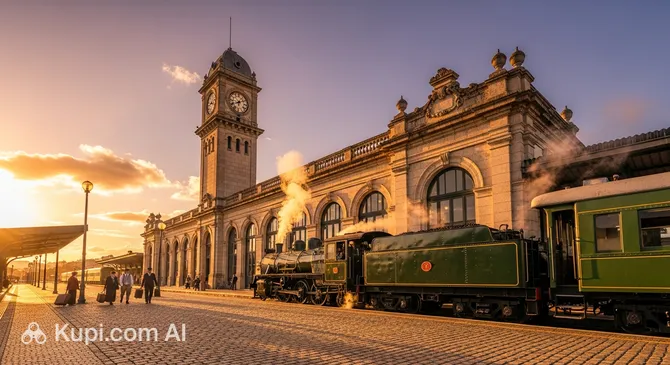
In the heart of the city of Sant'Ana do Livramento stands a majestic building that was once the pulse of the entire region. The Sant'Ana do Livramento Railway Station, built in 1910, has today been transformed into the David Canabarro Museum. This site is not just an architectural monument in Brazil, but a living witness to an era when steel tracks connected entire nations.
Sant'Ana do Livramento Railway Station. Illustration.
Source: Kupi.com AI
Traveler photos:
The station's architecture is a beautiful example of early 20th-century style, retaining its original appearance after careful restoration. The museum serves as an important cultural center where history comes alive through details: from military artifacts of the Ragamuffin War era to the daily items of railway workers. The station was once a key hub connecting Brazilian metropolises with Montevideo and Buenos Aires.
Today, the journey on the famous Trem do Pampa tourist train begins here. For modern travelers, it is a unique opportunity not only to see the museum exhibits but also to enjoy views of the endless plains right from the carriage window, immersing themselves in the rich heritage of the state of Rio Grande do Sul.
Contacts
For those planning a visit, we have gathered the current contact details of this historic site. Please note that the station building is easy to find, as it is one of the city's central points and an important landmark for travelers.
Visiting this place offers a fascinating immersion into the region's past. Inside the museum, you can explore rich collections dedicated to the development of railways and significant historical events, such as the Cisplatine War. Guests are particularly interested in the vintage train models and rare photographs that help recreate the atmosphere of the times when the station was bustling with people.
Be sure to stroll along the restored platforms and halls, where every interior element is steeped in history. If your timing aligns with the schedule, don't miss the chance to become a passenger on the Trem do Pampa. This trip across the picturesque pampas allows you to see rural landscapes firsthand and get closer to the unique culture of the local people—the gaúchos.
Getting There
Finding the station within the city layout is quite simple—it is located right in the center at Rua Tenente Aníbal Benévolo, 198-300. If you are near General Osório Square, a walk to the station will take only a few minutes, allowing you to soak in the atmosphere of the old town.
For those coming from outlying areas or from the Uruguayan border, it is most convenient to use a taxi or the Uber app. If you arrived in the city by long-distance bus from Porto Alegre, the trip from the bus station to the railway station will take no more than 10-15 minutes, making the site highly accessible for tourists.
Nearest city: Santana do Livramento
History & Facts
The station's history began on October 30, 1910, when it became the terminus of an important railway branch between Cacequi and Livramento. This event triggered a real economic boom in the region, turning the city into a major commercial and transport hub. Trains carrying livestock and agricultural products became a symbol of progress and prosperity for the border residents.
Interestingly, by 1912, the station provided a direct connection between giants such as Rio de Janeiro and Buenos Aires via Montevideo. In those days, the station was a center of social life: it was where important guests were welcomed, exotic goods were unloaded, and news from around the world was exchanged. The railway even influenced the development of sports, making it much easier for local football teams to travel to matches in other regions.
Although many routes were closed or dismantled in the 1970s, the station building itself was saved and turned into a cultural space. Today, it carefully preserves the memory of the times when the steam engine's whistle was the primary sound defining the rhythm of life and development for the entire city.
Time Needed
Usually, exploring the museum's main exhibition and walking through the station building takes about 1 to 2 hours. This is plenty of time to leisurely study all the halls, look at archival documents, and take commemorative photos against the backdrop of the ancient architecture.
However, if you plan to supplement your visit with a trip on the excursion train, you should budget an additional 2–4 hours. Such a trip turns a standard visit into a full-scale half-day adventure, allowing you to fully immerse yourself in railway history.
Working Hours
The museum is open to visitors on weekdays, from Monday to Friday, welcoming guests from 08:00 to 17:00. This is a convenient time for those who want to combine a tour of the attraction with a walk through the city's historic center.
It is important to remember that on Saturdays and Sundays, the museum is usually closed for general visits. We recommend checking ahead for the current schedule on official resources, especially if your visit falls on a public holiday.
Day
Working hours
Monday
08:00–17:00
Tuesday
08:00–17:00
Wednesday
08:00–17:00
Thursday
08:00–17:00
Friday
08:00–17:00
Saturday
Закрыто
Sunday
Закрыто
Nearby
The station's location in the historical part of the city offers tourists many opportunities for further walks. Its proximity to Uruguay gives this area a special charm, allowing you to cross the border in just a few minutes and experience the culture of another country.
Exploring the surroundings will help you deeper feel the unique atmosphere of the region, where Brazilian and Uruguayan traditions intertwine. Below are some interesting places located within walking distance of the station: