Support

Bujumbura International Airport

About the Airport

Melchior Ndadaye International Airport is not merely an air gateway to Burundi, but the first introduction to an amazing country located in the very heart of Africa. Sprawling on the shores of the majestic Lake Tanganyika, it welcomes travellers with warm air and scenic views even before the landing gear touches the ground. Despite its compact size, the airport plays a key role in the life of the nation, connecting it with major African and European hubs.
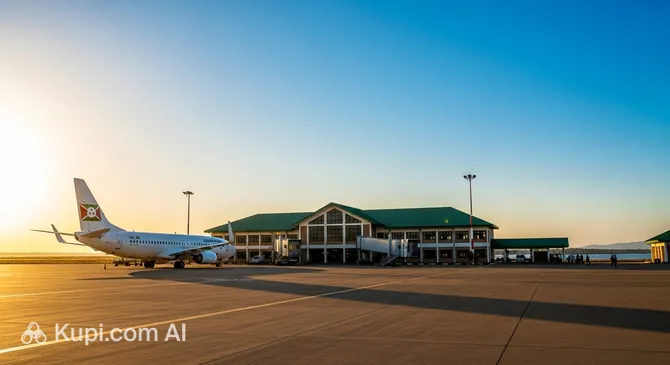
Bujumbura International Airport. Source: Kupi.com Binoculars
IATA Code BJM
ICAO Code HBBA
City Bujumbura
Distance to Centre 11 km
Status International
Passengers per Year Approx. 300,000
Popular Airlines Brussels Airlines, Ethiopian Airlines, Kenya Airways, RwandAir, Uganda Airlines

Bujumbura Airport is the sole international airport in the country, making it the primary transport hub for everyone arriving in Burundi by air. It consists of a single terminal that serves both domestic and international flights. The infrastructure here is quite simple but functional: passengers have access to several cafes where they can sample local snacks, duty-free shops, currency exchange points, and car rental desks.

The main advantage of the airport is its convenient location. It is situated just a 15-20 minute drive from the city centre of Bujumbura and most hotels located on the coast of Lake Tanganyika. This allows you to reach your destination quickly and without hassle, beginning your exploration of this unique and picturesque African country.

Contact Information

For the latest information on flights, services, and regulations at Bujumbura International Airport (BJM), please use the following contact details. It is recommended to verify information before travelling, as it is subject to change.

  • Official Website: Currently, the airport does not have a single official website. Information can be found on the portal www.bujumbura-airport.com, as well as on the Burundi Civil Aviation Authority (AACB) website.
  • Information Desk Phone: +257 22 20 54 00. You can call this number for general enquiries regarding airport operations.
  • Address: Avenue de la Tanzanie, Bujumbura, Burundi.
  • Email: For official enquiries, you may use the Civil Aviation Authority email: info@aacb.gov.bi.
  • Social Media: There are no official and regularly updated social media pages for the airport. We recommend obtaining information by phone or at the information desks within the terminal building.
  • Lost Luggage Information: For issues regarding lost or damaged luggage, please contact your airline's representative directly at the airport. Airport staff do not handle luggage tracing.
  • Passenger Support: For on-site assistance, please approach the information desks in the departure and arrival halls or call the main information helpline.

How to Get to the Airport

Bujumbura International Airport (BJM) is the main air gateway of Burundi, located just 11 kilometres northwest of the centre of Bujumbura. You can reach it in several ways, each with its own features, cost, and level of comfort.

Taxi and Private Transfer — the most convenient and popular way to travel to the airport. The journey from the city centre will take about 15–30 minutes depending on traffic conditions. It is recommended to use official taxi services or book a transfer in advance through your hotel. Be sure to agree on the fare before the trip begins, as not all cars are equipped with meters. The estimated cost varies, but this is the safest and most reliable option for tourists with luggage.

Public Transport in the conventional sense (regular scheduled buses) does not run to the airport. Locals often use route taxis (minibuses) and motorcycle taxis ("taxi-moto"). However, for tourists with suitcases, these options can be inconvenient and unsafe. If you still decide to use this method, be prepared for a lack of comfort and a clear schedule. There are no trains or metro systems in Bujumbura.

Car Rental provides maximum freedom of movement. Both international and local rental agencies operate at the airport and in the city. This option is suitable for experienced drivers ready for the peculiarities of local traffic. The road from the city centre is simple and well-marked. Ensure you have an International Driving Permit and are familiar with traffic rules in Burundi.

There is a parking area at Bujumbura International Airport where you can leave your vehicle for both short and long terms. This is convenient if you are travelling in your own or a rented car. It is better to check parking rates on-site, as tariffs may change.

For most travellers, especially those arriving in the country for the first time, the optimal choice would be a taxi or a pre-booked transfer. This will save time and ensure a comfortable and safe start or end to your journey.

Terminals and Map

The International Airport of Bujumbura (BJM), also known as Melchior Ndadaye Airport, is the compact and primary air hub of Burundi. Its structure is very simple, as it consists of one passenger terminal which serves all international and domestic flights. This significantly simplifies navigation for travellers, as all key zones are located in one building.

The terminal layout is intuitive. The building is divided into two main parts: the Arrivals Zone and the Departures Zone. They are located next to each other, and finding them is effortless. In the Arrivals Zone, passengers go through passport control, collect luggage in a small claim hall, and pass through customs inspection. The Departures Zone includes check-in counters, a security checkpoint, passport control, and a general waiting hall with boarding gates.

Despite the modest size of the airport, it is worth allocating sufficient time to complete all formalities. It is recommended to arrive at the airport at least 2-3 hours before an international flight. Although queues here are usually not as long as in major hubs, procedures can be leisurely. Navigating the terminal will not cause difficulties: all signs are clearly visible, and staff are ready to assist. Since everything is in one building, you will not have to worry about transfers between terminals or searching for the right zone.

Inside the terminal, there is a basic set of services for a comfortable wait for your flight. At your disposal are several small cafes where you can have a snack, a duty-free shop with souvenirs and essential goods, as well as waiting lounges. Given the compactness of the airport, all amenities are within walking distance from any point in the terminal.

Airport History

The history of Bujumbura International Airport (BJM) is inextricably linked with the development of transport infrastructure in East Africa. The airport began operations in 1952, becoming a vital link for Burundi. Initially, it was a relatively small airfield designed to provide air connections with neighbouring regions, but over time it transformed into the country's main air gateway, receiving flights from various corners of the continent and the world.

One of the most significant milestones in the modern history of the air harbour was the year 2019. In honour of the country's Independence Day celebrations, the airport was officially renamed to Melchior Ndadaye International Airport. This event was an important symbolic step reflecting respect for national history and statesmen, although in international booking systems, it is still often recognised by the code BJM.

Over the decades of its existence, the air complex has undergone several stages of modernisation. To meet growing safety and comfort requirements, reconstruction works on the runway and terminal updates were carried out. In recent years, special attention has been paid to technical equipment and the implementation of modern navigation systems, allowing the airport to accept larger aircraft and ensure a stable flight schedule.

An interesting feature of the airport is its unique location: it is situated in the immediate vicinity of the shores of the famous Lake Tanganyika. Furthermore, the airport retains the status of a key infrastructure object of the state, being the only air harbour in Burundi with a paved runway over 3 kilometres long, allowing it to remain the unrivalled centre for international travel to this region.

Services and Facilities

Bujumbura International Airport (BJM) offers passengers a set of essential services designed to make waiting for a flight comfortable and convenient. Within the terminal, you will find several cafes and refreshment areas where you can have a snack, drink coffee, or enjoy cooling beverages. Shops are also available where you can purchase souvenirs, gifts, and travel necessities.

For travellers preferring privacy and enhanced comfort, a VIP Lounge is available. Here you can relax in a quiet atmosphere away from the noise of the main hall, enjoying complimentary snacks and drinks. Wi-Fi access is provided throughout the airport, and special zones and sockets are provided for charging gadgets.

Currency exchange points and ATMs operate within the terminal building, making it easy to resolve financial matters. To ensure passenger safety and health, a medical point is functioning, ready to provide first aid. Travellers with children can use the mother and child room, and assistance in moving around the airport and boarding is provided for passengers with reduced mobility.

Although there are no hotels or conference halls on the airport territory itself, several hotels are located in the immediate vicinity, offering convenient options for overnight stays or business meetings. Basic business services may be available in the VIP Lounge upon prior request.

Where to Eat

Bujumbura International Airport (BJM) is the main air hub of Burundi, yet by global standards, it is relatively small. Passengers should note that the choice of dining establishments here is limited, and one should not expect the wide variety of restaurants and cafes typical of major international hubs.

The main place where you can have a full meal is the restaurant and lounge located in the general terminal area (landside), before passing through passport control and security screening. This is the best option for a full lunch or dinner. The menu usually offers standard international dishes, but sometimes you can find local cuisine, such as fish from Lake Tanganyika or meat skewers (brochettes). Prices here are generally higher than in the city. The establishment's operating hours are tied to the flight schedule.

After completing all formalities, in the departures area (airside), a small cafe or snack bar usually operates. This place is ideal for a quick snack immediately before boarding. Here you can buy coffee, soft drinks, water, as well as light snacks such as sandwiches, pastries, or crisps. This is the last opportunity to purchase food and drinks before your flight.

Passengers with strict dietary restrictions should be particularly attentive. Options for vegans, vegetarians, or people with gluten intolerance are extremely limited or may be absent altogether. In such cases, it is strongly recommended to carry your own snacks. If you have enough time, the best solution would be to eat at one of the restaurants in the city of Bujumbura before leaving for the airport, where the choice of dishes and price levels will be significantly more attractive.

Travel Tips

To ensure your journey through Bujumbura International Airport goes smoothly, make use of these tips. For international flights, it is recommended to arrive at least 3 hours before departure. This will give you enough time to calmly complete all formalities, especially during peak hours when queues may form.

When going through check-in and security control, keep all necessary documents to hand: your passport, flight ticket, and, crucially for travel to Burundi, a Yellow Fever vaccination certificate. It may be checked upon both entry and exit from the country. Be prepared for thorough screening and follow the instructions of airport staff.

If your airline allows seat selection, do so during online check-in. Window seats will allow you to enjoy views of Lake Tanganyika during take-off or landing, while aisle seats provide more convenience if you need to stand up during the flight.

Rules for carrying hand luggage are generally standard: liquids in containers no larger than 100 ml, packed in a single transparent bag, and no sharp objects. Nevertheless, it is strongly recommended to check the specific norms and rules of your airline in advance. Always carry all valuables, electronics, documents, and necessary medication in your hand luggage.

If you have a layover at Bujumbura airport, locate the information board or transit desk immediately upon arrival to clarify the status and gate number for your next flight. The transit area infrastructure may be modest, so it is useful to have a book or pre-downloaded films for entertainment.

When passing through customs control, be prepared to present your luggage for inspection and declare currency or valuable items if required by regulations. Remain calm, polite, and answer customs officers' questions clearly, having all supporting documents with you.

To save time, use online check-in if available for your flight. To save money, exchange only a small amount at the airport to cover immediate expenses, as the exchange rate may not be the most favourable. Often, a more sensible solution is withdrawing cash from an ATM. It is also worth booking a transfer from the airport in advance to secure a fixed and lower price.

In the event of a flight delay or cancellation, contact your airline representative first. Clarify what services (drinks, food, hotel accommodation) you are entitled to depending on the duration of the wait. Having good travel insurance that covers such incidents will help compensate for unforeseen expenses and save your nerves.

Reached the end of the page?

That means the route is fully explored