Support

Iqaluit Airport

About the Airport

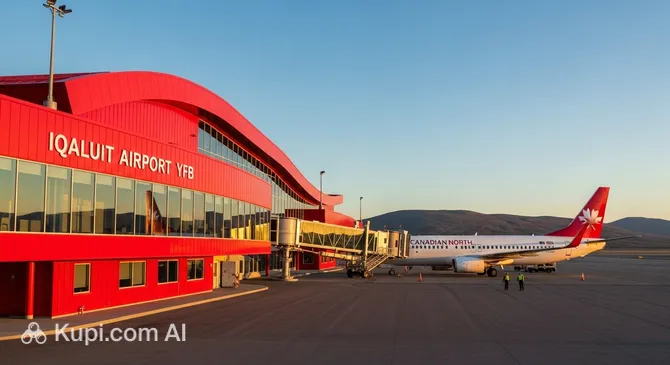
Iqaluit Airport. Source: Kupi.com Binoculars

Iqaluit Airport is not merely a transport hub, but the true "heartbeat" of the Canadian Arctic and the main gateway to the vast expanses of Nunavut. Like a bright beacon amidst the snowy desert, its modern terminal, shaped to resemble traditional Inuit dwellings, welcomes travelers with warmth and surprising comfort. Here, where the runway is capable of accommodating even a space shuttle, advanced aviation technologies coexist with the millennial culture of the North. This is the place where a true polar expedition begins, whether it is a business trip or a pursuit of the Northern Lights.

AirportIqaluit Airport
IATAYFB
ICAOCYFB
CityIqaluit
TimezoneAmerica/Iqaluit
ScheduleOnline board

Features and Advantages of the Airport:

Iqaluit Airport is unique in its combination of strategic importance and local character. The new terminal, opened in 2017, is not just a building but an architectural masterpiece, adorned with works by local artisans and designed to withstand extreme frost. Thanks to its long runway and the harsh climate, this airfield has become a favourite location for global aviation giants like Airbus and Boeing, which conduct testing of new aircraft here in deep freeze conditions.

For passengers, a huge advantage is the incredible proximity to the city: one can reach the centre even on foot, which is a rarity for international airports. Despite its remoteness from the "mainland," a full range of services is provided here, from a modern baggage department to cosy waiting areas. Furthermore, the airport plays a critically important role as an alternate aerodrome for transatlantic flights, ensuring the safety of air travel over the North Atlantic.

Contact Information

Below you will find contact information for Iqaluit Airport (YFB), which will help you plan your trip and resolve any potential queries.

  • Official Website: www.gov.nu.ca/edt/information/iqaluit-international-airport-yfb
  • Information Desk Phone: +1 867-979-5221
  • Address: 1514 Federal Road, Iqaluit, Nunavut, X0A 0H0, Canada
  • Email: An official email address for general inquiries is not published. It is recommended to use the telephone for communication.
  • Social Media: The airport does not maintain active official pages on popular social media networks. The main source of information is the official website.
  • Lost Luggage Information: For all questions related to lost or damaged luggage, please contact your airline representatives directly.
  • Passenger Support Contacts: For consultations and assistance, you may use the airport information desk phone: +1 867-979-5221.

How to Get to the Airport

Iqaluit Airport (YFB) has a unique location — practically within the city limits of Iqaluit, the capital of the Nunavut territory in Canada. Thanks to the city's compact size, getting to the terminal is effortless and takes very little time. The distance from the central part to the airport is so short that transport options are quite specific to this northern region.

Taxi — the most popular and reliable way to get to the airport. In Iqaluit, a fixed fare system often operates for trips within the city, making the cost predictable. A trip from most hotels or the centre to the airport will take just 5–10 minutes. You can order a car by phone through local taxi services. This is especially convenient if you have a lot of luggage or if the weather is not conducive to walking.

Surprisingly, one of the most viable ways to get to the airport is walking. If you are staying in the central part of Iqaluit and travelling light, you can walk to the terminal in 15–25 minutes. This is an excellent opportunity to take another look at the unique landscapes of the city. However, one must consider the harsh weather conditions, especially in winter when temperatures can be extremely low.

Car rental services are available at Iqaluit Airport, but they should be booked in advance. This option is suitable for those planning to explore the city's surroundings independently (the road network is limited to local roads only). For those arriving at the airport in their own or rented transport, parking is provided, located in the immediate vicinity of the terminal.

It is important to note that there is no public transport system in Iqaluit in the conventional sense — there are no city buses, metro, or trains here. All transport logistics are built around private cars, snowmobiles, and taxis. Therefore, when planning a trip to the airport, do not rely on bus routes.

To summarise, for most travellers, the optimal choice will be a taxi — it is fast, convenient, and relatively inexpensive. If the weather permits and your luggage is not heavy, a walk on foot will provide unique impressions. Regardless of the chosen method, the road to Iqaluit Airport will not be a difficult quest, allowing you to start or end your Arctic adventure without unnecessary hassle.

Terminals and Map

The Iqaluit Airport (YFB) is a modern and compact aviation hub that serves as the key gateway to the Arctic region of Canada. Its structure is extremely simple and intuitive for travellers, which significantly facilitates navigation.

The airport operates one passenger terminal, which handles all domestic flights. This modern building, opened in 2017, is designed taking into account harsh climatic conditions and replaces the old structure. Since all operations — from check-in to baggage claim — are concentrated in one place, passengers do not need to worry about transfers between terminals.

The terminal layout is very logical. Upon entering, you find yourself in the general hall where airline check-in counters are located. Immediately behind them is the security checkpoint leading to the departure zone. The departure zone is a comfortable waiting lounge with a sufficient number of seats. The arrival zone is equally simple: after disembarking from the aircraft, passengers immediately proceed to the baggage claim belt and the exit to the city.

Despite the small size of the airport, it is recommended to arrive for check-in well in advance — typically 90-120 minutes before departure. Check-in and security procedures usually proceed quickly, but it is worth considering that the weather in the Arctic can be unpredictable and affect flight schedules. The simple and clear design of the terminal makes navigation easy: all zones are clearly marked, and the small space will not allow you to get lost.

Airport History

The history of Iqaluit Airport (YFB) is a fascinating saga of how a military airfield turned into a vital gateway to the Arctic. Its foundation dates back to the times of World War II. In 1942, the US Air Force built an airfield here called Frobisher Bay Air Base. It served as part of the so-called "Crimson Route" — a secret air corridor for ferrying military aircraft from North America to Europe. This runway, built in harsh conditions, laid the foundation for the future development of the region.

After the war, during the Cold War period, the strategic importance of the airfield only increased. It was transferred to the administration of Canada and became a key logistical hub for supplying the Distant Early Warning (DEW) Line stations. This radar system was created to warn of possible aerial attacks on North America. It was during this period that the airport became the main transport artery connecting isolated northern communities with the rest of the world.

Gradually, a town grew around the airfield, which officially changed its name from Frobisher Bay to Iqaluit in 1987. When the new territory of Nunavut was created in 1999, and Iqaluit became its capital, the airport received a new impulse for development. To meet the new status and growing passenger flow, large-scale modernization was carried out. The most significant reconstruction was completed in 2017, when a new, modern terminal was opened. Its striking building with a unique design inspired by Inuit culture became a symbol of the modern North.

One of the most interesting facts in the history of Iqaluit Airport is its role as a testing ground for aviation technology. Thanks to extremely low winter temperatures and a long runway, leading global aircraft manufacturers, including Airbus and Boeing, bring their newest aircraft here, such as the Airbus A380 and A350, for testing in severe weather conditions. Additionally, the airport often serves as an emergency landing site for transatlantic flights encountering technical or medical issues in flight, confirming its strategic importance in international aviation.

Services and Amenities

Iqaluit Airport (YFB) is a modern and important transport hub in the north of Canada, providing passengers with all essential amenities for a comfortable journey. Despite its relatively small size, the terminal is designed to make your stay here as pleasant as possible.

Within the airport, you will find a restaurant and café where you can have a full meal or grab light snacks and hot beverages, which is especially relevant in the Arctic climate. There is also a gift shop offering unique items by local artisans, Inuit artwork, and memorable gifts that will serve as excellent reminders of your trip to Nunavut.

Although there are no separate VIP lounges at the airport, spacious and comfortable waiting areas are provided for all passengers. Free Wi-Fi and charging stations for electronic devices are available throughout the terminal, allowing you to stay connected or work while waiting for your flight. An ATM is installed for financial transactions; however, currency exchange services are limited, so it is recommended to arrange this in advance.

The airport is fully equipped to serve passengers with reduced mobility: ramps, accessible restrooms, and elevators are available. Staff are always ready to provide necessary assistance during boarding and disembarking. For travellers with small children, mother and child rooms with changing tables are provided. Basic medical services and first aid are available on-site, and if necessary, passengers will be directed to city medical facilities.

There are no hotels directly inside the airport building, but several hotels are located in the city of Iqaluit itself, just a few minutes' drive from the terminal. Specialized business centres or conference halls are not provided in the airport, but these services are often offered by hotels in the city.

Where to Eat

Iqaluit Airport (YFB) is a modern yet compact transport hub, and dining options here correspond to its size. Passengers have access to several spots where they can have a snack before their flight, although the selection is not comparable to large international airports.

The main catering establishment is located in the general area before security control (landside). Here you will find a café that offers the widest range in the airport. Its menu usually includes hot and cold sandwiches, soups, salads, pastries, as well as coffee and other beverages. This is the best place for a more or less full lunch or dinner if you have arrived at the airport in advance.

After passing security (airside), in the departure zone, the choice becomes more limited. Typically, a small kiosk or coffee corner operates here. It is ideal for a quick snack: you can buy packaged snacks, chocolate, crisps, and bottled drinks to take with you on board the aircraft.

As for local cuisine, it is practically impossible to find exotic dishes like muskox or caribou meat at the airport. However, sometimes the café menu may feature dishes made from Arctic char — a popular local fish. Otherwise, the cuisine is oriented towards standard North American and European dishes. Be prepared for the fact that prices for food and drinks are significantly higher than average in Canada due to the remoteness of the region and logistical difficulties with food delivery.

Options for passengers with specific dietary requirements (vegan, gluten-free, Halal dishes) are extremely limited. If you follow a strict diet, the most reliable option would be to bring food with you. The operating hours of the café and kiosk depend directly on the flight schedule: they open a few hours before the first departure and close shortly after the departure of the last flight.

Travel Tips

Planning a trip through the airport of Iqaluit (YFB), the main air gateway of Nunavut, requires special attention to detail, especially due to the unique climatic conditions of the region. To ensure your journey through the Arctic part of Canada goes smoothly, make use of these helpful tips.

Arrival Time and Check-in. Although Iqaluit Airport is not as large as capital hubs, it is recommended to arrive in advance. For domestic flights — 2 hours before departure, for international ones — 3 hours. Weather conditions in the Arctic can be unpredictable, which sometimes affects the schedule. To save time, complete online check-in if your airline provides such an option, and print or save your boarding pass in advance.

Security Check and Seat Selection. Security procedures here are standard, but due to the small number of staff, the queue may move slowly. Have your passport and boarding pass ready. When choosing a seat on the plane, prefer a window seat — views of the icy landscapes, fjords, and the Arctic Ocean are truly unforgettable. An aisle seat will be more convenient if you need to get up during the flight.

Hand Luggage. Standard rules for carrying liquids (in containers up to 100 ml) and the ban on sharp objects apply here as well. An important tip for this region: be sure to pack a warm jumper, hat, and gloves in your hand luggage. Even if you are flying in summer, the weather can change abruptly, and in case of a flight delay, warm clothing will be very useful.

Transfers and Customs. If you have a connecting flight, clarify whether you need to collect and re-check your luggage. Allow sufficient time for the transfer, especially in winter when weather-related delays are more likely. For passengers arriving on international flights, it is necessary to pass customs and border control. Fill out the declaration in advance and be ready to answer questions from the Canada Border Services Agency (CBSA) officer.

Economy and Unforeseen Situations. Prices for food and drinks at northern airports can be significantly higher, so it is wise to bring a small snack and an empty water bottle, which can be filled after the security zone. In case of a flight delay, remain calm. Contact your airline representative to find out about your rights regarding the provision of meals or accommodation. Ensure your electronic devices are charged and keep the contact details of the airline and your hotel with you.

Reached the end of the page?

That means the route is fully explored